Roller skating in Norwich through the decades
Since the Victorian period, roller skating in Norwich has fluctuated in popularity. Its biggest boom seems to have been in the 70s and 80s; even though there were no purpose-built rinks, different leisure centres and venues hosted roller skating sessions. For example, the Norwich Lads Club which was situated on King’s Street in Norwich city centre was home to many different leisure activities, primarily boxing, but hosted other clubs from skating to table tennis. The popularity of skating at the Norwich Lads Club led to special skating events, including skating marathons which was introduced to the city by Tim Nelson, who is also my father. I conducted an informal interview about the roller marathons in Norwich with Tim to gain more of an insight into what the event was like from someone that organised the event and was an avid participator.
Read more: Roller Skating in Norwich (part 2)Interview start.
Interviewer: Can you tell me a bit about who you are and your role at the Lad’s Club?
Tim Nelson: My name is Tim Nelson, and I used to run Norwich City Roller Hockey Club for 20 years, I was the founder of the club, and I was on the Lad’s Club committee. I used to skate down the Lad’s Club from the age of 16 and then started up the hockey club from there.
Interviewer: I see, so what was the purpose of the roller marathon?
Tim Nelson: It was in aid for the Cherish the Child charity. So, the first marathon was in 1986 and was to raise money for the charity and for the Lad’s Club itself for it to survive due to increasing upkeep of the club. The original idea was to skate from Norwich to Rouen, France which is the twin city of Norwich, skating on roads and staying at youth hostels on the way, then drive back.
Interviewer: How long did you think it would take to skate to France?
Tim Nelson: It was estimated that the skate would take roughly up to a week to skate there. However, two weeks before the event the police contacted the Lad’s Club and stopped the event saying it was too dangerous.
Interviewer: That is a shame, what did you do then?
Tim Nelson: The manager and I decided to change the event and to do it round Norwich. Chapelfield gardens was chosen due to the footpath being smooth and in a circular shape. It worked out to be 70 laps of the route around the gardens to complete a full marathon. There was a half marathon option for those who could not complete a full marathon or skate as much as you could.
Interviewer: Was the event publicised at all?
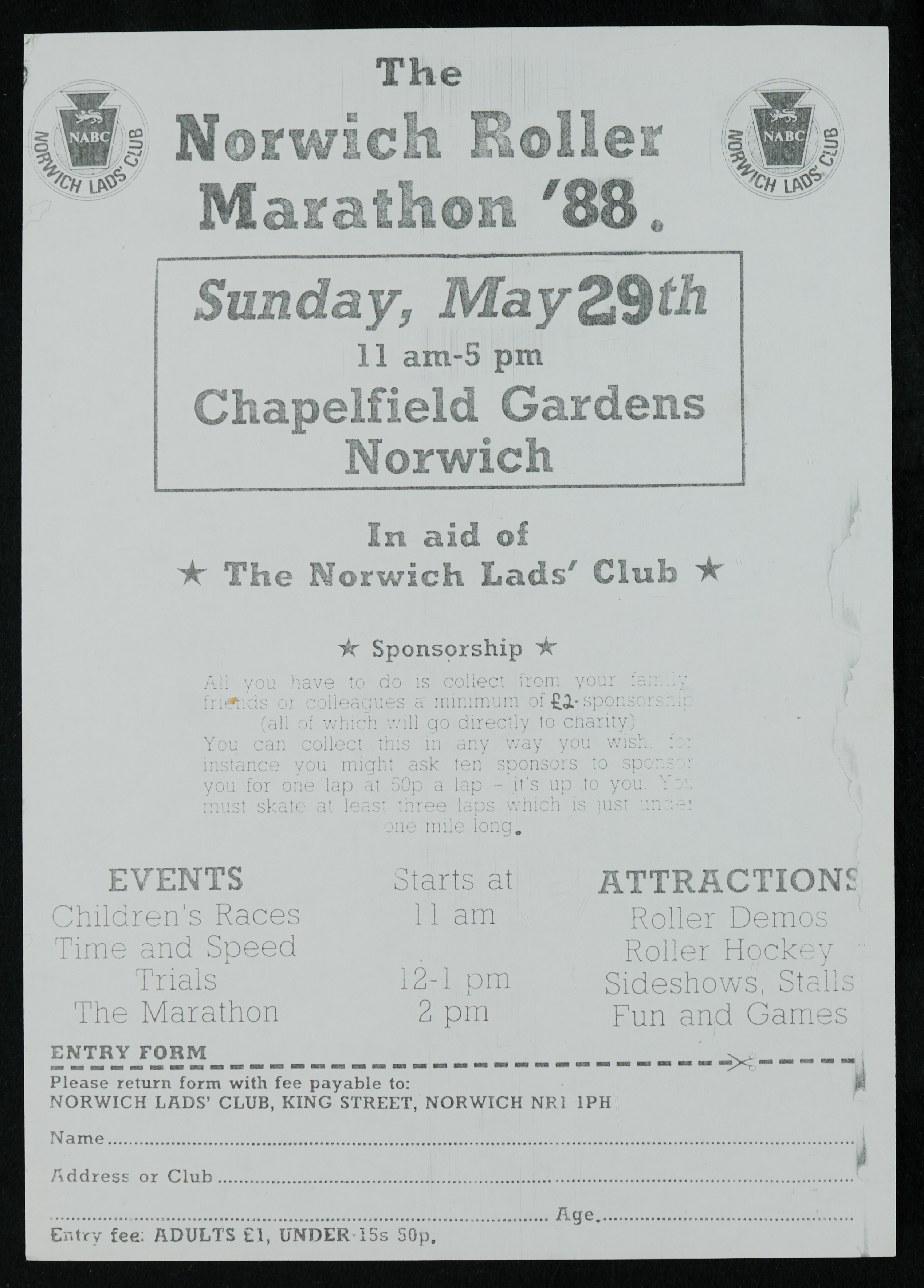
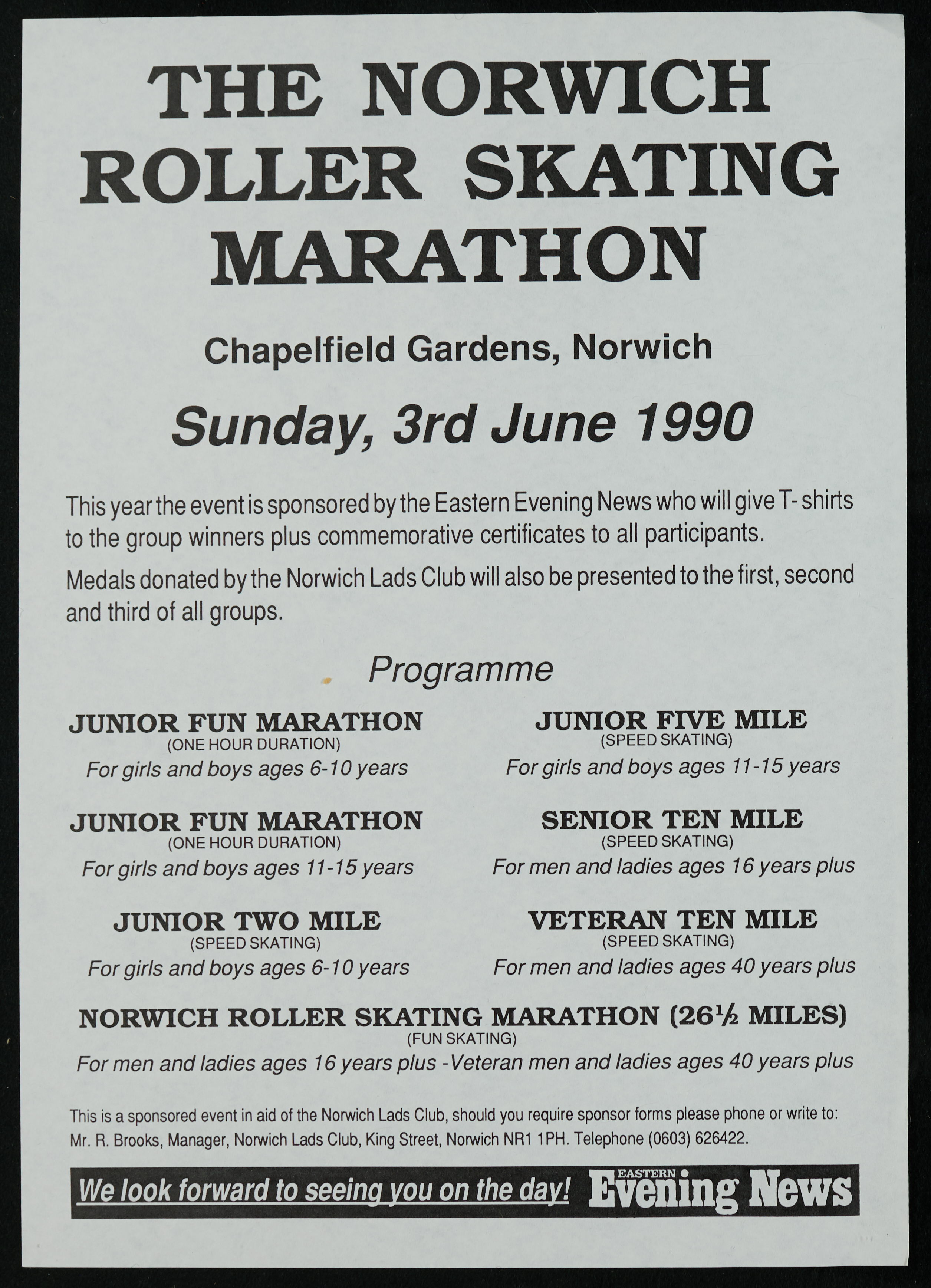
Tim Nelson: Yes, Eastern Evening News publicised the event for ages from 10 years upwards, but you must have your own skates and be competent skater, no beginners. There were food stalls, games and a DJ in the band stand for spectators. Lots of people and skating clubs took part and got sponsorships.
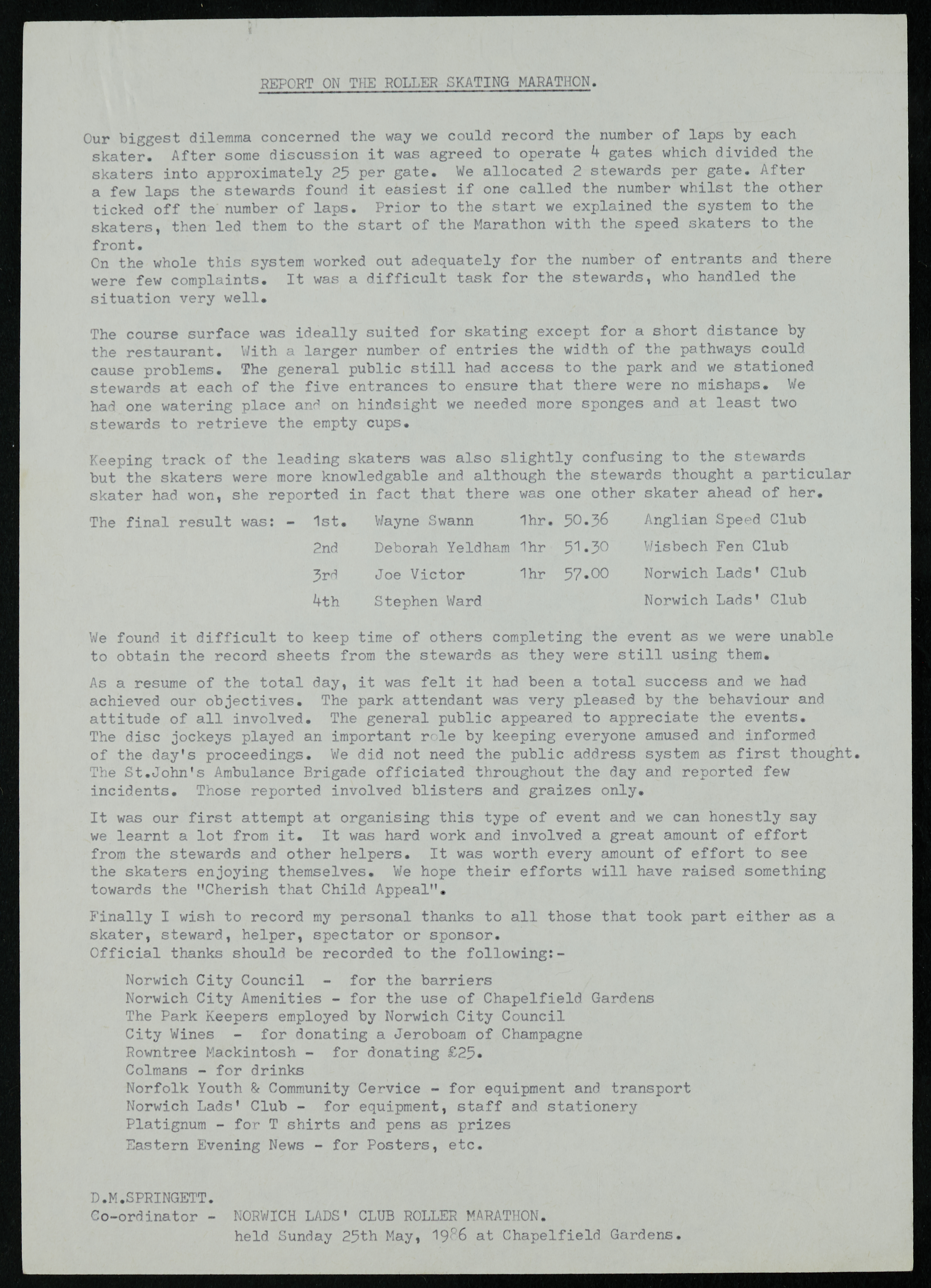
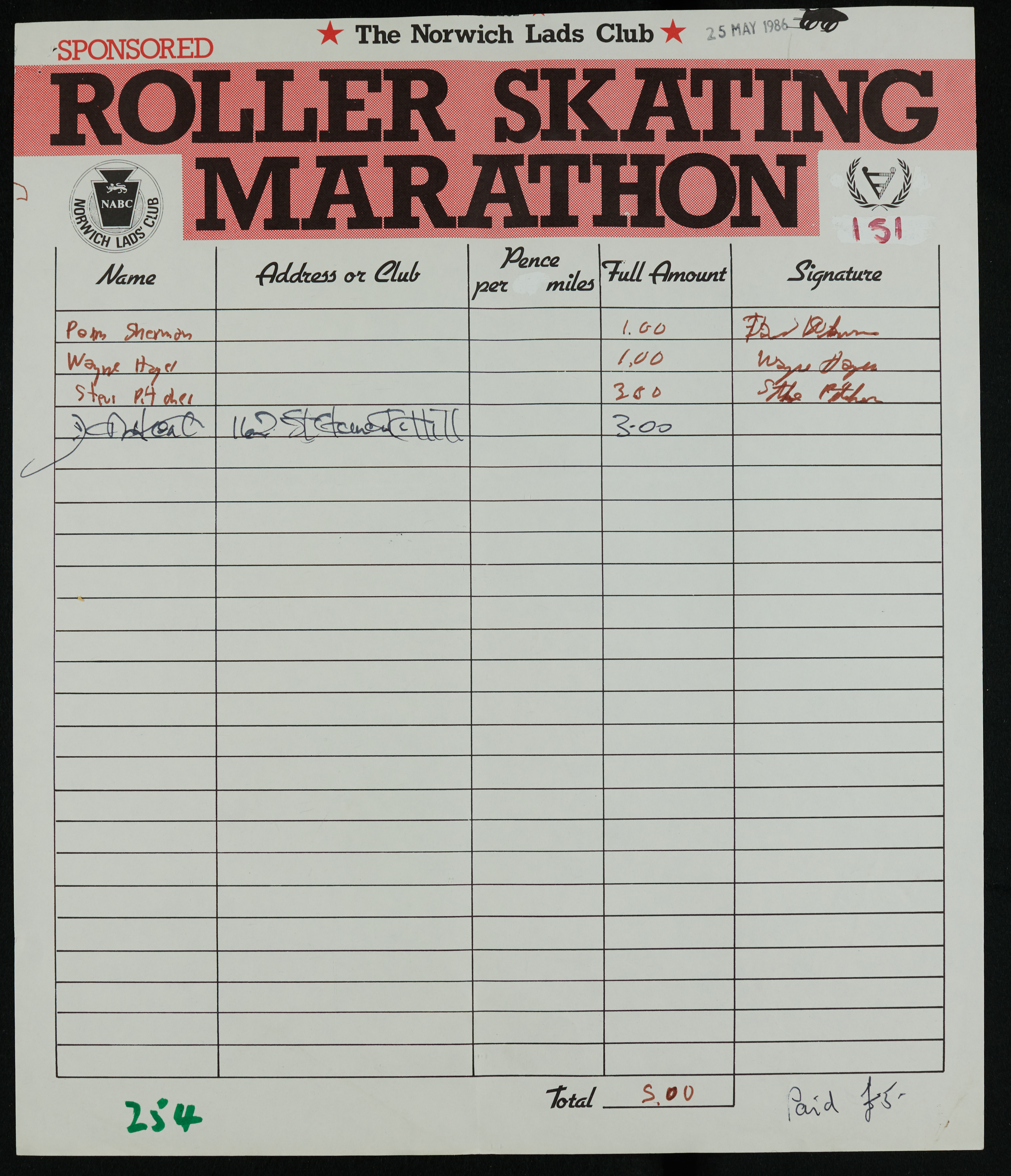
*An example of a sponsorship form held at the Norfolk Record Office can be seen below, as well as a typed report on the event. As you can see from the report lots of local businesses supported the marathon including global brands-Colman’s and Rowntree Mackintosh.
Interviewer: Did participants get anything for taking part?
Tim Nelson: Yes, participants got a certificate congratulating them. The fastest to complete the race was a gentleman from the Anglian Speed Club, a speed skater who completed the marathon in: 1hr 50.36. Roughly the money raised was £3,000, which was a lot of money back then.
Interviewer: Where abouts did you finish and did you complete the marathon?
Tim Nelson: I believe I finished 12thand yes I did complete the marathon.
Interviewer: Did you hold any other marathons?
Tim Nelson: We did, due to the success of the 1986 marathon 2 further marathons were organised in 1988 and 1991. The event publicised skating in Norwich and increased numbers at the Lad’s Club in skating, either be in artistic or roller hockey. So overall it was a good event.
* Examples of some of the posters held at the Norfolk Record Office promoting the event can be seen below.
Interviewer: Why did the marathon stop after 1991?
Tim Nelson: They stopped because the Lads Club closed due to increasing rent prices of the building, basically the Lads Club went bankrupt and the council wanted to redevelop the site so we as a hockey club had to move elsewhere, we played in the old Corn Hall on Hall Road for a little while and they did skating sessions there but again that closed due to the site being redeveloped which is when we ended up at Super Skate as it was known then.
Interview ended.
It was fascinating to speak with my father about his involvement in roller skating in Norwich. I had not realised the extent of his influence within the local skating community or the contributions he made to both the sport and the wider public. It is unfortunate that the roller marathons are no longer held, as they are events I would have enjoyed participating in, and I am sure many other active skaters in Norwich would feel the same. The interview also highlighted the challenges surrounding skating venues, particularly the impact of redevelopment projects and increasing venue costs. To my knowledge, this is not an issue unique to Norwich. For example, Roller World in Colchester closed a few years ago after rising rent costs made it financially unsustainable. It is disappointing to see so many skating venues disappear, as this has a direct impact on the skating scene today.
This raises several questions about the current state of roller skating in Norwich. Is there still enthusiasm and demand for the sport? Are there any dedicated venues remaining, or has roller skating never truly recovered from its popularity in the 1980s?
Roller skating in Norwich today
From my own experiences and research, I believe skating today in Norwich is still popular, this is mainly a result of the purpose-built roller rink that was made in 1992 on Spar Road, Off Vulcan Road on the outskirts of Norwich, which has yet to succumb to closure. “Originally called Super Skate, in 1992, which changed to Solar Skate in 1994-5, Funky Monkeys in 2000 and finally Funky’s in 2004” as stated by the co-owner of Funky’s (3), has been a popular destination for skating lovers for the last 2 decades, with their maple wood, sprung floor which is 17 metres by 40 metres, plenty of ample space to roll (4) as you can see from the image below.
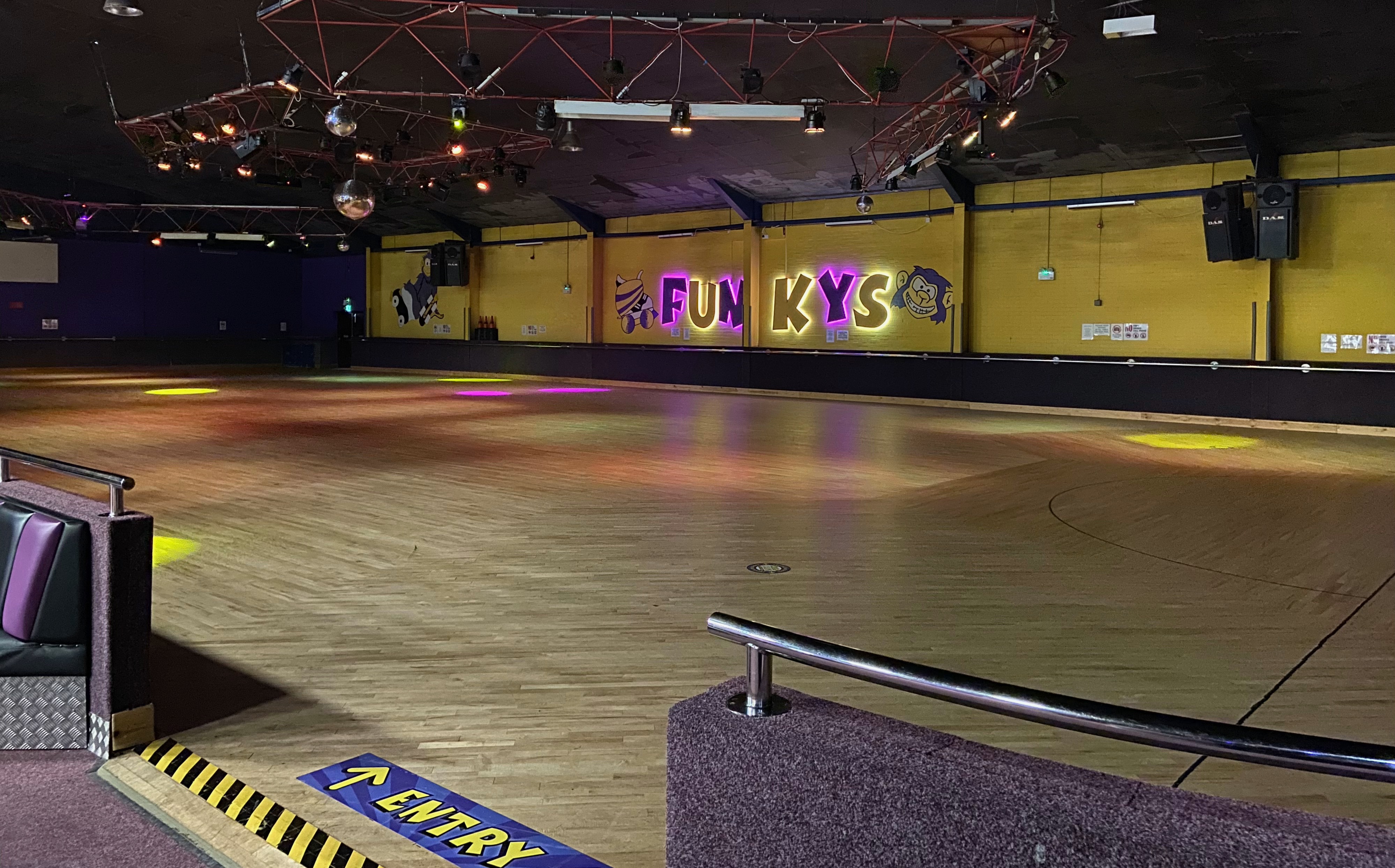
The hobby still seems affordable with Funky’s charging a reasonable price and they state on their website that they: “cater for all ages and abilities so whether you want a dedicated learning session or a full on roller disco..” (4). This is key to keeping the sport alive, as new participants want a hobby that’s not only affordable but also somewhere that will teach you the basics, so people don’t become disheartened and give up like they did back in the Victorian time with the Old Skating Rink!
The recent increase in interest in roller skating may be partly attributed to social media platforms such as TikTok, where skating content became particularly popular during the COVID-19 lockdowns. I recall seeing numerous videos of people learning new skating skills and using the sport to stay active outdoors. Despite this renewed interest, opportunities for skating in Norwich still remain limited. Currently, there is only one dedicated location available for skaters. There was previously a venue called Retro Skate in Great Yarmouth, where I regularly skated; however, it also closed in recent years. The lack of suitable skating facilities appears to be linked to a shortage of appropriate venues, as many sports halls do not have flooring suitable for roller skating. In addition, rising venue hire costs have made it increasingly difficult to sustain skating facilities and clubs.
Nevertheless, online research suggests that several skating disciplines continue to have an active presence in the region, including artistic skating, roller hockey, and roller derby. My own club, Norwich City Roller Hockey Club, remains active, although it faces significant challenges. Due to the difficulty of finding a suitable and affordable sports hall in Norwich, the club is required to train in Beccles. Alongside venue limitations, the overall cost of participation presents an additional barrier to the growth and sustainability of the sport.
Conclusion
To conclude, the history of roller skating in Norwich has been on a roller coaster of ups and downs. However, based on my own experiences and frequent visits to Funky’s, skating remains popular within the local community. The consistently busy sessions demonstrate that there is still a strong demand for the sport and an enthusiastic skating culture in the city. I am grateful that the skating scene in Norwich has endured, as it has provided me with the opportunity to develop my passion for both roller skating and hockey. Looking ahead, I hope there will be greater investment in the sport, particularly through the development of purpose-built skating facilities to not only support existing skaters but also encourage future generations to become involved in the sport.
By Francesca Nelson
(1) Rolling back the years: Memories of Funkys indoor skating rink | Eastern Daily Press