War was beginning to look likely in Britain during the 1930s, the memory of Zeppelin raids and bombing on civilian populations reigned heavily on the minds of Britons from not only the First World War, but from what they had read about the Spanish Civil War: Massive amounts of bombs falling on towns and cities leaving fires, destruction and death in their wake. Coming across A.R.P. Manuals in the archives, particularly the Fire Warden’s Handbook, inspired me to dive into the Fire Service’s role during the war, and the attitudes towards them.
With growing tensions in Europe, and the fear of war breaking out, the Home Office set up a Civil Defence, whose task was to lower casualties of air raids whilst taking precautions to be able to deal with injuries and widespread destruction. The Home Office believed that a single German bomber could be responsible for starting 150 fires over three miles. Concerns regarding the use of gas on civilian populations led to gasmasks being issued to civilians along with instructions on how to use them. The Fire Warden’s Handbook gives us grave insight into the type of bombs the Luftwaffe were dropping, and how they were to be dealt with.
Read more: The role of a Second World War Fire GuardIn the prelude to the war, the fire brigades of Britain were all put under the Auxiliary Fire Service (AFS). Volunteers began to join the AFS in their thousands, and training was provided by original firefighters based on what the Home Office believed to be the major dangers in incendiary bombs. Certificates were awarded out to those who had completed their training.
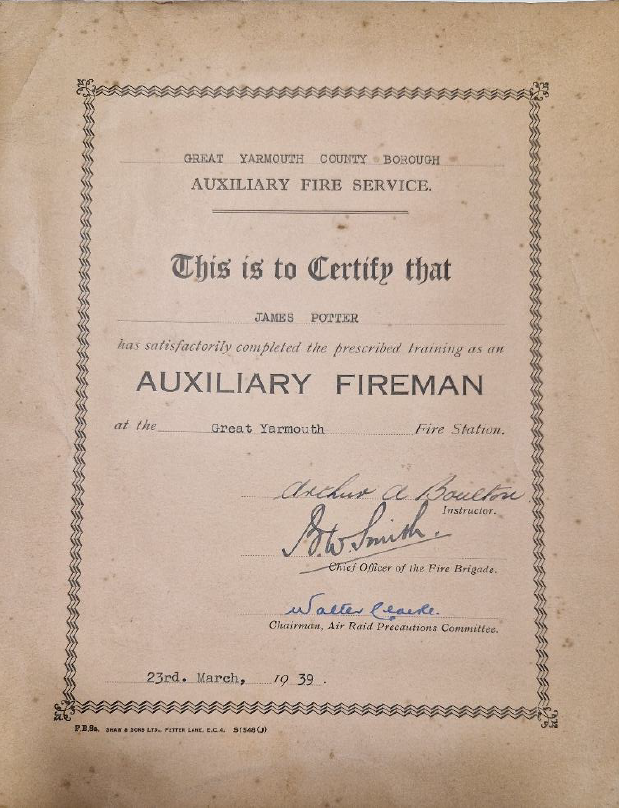
The end of the AFS and the beginning of the NFS
There were over one-thousand different fire brigades in Britain before the development of the AFS. Interestingly, there was no leading command structure for the country’s firefighters. Methods used by one brigade may have been different to another brigade who were “next door.” This posed a problem when heavier bombing campaigns began on towns and cities, who required reinforcements from neighbouring cities or towns. When reinforcements arrived, it was found that methods differed and hoses would not connect to hydrants as they had different connections.
This would prove to be a major issue; the Home Office decided that the AFS would be scrapped. In its place, the National Fire Service (NFS) was founded in August 1941. The NFS would be commanded from the Home Office itself, unifying the methods and practices of the brigades and AFS under one unit.
The Fire Warden’s Handbook was introduced alongside the new nationalised establishment. The handbook mainly concerns itself with the effects of incendiary bombs. The Home Office were under the impression that incendiary bombs could not be handled alone by the NFS, who would have to deal with a range of issues in one night of bombing.
Handbook 14, issued in 1942, teaches us the role of the Fire Guard. Their duties were to only to put out incendiary bombs and stop fire from spreading. This would be under the direction of their own officers under the A.R.P., not the NFS. If it became clear that the NFS would need to be involved, the NFS were contacted and the Fire Guards in turn would come under the NFS command.
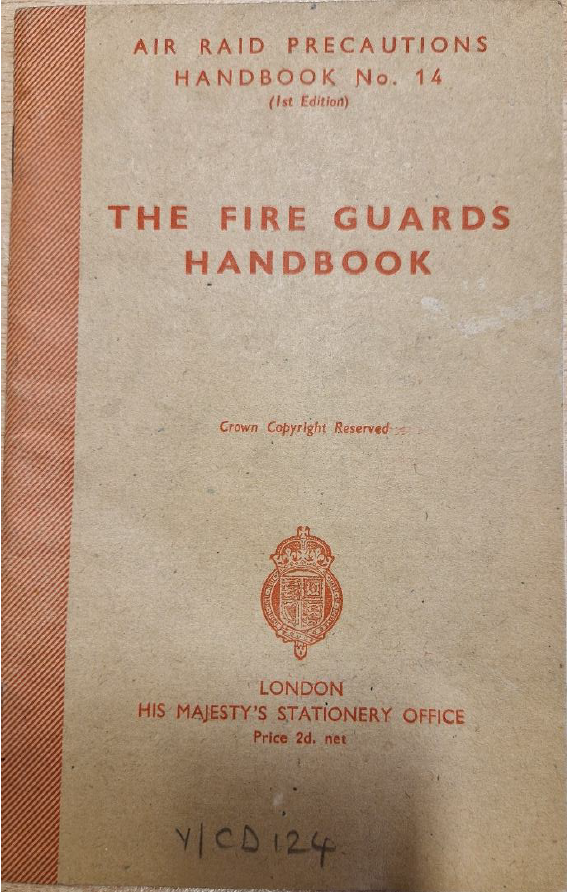
The booklet can give us insight into why the Fire Guard was set up, and what was to be expected of it. In the introduction it is admitted that the actions of the NFS alone would not be enough to put out fires, as the incendiary bombs could be dropped at a staggering rate.
From a local perspective, in Great Yarmouth on the 7th and 8th April 1941, an estimated 4,000 highly explosive bombs were dropped on the town. This caused fifteen major fires and created two hundred smaller fires. Reinforcements had to be called upon from Lowestoft and Beccles, and later Norwich and Cromer. Fire was such a massive threat to the country.
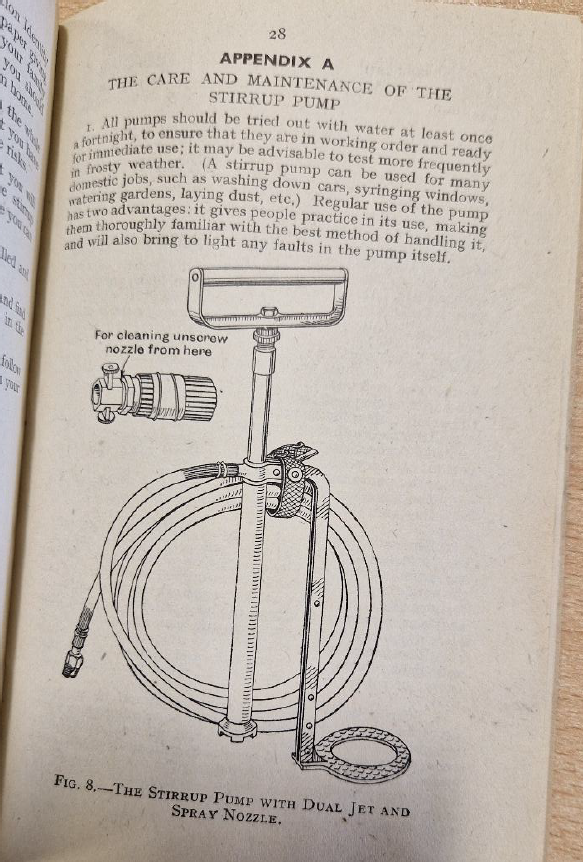
The main piece of equipment for any Fire Warden was the stirrup pump. This pump was essentially used for putting a highly explosive bomb out of action, should one not have exploded. Pages 9 and 10 of the handbooks outlines how a team should operate a stirrup pump. The writer realised that some teams may not have three people available and therefore gives instructions for two people or, in extreme cases, one person.
Public perception and the end of the NFS
As you might expect, the members of the NFS and Fire Guards would need to be tackling fires and unexploded bombs while the Luftwaffe were still dropping them. This gave the NFS a huge boost in popularity and were often compared to the military for valour and sacrifice. Surprisingly, before the advent of German bombs, the story of the firefighter’s heroism was far from the public eye.
As the war started, the term “Phoney War” described the period of the war which saw little to no allied armed movements, likewise there were no immediate bombings on towns and cities. Therefore, despite the numerous amounts of sign-ups to the Fire Service, there was not much to do. The fire service, wardens and other members of Civil Defence were called cowards and army-dodgers, earning money for doing nothing.
Of course, that attitude soon changed when Germany began heavy bombing campaigns. With this, their heroic stance was portrayed through film and newspapers.
As the war took a turn in favour of the Allies, German bombing began to ease up. Although it did not end outright, it certainly was no longer at the levels seen in 1940-41. Great Yarmouth saw little to no bombs during the period between 1943-45, for example. During lulls in action, members of the fire service were found to work allotments and make and repair toys for nurseries.
With no real need for the number of wardens, and as many members of the Fire Service as there were, numbers were soon cut back. The National Fire Service and Civil Defence were dissolved in 1947. Fire Brigades returned to their locality rather than national command structure. Their importance and services are remembered through these handbooks; long may they do so.
Researched and written by Max Hubbard
External Bibliography
- Baily, Victor. Forged in Fire. London: Lawrence & Wishart Ltd., 1992.
- Box, Charles G. Great Yarmouth Front Line Town 1939-1945: An Official Account of the A.R.P. Activities and Enemy Action within the County Borough of Great Yarmouth Which Includes Gorleston-On-Sea. Bradford: William Byles & Sons, 1946.
- Brown, Mike. Put That Light Out! Thrupp: Sutton Publishing Ltd., 1999.
- Ewen, Shane. Fighting Fires. London: Palgrave Macmillan, 2010.
- O’Brien, Terence H. History of the Second World War. London: Her Majesty’s Stationery Office and Longmans, Green and Co., 1955.
- Robb, Linsey. “‘The Front Line’: Firefighting in British Culture, 1939–1945.” Contemporary British History 29, no. 2 (October 13, 2014): 179–98.
Archive Sources
- Certificate for James Potter, Great Yarmouth Auxiliary Fire Service. NRO, MC 2159/2, 923X8
- Printed A.R.P. Manuals. NRO, Y/CD 124
- Fire guards register, to 1944. NRO, Y/CD 108