During the 1930s, Norwich grappled with high unemployment. The worldwide depression that hit Britain in 1930 led to increased economic instability. The city endured elevated levels of unemployment before the outbreak of the Second World War (1939 – 1945). The worst month, January 1933, saw unemployment as a percentage of the population, at 7.4 per cent, while nationally it stood at 6.5 per cent. This included workers who did and did not have government unemployment insurance,.[1] [2] Among those covered by insurance, (an average of 38.8 per cent of Norwich’s population in the 1930s), 19.8 per cent found themselves out of work at the peak.[3] A large portion of those unemployed in Norwich originated from the boot and shoe industry. In 1931, just over 22 per cent of the population worked in this sector, with women making up 43 per cent of its workforce.[4] During the worst month, one in five of the unemployed originated from this industry.[5] Against this backdrop, the Norwich Unemployed Welfare Association (NUWA) formed to provide relief for those out of work.
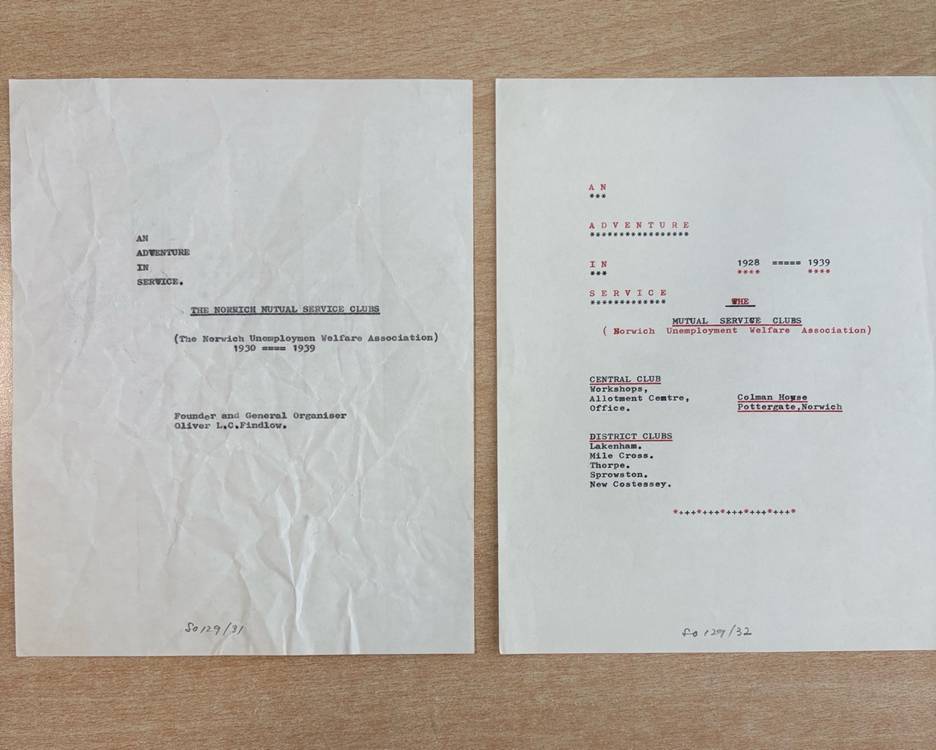
Read more: The Norwich Unemployed Welfare Association: A Brief HistoryWhile it originated from Christian charity groups in Norwich, it did not form with the aim of proselytising the unemployed. Much of its support came from the Industrial Christian Fellowship (ICF), the Young Men’s Christian Association, the Society of Friends, and the clergy of the Church of England, Roman Catholic Church, and Free Church.[6] According to the history detailed in the four drafts of their ‘An Adventure in Service’ document, the association was partly formed from a study group founded in 1928 by the ICF’s Norwich branch. The association investigated the causes of mass unemployment and the best solutions to assist men and women who lost their jobs.[7] . During an open-air meeting of ICF minister Oliver Findlow at Norwich’s marketplace in the early 1930s, a group of unemployed men requested him to lead a deputation to the City Council’s Public Assistance Committee, to which he agreed. They sought to receive a rest and recreation room for the unemployed with their assistance.[8] Upon the room’s success and receiving the support of the Lord Mayor, Sir George Ernest White, the NUWA was formed.
The drafts of the document differ in some details on the organisation. They show varying dates for the formation of the NUWA, ranging from 1928 to 1932.[9] It indicates a debate inside the association over whether to officially date their start to the mass unemployment study by ICF Norwich, or the formation of the rest and recreation room under Finlow. The closest to a finished draft appears to have taken a middle ground, placing the start date in 1929, but it is unclear why the date was specifically chosen.[10] What was clearly agreed was their closure year, which remained consistent across all drafts at 1939.[11] This consistency applied to their objectives as well. All drafts listed the goals of the organisation as,
- To STIMULATE and ENCOURAGE a helpful COMRADESHIP.
- To ENCOURAGE men to RE-TRAIN and RE-GAIN CRAFTSMANSHIP.
- To PROMOTE by LECTURES and DISSCUSSIONS an interest in the affairs of life.
- To PROVIDE facilities for INDOOR and OUT DOOR [sic] RECREATION.
- To ADVISE and help in ALL cases of need.[12]
They framed their work as a collaboration with Norwich’s unemployed to provide them with the tools to restore dignity in their lives. The NUWA explained, ‘We were working WITH the unemployed – rather than just FOR them.’[13] They wanted to convey that the organisation provided tools to help the unemployed regain their footing, rather than just providing them with charity. In their view, restoring their sense of self, combined with some form of light charity, would be more effective.[14] Based on these principles, they developed schemes and activities.
The NUWA ran multiple clubs and services. Alongside the central club, located in Pottersgate, five district clubs ran at Lakenham, Miles Cross, Thorpe, Sprowston, and New Costessey. All were independent, with each having an unemployed chairman who served as a representative on the NUWA Central Council.[15] One of the services they ran was an allotment scheme in co-operation with the Society of Friends. According to the drafts, they opened 300 new plots for allotment gardens, worked by 1,200 unemployed men.[16] They also provided seeds and tools to over 7,000 individuals working both allotment and home gardens.[17] Additionally, they ran a workshop led by a paid instructor to help build and repair allotment huts, furniture, and toys.[18] Another service was boot repair and tailoring for the unemployed, run by a retired bootmaker and tailor.[19] In sports recreation, the organisation ran a diverse range of clubs. These included a football league of ten teams, a cricket league with four teams, and bowls.[20] Teams for chess, draughts and bagatelle were also found through the association.[21] While most of the clubs targeted unemployed men, there were also services for women.
As women made up almost half of the Norwich boot and shoe industry, it can be assumed that at least some of the unemployed who originated from the sector were women. Additionally, the NUWA’s statements emphasised its service to both men and women, indicating indicate a non-negligible number who required some form of assistance.[22] The association included the Women’s Club and the Ladies’ Auxiliary. The Women’s Club began as an independent organisation for unemployed women in 1932, but eventually became absorbed by the NUWA, with its founder taking a position on the council.[23] Through their group, they planned weekend camps on land owned by the NUWA.[24] The Ladies’ Auxiliary focused more on women in families experiencing unemployment than strictly on unemployed women. Seventy-five women would visit homes of families that they called their ‘adopted families’ with the main goal to ‘…ease the burden which fell most heavily upon the shoulders [of] “THE MOTHER” in the home when DAD was out of work.’[25] The types of assistance offered are not fully explored beyond the work of repairing and remaking old clothes for the families they helped.[26] While the groups that ran for men focused mostly on regaining their confidence and skills, those for women within the organisation appeared to have focused more on the charity aspect.
Researched and written by Rocky Hage
Bibliography
Primary Sources
‘An Adventure in Service, The Norwich Unemployed Welfare Association 1929 – 1939’, 1939. Norfolk Record Office, SO 129/28-38, 692X2
Secondary Sources
Aldcroft, Derek H. The British Economy Between the Wars. Philip Allan Publishers, 1983.
Constantine, Stephen. Unemployment in Britain between the Wars. Longman Group, 1980.
Cunningham, Paul. ‘Unemployment in Norwich During the Nineteen Thirties.’ PhD Diss., University of East Anglia, 1990.
Doyle, Barry M. ‘Structure of Elite Power in the Early Twentieth-Century City: Norwich, 1900 – 35,’ Urban History 24, No. 2 (1997): 179 – 199.
Doyle, Barry M. ‘Urban Liberalism and the “Lost Generation”: Politics and Middle Class Culture in Norwich, 1900 – 1935,’ The Historical Journal 38, No. 3 (1995): 617 – 634.
Garside, W.R. British Unemployment 1919 – 1939: A Study in Public Policy. Cambridge University Press, 1990.
Scott, Peter. ‘The State, Internal Migration, and the Growth of New Industrial Communities in Inter-War Britain,’ The English Historical Review 115, No. 461 (2000): 329 – 353.
[1] Paul Cunningham, ‘Unemployment in Norwich During the Nineteen Thirties,’ PhD Diss., (University of East Anglia, 1990). 10,15.
[2] Ibid. 11.
[3] Ibid. 17.
[4] Ibid. 24.
[5] Ibid. 39.
[6] ‘An Adventure in Service, The Norwich Unemployed Welfare Association 1929 – 1939’, 1939. The Norfolk Record Office (NRO), SO 129/28-38, 692X2
[7] Ibid.
[8] Ibid.
[9] Ibid.
[10] Ibid
[11] Ibid
[12] Ibid.
[13] Ibid.
[14] Ibid.
[15] Ibid.
[16] Ibid.
[17] Ibid.
[18] Ibid.
[19] Ibid.
[20] Ibid.
[21] Ibid.
[22] Ibid.
[23] Ibid.
[24] Ibid.
[25] Ibid.
[26] Ibid.