The introduction of conscription by the Military Service Acts of 1916 meant that every male British subject between eighteen and forty-one was liable to be called for military service. The British Army had traditionally relied upon volunteers, and the government had significant reservations about the social, cultural, and political implications of introducing conscription.
To make the compulsory nature of the legislation more palatable, the Acts allowed four principal grounds for exemption from service in the military: economic or domestic hardship, essential war work or work of national importance, ill health, and conscientious objection. Applications for exemption from military service were made both by employers, in respect of employees they considered to be invaluable or irreplaceable, as well as by individual men on their own behalf. Local tribunals were set up to decide applications for exemption. These could be absolute, temporary, or conditional, or the application could be rejected.
Read more: Behind the scenes at the Local Tribunals“His mother was now solely dependent upon his allotment.”[1]
Between 29 February and 1 March 1916 the Great Yarmouth Military Service Tribunal heard applications from 51 men already in uniform. [2] The men were serving with the 63rd Provisional Battalion, which was stationed in Gorleston on Sea, charged with training and home defence. Coastal towns like Great Yarmouth and Gorleston, their industries and civilian populations were at risk from attack by sea and air in the new era of ‘Total War’.
These cases presented an interesting legal and technical challenge for the Tribunal, because when the men had attested with the Territorial Forces, they had signed up for home service only. A man serving with the Territorial Forces could not be deployed overseas unless he had signed the Imperial Service Obligation. However, under the terms of the Military Service Acts, all eligible men were deemed to have enlisted for general service, meaning they could be deployed overseas. [3] Although the men were already in khaki, the Tribunal “had the same duties to perform as in the case of civilians”, because the change to their status imposed by the Military Service Acts affected their civil liberties. Grounds for exemption from general service included medical unfitness for overseas service and serious hardship. However, notwithstanding a grant of absolute exemption, the men remained members of the Territorial Forces.[4]
On 29 February 1916 the Tribunal considered the first 39 applications, granting absolute exemption on grounds of serious hardship in 23 cases. One man was granted temporary exemption for a day; the remaining fifteen applications were disallowed. Twelve cases were adjourned until the following day. When the Panel reconvened on 1 March, eight men were granted absolute exemption on grounds of serious hardship and one application was disallowed. Three of the applicants withdrew their claims. One of whom, nineteen-year-old Alfred Salmon from London was a ‘carman’ in civilian life, responsible for the delivery and collection of goods and parcels. He attested for service with the Royal Garrison Artillery on 22 May 1916. Alfred Salmon later served in Egypt with the 24th Battalion of the Royal Welsh Fusiliers, where he died of wounds on 3 January 1918.[5] After his death, the military could only identify an unofficial ‘foster mother’ to receive his effects and his service medals.
A further series of applications for exemption from overseas service from soldiers in the Territorial Forces were brought before the Great Yarmouth Tribunal in July 1916.[6] In all but two cases, these later applications were disallowed. One man was granted exemption on grounds of ill health. Another, Sergeant William Arnell was granted temporary exemption from overseas service until January 1917, despite protest from the Military Representative.[7] William Arnell was a former soldier who had fought with the City Imperial Volunteers in the South African wars. In response to an appeal for experienced non-commissioned officers to help train new recruits, he had closed his dentistry business and donned khaki again. He was married with four children and a wife whom he described as being in ‘delicate health’. William Arnell finished his wartime service as a gunnery instructor in the Royal Flying Corps. He did not end up serving overseas. [8]
The grounds on which the soldiers sought to demonstrate serious hardship in the event of being posted overseas added another layer of complexity for the Great Yarmouth Tribunal, specifically, the question of adequate provision for dependents. Dependents were members of a soldier’s family (other than a wife, legitimate children or stepchildren) who were wholly or partly dependent on his earnings when he mobilised, or when he enlisted. The youngest of the applicants were single men aged between 18 and 22. When they attested for service with the Territorial Forces they had no dependents. One applicant was still at college.[9] Consequently, at the time of attestation these young soldiers had not made any allotment from their pay for dependents. Nor had arrangements been put in place for the payment of a separation allowance to dependents. A separation allowance was a portion of a soldier’s pay which was matched by the government and sent to his dependants to make sure they were not left destitute while he was on active service.
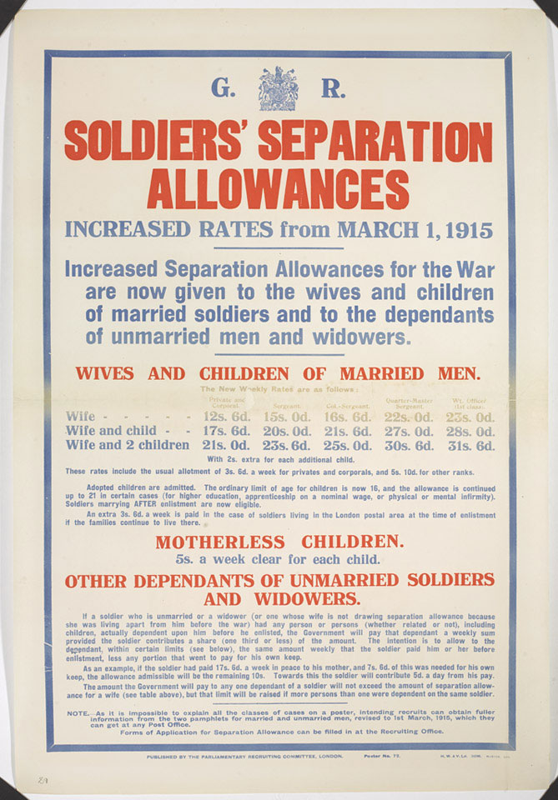
By 1916 the circumstances of these young soldiers had changed significantly. Fathers and older brothers had died or been killed in the war. These young men were now responsible for the support of their widowed mothers and younger siblings. In the absence of formal arrangements for the support of their dependents, as a purely practical matter if they went overseas it would be more difficult to ensure that money reached their dependents at home. Nor was there any guarantee that their pension would be paid to their dependents in the event of their death. The Panel recognised that the applications were being made by “men who had no knowledge of procedure and their parents knew nothing of the technicalities for getting pensions. The person who could best look after that would be the soldier, and he would be dead.” [10]
The Tribunal established that it was possible (but complicated) for a soldier to make an allotment for dependents even if it had not been done at the time of attestation, but that a separation allowance would not be granted as well. [11] As far as the payment of pensions was concerned, the Great Yarmouth Panel sought to understand the legal situation before making final rulings. “Where mothers or similar dependents were likely to be prejudiced, the appeals should be adjourned till the Tribunal was assured they would be pensionable”. [12] The Town Clerk wrote to the War Office asking for clarification as to whether widowed mothers (or other dependents) of these men would receive their pensions in the event that they were killed on foreign service. Conflicting responses were received. “One letter had been received from headquarters, stating they would not be pensionable. The Town Clerk now read another, to the effect that the War Office ‘is prepared to consider’ the issue of pensions to soldiers’ dependents, notwithstanding the fact that whilst in the Army no allotment was made, provided good reason can be shown why no separation allowance was claimed in a soldier’s lifetime.” [13]
For the military, the situation was simple. “If they refused to sign their foreign service papers they would be automatically discharged from the Army. Then when re-taken under the Military Service Act, they could make an allotment and would then ensure a pension being granted”.[14] By August 1916, the Military Representative urged the Panel to take a pragmatic approach. “I shall have to ask for a decision some time. The point is cleared up as far as we can go into it. It is clear that dependents will get consideration from the State or the Local Committee. That is as far as we can go”. The “military representative might be satisfied if he liked” but Panel members were unhappy with the lack of any definitive clarification from the War Office. On 19 August they moved to adjourn the cases sine die.[15] Nineteen cases were later considered by the Norfolk Appeal Tribunal. The Central Tribunal also heard an appeal in connection with a soldier in the Territorial Forces who had applied for exemption from overseas service or absolute exemption on grounds that he was responsible for the payment of a mortgage on the house he shared with his widowed mother and sister. No exemption was forthcoming in his case either.[16]
In July 1916, the Military Representative for the Great Yarmouth Local Tribunal applied to have the 31 certificates of exemption granted in March withdrawn. When these applications were first heard, the Panel queried whether absolute exemption was the correct decision. If a man’s circumstances changed (for example if his widowed mother died) would the military not be at liberty to review the case? The Town Clerk recognised that, as with civilians, the Military Representatives or the Tribunal “had power to review a case at any time.” Realistically, these exemptions were only ever conditional upon the continuation of the applicant’s circumstances. Notwithstanding that this was “the word used in the Act”, the Panel felt it was inappropriate (“a very silly word in the circumstances”) because it suggested a false degree of certainty. [17] Over a series of hearings between 17-21 July, all except one of absolute exemptions granted by the Panel in February and March were overturned.[18] Following the re-examination of these cases, eighteen-year-old Percy Horace Cheattle, a clerk from Forest Gate in London was discharged from the armed forces. The Register entry does not record the grounds on which this was decided. [19] Nineteen men appealed to the Norfolk Appeal Tribunal. All the appeals were denied.
Researched and written by Anya Page, originally posted on Grounds for Appeal Substack site
[1] Yarmouth Independent, 22 July 1916, p.6.
[2] Y/TC/90/122/6 Cases numbered 31 to 42; 54 to 62; 64 to 69; 74 to 96 and Y/TC/90/122/6/100
[3] Territorial and Reserve Forces Act 1907 (7 Edw. 7. c. 9) and Military Service Act 1916 [a] (5 & 6 Geo. 5. c. 104).
[4] Yarmouth Independent, 4 March 1916, p.8
[5] Y/TC/90/122/6/31, http://www.ancestry.com
[6] Y/TC/90/122/7/ cases 327-377
[7] Yarmouth Independent, 22 July 1916, p.6.
[8] Y/TC/90/122/7365, Yarmouth Independent, 22 July 1916, p.6, Ealing and Acton Gazette, 30 April 1965, p.2 and http://www.ancestry.com
[9] Y/TC/90/122/6/59, Yarmouth Independent, 19 August b1916, p.2. and http://www.ancestry.com. 22-year-old Walter Percy Rayner had attested in 1912 while a student at St Mark’s College, Chelsea. At the time he was considered to be financially supported by his mother and was not permitted to make an allotment. Four years later, he appeared before the Tribunal to request exemption from overseas service. His circumstances had changed and he was now responsible for supporting his mother. His case was disallowed.
[10] Yarmouth Independent, 19 August b1916, p.2.
[11] Yarmouth Independent, 19 August b1916, p.2.
[12] Yarmouth Independent, 29 July 1916, p.3.
[13] Yarmouth Independent, 19 August b1916, p.2.
[14] Yarmouth Independent, 22 July 1916, p.6.
[15] Yarmouth Independent, 19 August b1916, p.2.
[16] Tribunal Manual. 1917. Cases decided by the Central Tribunal, number 35
[17] Yarmouth Independent, 4 March 1916, p.8
[18] Y/TC/90/122/7 cases 327 to 358
[19] Y/TC/90/122/6/37 and Y/TC/90/122/7/328