
On 29 February 1908, The Lancet published a paper by F.C. Wallis, a surgeon at Charing Cross Hospital in London, entitled Three cases of fractures of the lower end of the Humerus. Case number one involved seven-year-old John Zigomala, the son of Major Pandia and Hilda Zigomala (nee North). The family lived in London but were regular visitors to Norfolk. They would stay at the family home where they had married in 1889, Rougham Hall, by now the home of Hilda’s brother Frederick. It was on a visit to Tittleshall on April 2nd, 1907, detailed in Hilda Zigomala’s journal, (NRO, MC 2738/11), that master John was thrown off a pony after the pony caught its foot in a rabbit hole.
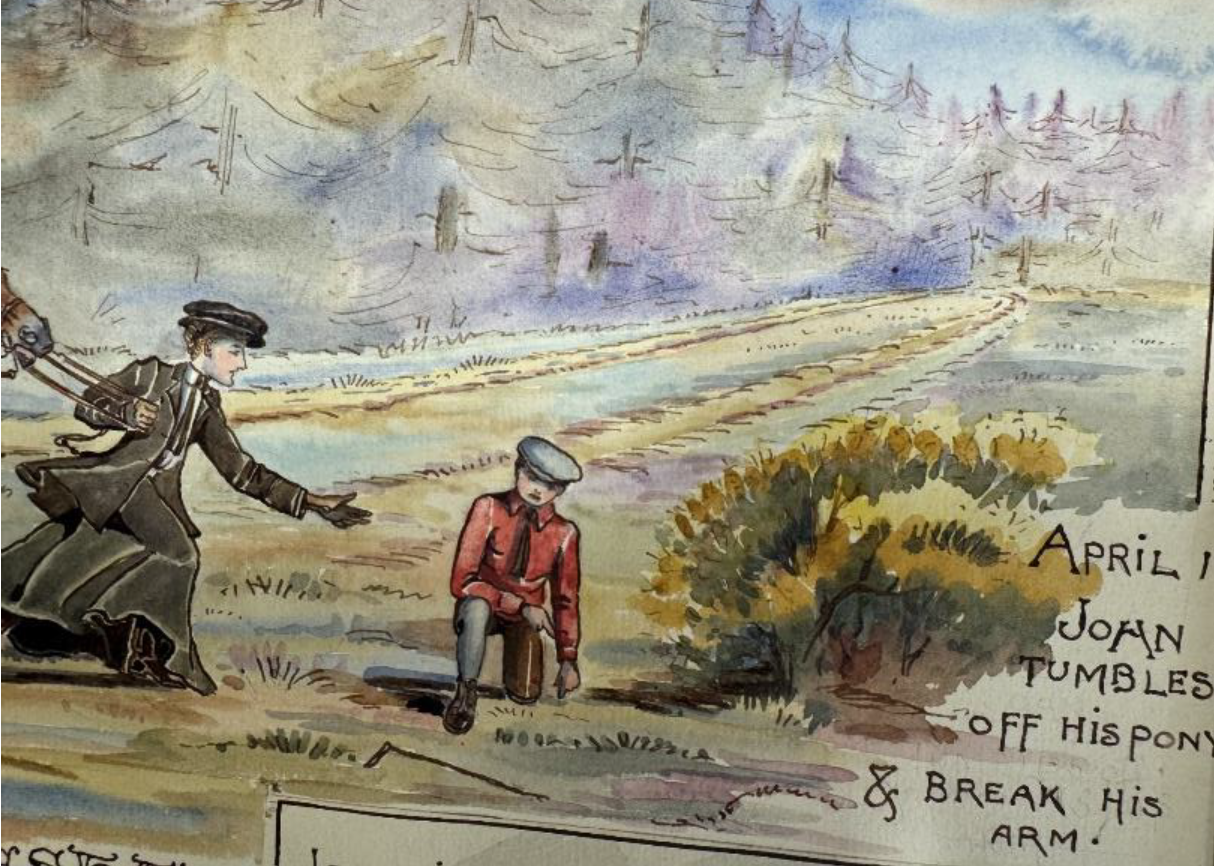
John sustained a fracture of the humerus above the Olecranon fossa (the space that sites the humerus at the elbow joint). He travelled back to London; an unsuccessful attempt by manipulation did not reduce the fracture. To avoid limb deformity, a skiagram (X-ray) revealed extensive displacement.
Read more: Early X-rays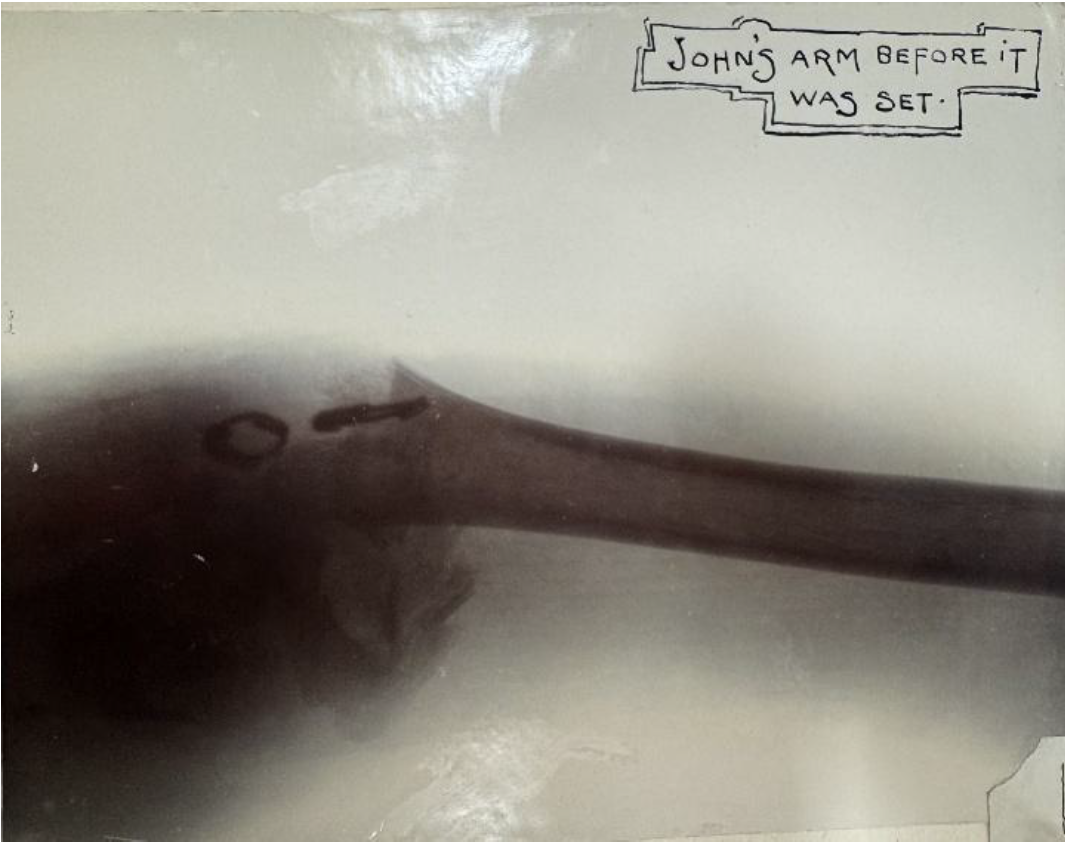
On April 16th, two weeks after the accident, he had a successful operation to repair the fracture and was back to boisterously playing ‘well as ever’ within three months.
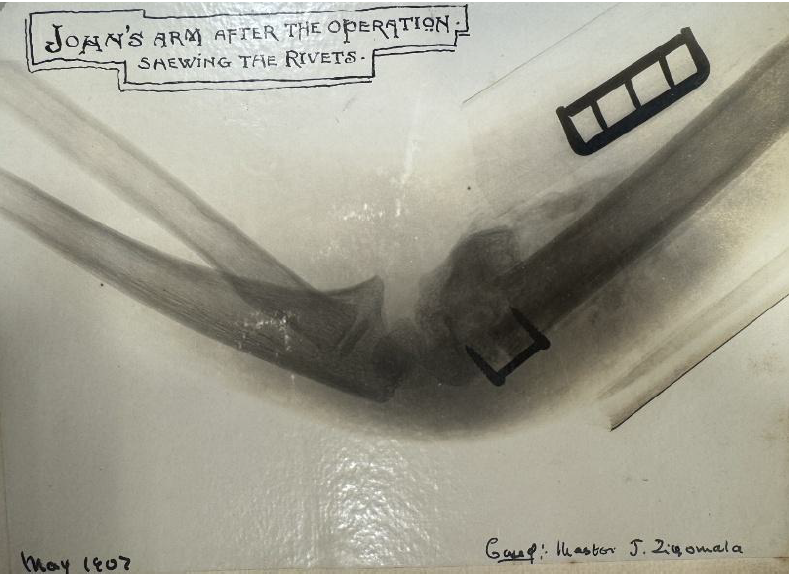
John was fortunate that X-rays were a diagnostic tool at this time. It had only been twelve years previously that German experimental physicist Wilhelm Röntgen, repeating experiments of former colleagues Johann Hittorf and William Crookes, had discovered high-energy radiation could excite atoms in fluorescent materials, rendering them capable of penetrating certain materials such as wood, metal and bone, at differing densities producing shadows, thereby making them transparent. This technique he called X-rays. Röntgen presented his findings in 1895 and was subsequently awarded the first Nobel Prize in 1901.
Over the next 25 years X-ray machines were installed in many of Norfolk’s Hospitals. 1904 saw the opening of both the Norfolk and Norwich and the Jenny Lind Infirmary for Sick Children’s hospital x-ray departments. Yarmouth General Hospital installed its first X-ray machine in 1908. St Andrew’s Hospital in Norwich was requisitioned by the British Army in 1914, becoming the Norfolk War Hospital. By 1915, the army had installed temporary blocks containing operating theatres, sterilising, anaesthetising and X-ray facilities. The Norwich Workhouse bought its first X-ray machine in 1920. Mundesley Sanatorium installed its first X-ray machine in 1925.
Kelling Lodge Sanatorium opened its first X-ray department in 1923, and included a machine that was purchased for £500 by a local businessman, a Mr Simpson. A new X-ray department, designed by architects E.D.W. Boardman and Sons, opened in 1951.
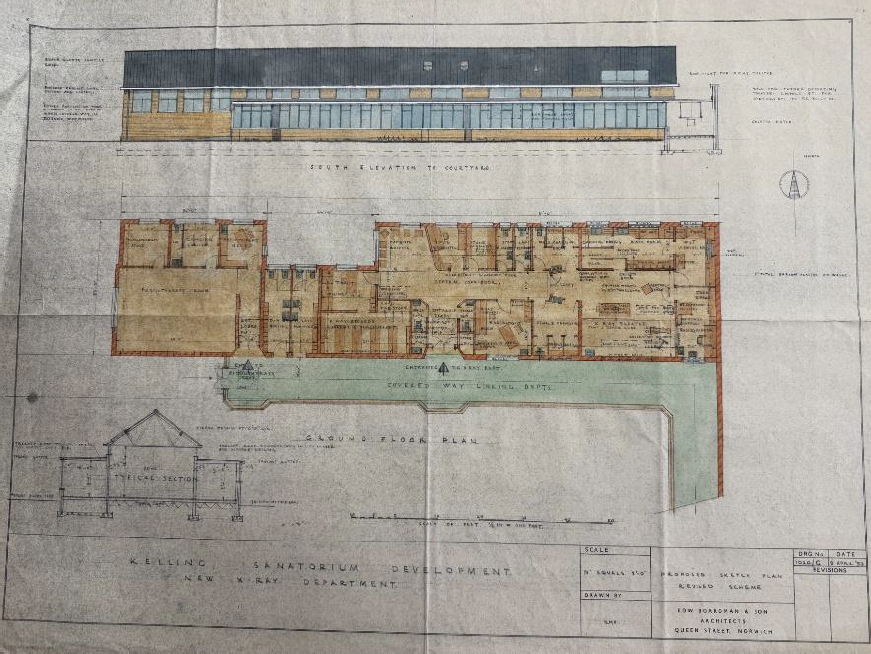
The department had its own wing at the hospital, placed conveniently next to the operating theatres. On the original plans are dated 22nd February 1952 (NRO, BR 35/2/64/4), you entered the unit into the central corridor, the patient’s waiting area was set off to the left. Directly in front was the nurse’s reception area. As you turn right down the main corridor, the male changing rooms are on the left, with the females on the right. Next to the female changing room was the X-ray theatre, with the radiographers’ room beside it. Opposite the theatre was a dark room with a cassette hatch followed by a wet viewing room. Revised plans, drawn up in April 1952 were proposed with a third revision drawn up in May of 1952. The fourth revision dated July 1952 sees a radical altering of the initial layout. The radiologists’ room is now placed in the waiting area. Opposite the entrance way there is now the admin department. To the left down the hall is the patient’s waiting area, opposite the unisex changing cubicles. The radiographers’ room is to the left, next to the X-ray theatre, now placed centrally facing down the main corridor, with the dark, wet and mixing rooms to the rear. These revisions highlight changing priorities but also point to a patient focused transition through the unit.
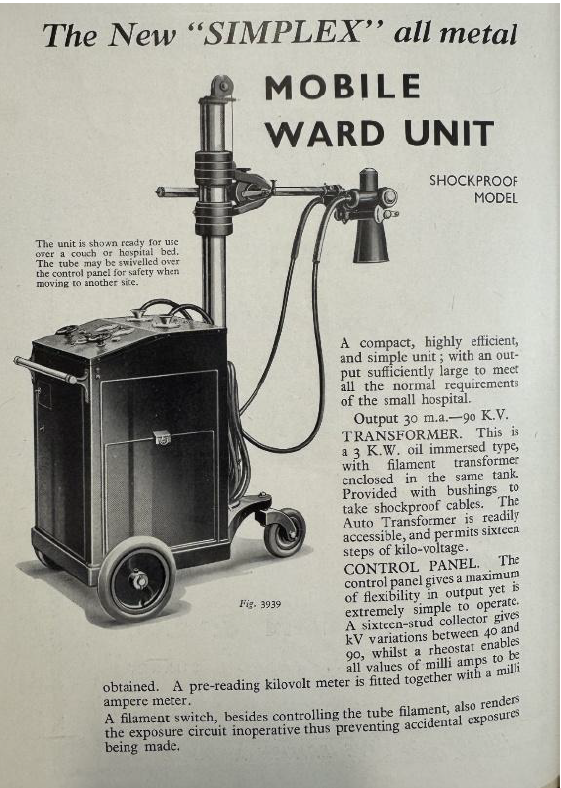
The North Walsham War Memorial Cottage Hospital opened in 1924, one of eight in Norfolk extant between 1859-1948 is known to have included an X-ray department. (NRO, H 24/10/3) Detailed estimates for various equipment, including an upgraded X-ray machine. The first document, from 1947, from A.E Dean & Co of Surrey, which describes itself as ‘The Progressive British X-ray House,’ is a catalogue detailing the equipment required for the upgrade, including a high-tension transformer unit, a motor-driven tilting table, and a mobile ward unit.
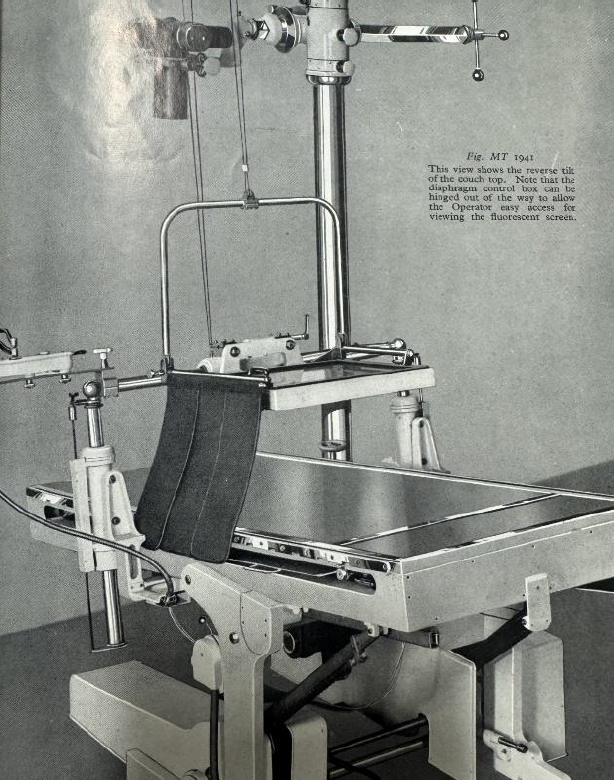
The second document contains estimate Number 1 for the three pieces of equipment. The high-tension transformer costs £687. 10. 0d, the Potter Bucky motor-driven tilting table at £650. 0. 0d and extras required an additional £414. 0. 0d including delivery, erection, and demonstration, a total sum of £1794. 15. 0d. The second quotation for the mobile ward unit is £580. 0. 0d, which comes with free installation and demonstration. The total cost amounts to £2,374. 15. 0d, which today would equate to £82,000.
Finance is always a concern and when Thetford Cottage Hospital had a new wing and x-ray apparatus installed in 1924, paid for by public subscription, ‘in memory of the men of Thetford who gave their lives for King and Country in the Great War 1914-1918.’ John Zigomola, a 19-year-old Lieutenant of the Irish Guards had served in France in 1917-18, commanding 280 men and 6 officers and had received an MBE for bravery during a bombing accident at Warley Barracks, Essex. John died in an explosion aboard HMS Glowworm volunteering with the Russian relief force in the Russian Soviet Republic in 1919, aged twenty-one. Hilda would surely have approved of Thetford’s poignant gesture as she spent the years after the death of John working with disabled ex-servicemen.
Researched and written by Mark Hatchell
Bibliography
Primary Sources
Plans for Kelling Lodge Sanatorium New X-ray department. NRO, BR 35/2/64/4
Estimates for equipment at North Walsham War Memorial Cottage Hospital. NRO, H 24/10/3
Journal of Hilda Zigomala. NRO, MC 2738/11
Secondary Sources
Blogs
Draper, Victoria. “A Variety of Ways to Celebrate Christmas: Exploring the Many Christmases of Hilda Zigomala.” Norfolk Record Office (blog). May 09, 2026. https://norfolkrecordofficeblog.org/2020/12/24/a-variety-of-ways-to-celebrate-christmas-exploring-the-many-christmases-of-hilda-zigomala/.
Long, Daryl. “The great adventure of it all ….’: The Wartime Volume of Hilda Zigomala.” Norfolk in World War One (blog). May 10, 2026. https://norfolkinworldwar1.wordpress.com/2018/11/28/the-great-adventure-of-it-all-the-wartime-volume-of-hilda-zigomala/.
Spirit, L. “Ballgowns and Dinner Invitations.” Norfolk Record Office (blog). May 09, 2026. https://norfolkrecordofficeblog.org/2022/01/08/ballgowns-and-dinner-invitations/.
Books
Authier, André. Early Days of X-ray Crystallography. Oxford University Press, 2013.
Cherry, Steven, and Economic History Society. Medical Services and the Hospitals in Britain, 1860-1939. Cambridge University Press, 1996.
Cherry, Steven. Mental Health Care in Modern England: The Norfolk Lunatic Asylum/St Andrew’s Hospital, 1810-1998. Boydell & Brewer, 2003.
Emrys-Roberts, Meyrick. The Cottage Hospitals, 1859-1990. Tern Publications, 1991.
Mould, Richard F.. A Century of X-Rays and Radioactivity in Medicine: with Emphasis on Photographic Records of the Early Years. Institute of Physics Publishing, 1993.
Thomas, Adrian M. K. and Arpan K. Banerjee. The History of Radiology. Oxford University Press, 2013.
Slator, James. Kelling Hospital Norfolk: The First Sanitorium for Working Men. Larks Press, 2000.
Swete, Horace. Handy Book of Cottage Hospitals. London, 1870.
Book Reviews
Bartlett, Peter. Review of Mental Health Care in Modern England: The Norfolk Lunatic Asylum/St Andrew’s Hospital, 1810-1998, by Steven Cherry. Bulletin of the History of Medicine 79, no. 1 (2005): 147–48.
Bretland, P.M.. Review of Pioneers and Early Years: A History of British Radiology, by E.H. Burrows. Journal of the Royal Society of Medicine 80 (1897): 788.
Digby, Anne. Review of Mental Health Care in Modern England: The Norfolk Lunatic Asylum, St Andrew’s Hospital, 1810-1998, by Steven Cherry. The English Historical Review 121, no. 490 (2006): 250–52.
Helliwell, John R. Review of Early Days of X-ray Crystallography, by Andre´ Authier. Acta Crystallographica. Section A, Foundations & Advances 70, no. 1 (2014): 92–94.
Sarton, George. Review of Wilhelm Conrad Röntgen and the Early History of the Roentgen Rays, by Otto Glasser and Margret Boveri. Isis 22, no. 1 (1934): 256–59.
Solla Price, Derek J. de. Review of The Trail of the Invisible Light from X-Strahlen to Radio (Bio)Logy, by E. R. N. Grigg. Journal of the History of Medicine and Allied Sciences 21, no. 4 (1966): 424–424.
Journals
Bradley, William G. “History of Medical Imaging.” Proceedings of the American Philosophical Society 152 3 (2008): 349–61.
Cherry, Steven. “Change and Continuity in the Cottage Hospitals c. 1859-1948: The Experience in East Anglia.” Medical History 36 (1992): 271-289.
Clayton, J. H. “Needle in Hand: Removal with the Aid of the Röntgen Rays.” British Medical Journal 1 (1896): 749.
Jauncey, G.E.M. “The Birth and Early Infancy of X-Rays.” American Journal of Physics 13 362 (1945): 362-379.
Reynolds, Russell, J. “The Early History of Radiology in Britain.” Clinical Radiology 12 2 (1961): 136-142.
Thompson, A.P. “Early X-Rays.” British Medical Journal 4 5735 (1970): 617-618.
Wallis, F.C. and B.C. Cantar. “Three Case Studies of Fracture of the Lower End of the Humerus.” The Lancet 1 4409 (1908): 627-628.
Websites
Bank of England. “Inflation Calculator.” Accessed May 15, 2026. https://www.bankofengland.co.uk/monetary-policy/inflation/inflation-calculator.
The War Graves Photographic Project. “Zigomala, John Copeland.” Accessed May 10, 2026. https://www.twgpp.org/photograph/view/2688116.
War Memorials Register. “Thetford Cottage Hospital Wing.” Accessed May 10, 2026. https://www.iwm.org.uk/memorials/item/memorial/56468.



Very interesting – thank you. The Editor of the Lancet for many years in the first half of the 20th century (1909-1937) was a Norfolk man – Samuel Squire Sprigge, who was born in Watton, the son of a doctor, Squire Sprigge. As well as editing the Lancet, Samuel worked at Great Ormond Street Hospital.
Andy Reid
LikeLike
Thanks Andy, that is really interesting.
LikeLike