The Georgian Period in 18th century England was often associated with elegance and strict social order, however it was also marked by a series of scandals which were tried and testified in court houses such as Walsingham Abbey in Norfolk. Being involved in a scandal during this period had devastating social and physical impact on many members of society, especially women of middle and upper classes, as trials reflected the law but also the strict gender social expectations of Georgian etiquette, where reputation was prioritised and breaches of social conduct could lead to lifelong ostracism.
Social etiquette played a crucial role in influencing how individuals interacted and formed relationships in the lives of the upper and middle classes. Georgian society was largely hierarchical, maintaining strict rules regarding interaction between classes. Social etiquette regarding gender expectations within Georgian society also heavily influenced how both men and women interacted due to the expectations for men to be chivalrous, socially dominant and rational, women in contrast were expected to be demure and largely confined to the social and domestic sphere. A woman’s reputation was fragile in Georgian society and scandals or even suggestion regarding her virtue could permanently damage her place and worth in society. However, men were often judged much more leniently, reflecting the sexual double standards deeply embedded in Georgian societies which helped to influence the outcome of the trials regarding any sexual scandals.
Read more: Georgian ScandalsMarriage customs further reflected these expectations regarding class and gender as among upper-class families arranged marriages were common and often designed to preserve wealth and status whereas love matches were much more common in middle-class families, although social respectability remained essential. In both cases regarding marriage, a woman was expected to remain a virgin until marriage, while men were allowed much more sexual freedom which was deemed and dismissed by society as just youthful behaviour for a young man. These unequal standards heavily influenced courtroom outcomes, especially in cases surrounding adultery, fornication or illegitimacy.
The strong emphasis on respectability and reputation within Georgian society meant that legal disputes were shaped by public opinion as much as evidence and courtroom jurisdiction. Newspapers and gossip circles played significant roles in spreading scandals, allowing public opinion and narratives to influence how judges and juries interpreted cases. If society believed an individual had violated polite behaviour, this could shape assumptions in favour of finding the participants guilty. Women experiencing scandals regarding their virtue were often judged not on justice but morality while men frequently escaped severe consequences. Therefore, high profile scandals in Georgian England often became public spectacles where fascination and judgement overpowered fairness.
One revealing case is the 1710 deposition of Susan Jefferys in the fornication cause against Anthony Hunt. This case highlights how class and gender expectations in Georgian society shaped both scandal and legal judgement. Susan Jefferys was a servant employed by Anthony Hunt and his father at their house in Bramorton. According to her deposition, Hunt repeatedly promised to marry her to persuade her into a sexual relationship. Jeffreys claimed that Hunt’s promises persuaded her to trust him, ultimately resulting in pregnancy and the birth of an illegitimate child. In Georgian England, illegitimacy carried severe consequences. A child born outside of wedlock faced lifelong social stigma, while the mother’s reputation was often irreparably damaged. For Jeffrey’s the consequences were intensified by class difference as intercourse between a gentleman and a servant was viewed as deeply inappropriate and marriage between different classes was rare and socially condemned.
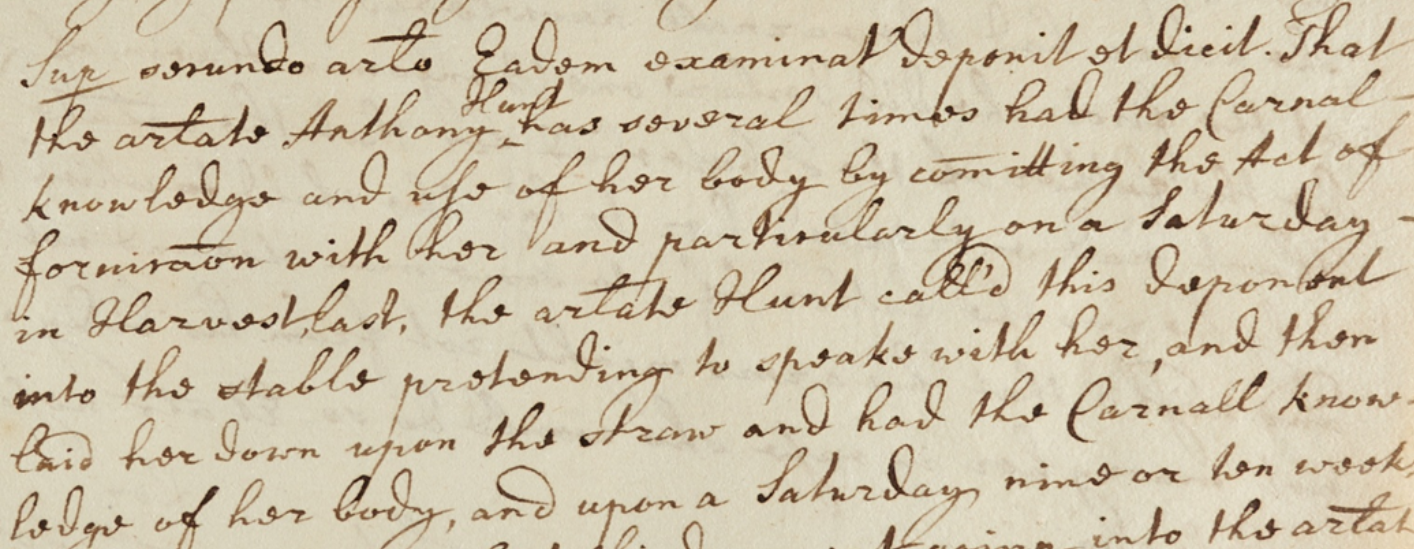
The accusation became public during Jeffrey’s labour when she was reportedly suffering severe pain and declared Anthony Hunt as the father. Her declaration was taken seriously due to her physical distress as people believed that extreme suffering encouraged truthfulness. Susan Jeffrey’s herself reported the accusation making her both the victim and witness. Court documents survive as the key evidence of the case and supporting evidence included Jeffrey’s testimony that Hunt was her only intimate partner as well as eyewitness statements from Mary Skinner who shared quarters with Jeffreys and allegedly witnessed Hunt entering their bed chamber, providing supporting context and credibility to Jeffrey’s accusations against Hunt.
However, court documents question the scandal’s certainty. Contradictions emerged when Jeffreys had earlier claimed Benjamin Warren as the father of her child. This inconsistency could undermine her credibility especially due to the assumptions that women may fabricate accusations for financial support or revenge. Although, these doubts and assumptions must be weighed against the vulnerability of servants in Georgian society as women such as Susan Jeffrey’s had little power against wealthy employers and legal systems often favoured men of status.
This scandal demonstrates how social etiquette influenced legal judgement. Hunt’s higher social standing as a man and a member of a higher class may have provided him protection compared to Jeffreys’ more vulnerable position as a woman of a lower class, making her more susceptible to suspicion. Georgian courts often reflected class hierarchy, where a gentleman’s honour was presumed to be more credible than a servant woman’s testimony. This case shows how morality and social expectations could potentially outweigh objective justice, demonstrating the importance of adhering to social values and norms in Georgian society.
Punishments in court houses such as Walsingham Abbey in Norfolk reflected a society determined to maintain order through fear and discipline. However, they also exposed inequalities as wealthier offenders could often avoid harsh treatment through influence or legal representation, while poorer individuals faced more disproportionate punishment.
The scandals of Georgian England reveal far more than just individual wrongdoing, they expose a society ruled by strict etiquette and expectations, class divisions and unequal expectations of men and women. Cases such as Susan Jeffrey’s deposition show how easily reputation could be destroyed for women and how legal outcomes are often shaped by social assumptions rather than pure evidence.
Researched and written by Isabeau Hurrell
Sources used
The Georgian Era: A Guide to Social Etiquette – portndb
18th Century Ettiquette & Expectations | Lovers and Liars
Deposition of Susan Jefferys in fornication cause against Hunt, 1710. NRO, DN/DEP 75/37