
Of the estimated 15,000 Norfolk men who died in the First World War (FWW) just 228 wills appear in the volumes of wills proved in the Norwich Probate Court. These wills have come to light whilst indexing wills at the Norfolk Record Office. They are defined as ‘Battlefield Wills’ because:
- They were made because the testator was about to go to war or was already in military service, sometimes even on the battlefield itself and
- their deaths are recognised by the Commonwealth War Graves Commission (CWGC) – their definition being deaths between 4 August 1914 and 31 August 1921.
Types of Will
Soldiers carried their Army Paybook (AB64) at all times unless they were involved in a trench raid. It included a page to allow the soldier to make a will. As it was not witnessed it was categorized as informal under the Wills Act, 1837 but it did have to be signed for it to be legal. If a soldier was killed, where possible the will would be extracted from his pay book and sent back to the War Office in the UK. A further declaration stating the legality of the will was made in the War Office. Most military wills are in this category and needed an affidavit to confirm the soldier had written it. Of the 228 wills, 190 had affidavits. The crucial wording is written in the margin of the probate copy; “while a soldier in actual military service”.
Formal wills were those signed by two witnesses using Army forms B243, B244 or W3297. These would not be part of the soldier’s pay book and would not routinely be carried by the soldier.
Many soldiers did not make a will despite being urged to do so. Sometimes no pay book was found or was able to be recovered after death. In such cases the War Office would use the details of next of kin on the enlistment papers to handle the soldier’s estate.
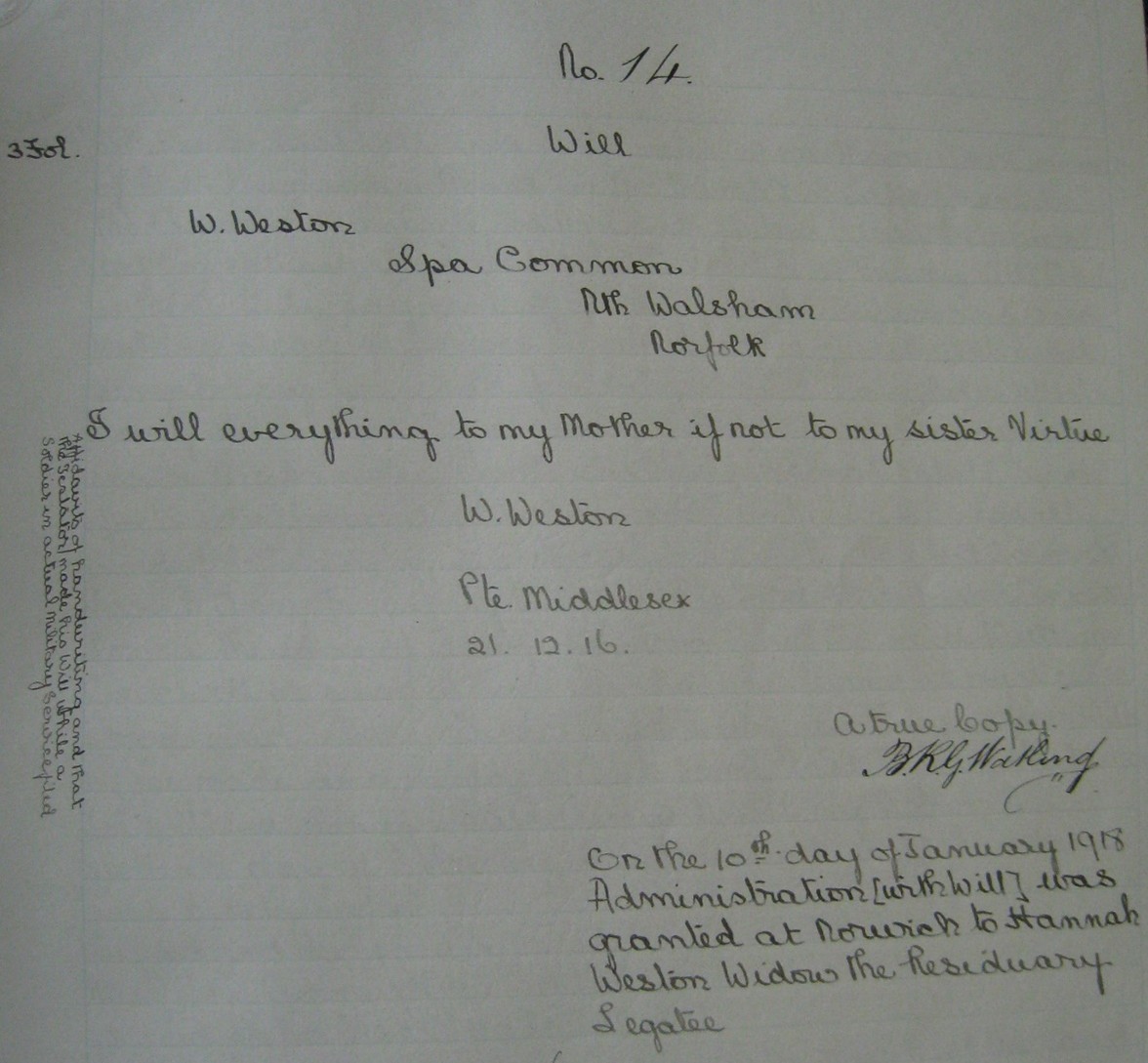
There were no witnesses for W Weston’s will and so there is an affidavit in the left-hand margin to verify it was made while in military service. Genealogy sites and the CWGC site reveal that this is William Weston who lived with his widowed mother Hannah and sister Virtue. William served in the 2nd Battalion of the Middlesex Regiment, service number 6903. He died on 11 August 1917 and is commemorated in Lijssenthoek Military Cemetery, Belgium. His will was proved in January 1918.
Will Volumes
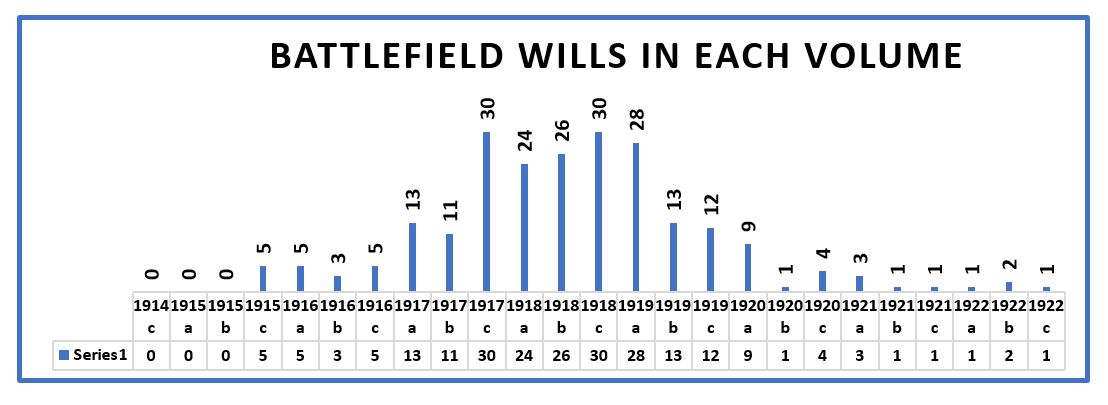
Norwich Probate Court produced three volumes a year. Starting with the final volume of 1914 (August to December) and ending with the final volume of 1922 we see that the earliest death was on 12 March 1915 and proved 8 months later. The last death was on 26 March 1921 and was proved 6 months later. The last to be proved (research so far) was in October 1922, four years after the soldier’s death.
Data Spreadsheet
A spreadsheet was created recording all the information from the wills and other sources. Several factors had to be considered; for example age was not always a simple calculation.
Surnames
None of the 228 men were related but several did lose brothers in the war. Joseph Fisher from Honingham (NRO, PRDR 2/179, will 193) died in Gaza on 19 April 1917, his brother Edgar died the same day.
Birthplace
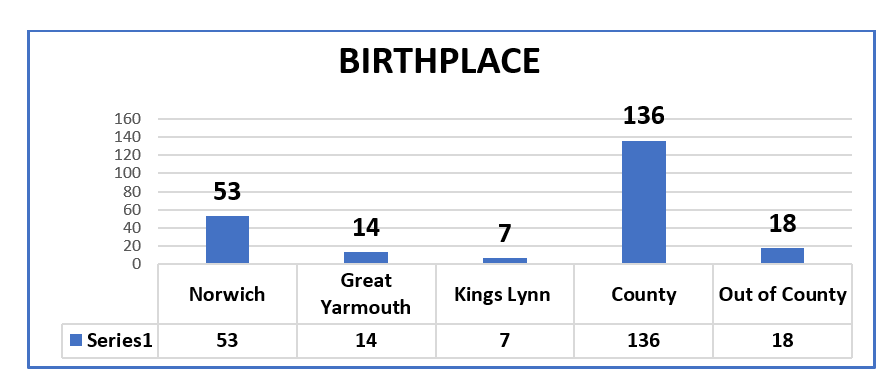
Of the 18 not born in Norfolk four came from overseas; one from India, one from the USA, one from Canada and one from New Zealand.
Age
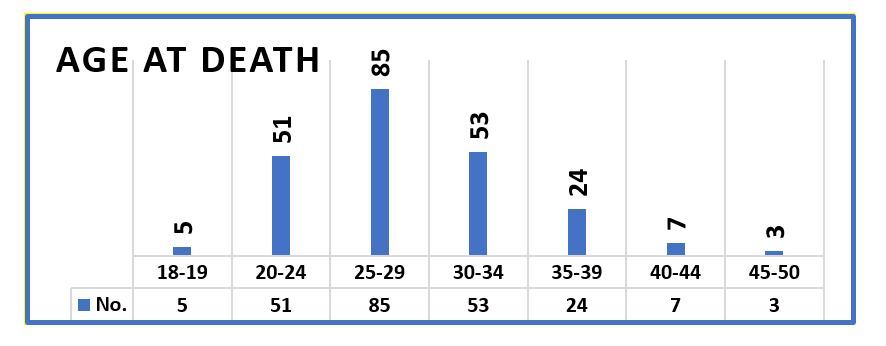
With few exceptions these were all very young men.
Rank and Service Number
64% of the men were at the equivalent rank of private and almost all were serving in the Army. They belonged to many different regiments and, within that, battalions, companies and brigades. Just 30% were in the Norfolk Regiment.
The period between a soldier making his will, his death and the will being proved ranged from months to years. Therefore it was inevitable that by this time some soldiers had changed rank, regiment or battalion.
Cemeteries and Memorials.
The CWGC has over 2500 designated WW1 cemeteries and numerous memorials as well as solitary headstones in various cemeteries. These 228 men are commemorated in one of 110 cemeteries or commemorated on one of 18 memorials. Some memorials do not belong to the CWGC such as the Chatham Naval Memorial. Of the 145 with an actual grave just 68 have an inscription. Many are simple and often biblical.
Wives and Sweethearts
What happened to the wives and sweethearts left behind? 60 were married and 24 named their sweethearts. The 1921 census reveals that 14 widows had remarried.
Cause of death.
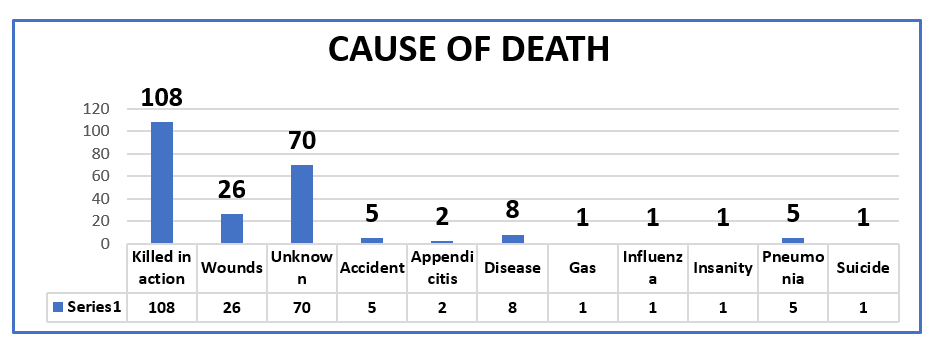
Without further research the cause of death for 70 of the men is unknown. Those reported as missing were later reported as KIA on the day they went missing.
Cause of Death- Insanity
Harry John Mason was one of the three oldest men. At first glance his will is simple and straightforward but his story is not.
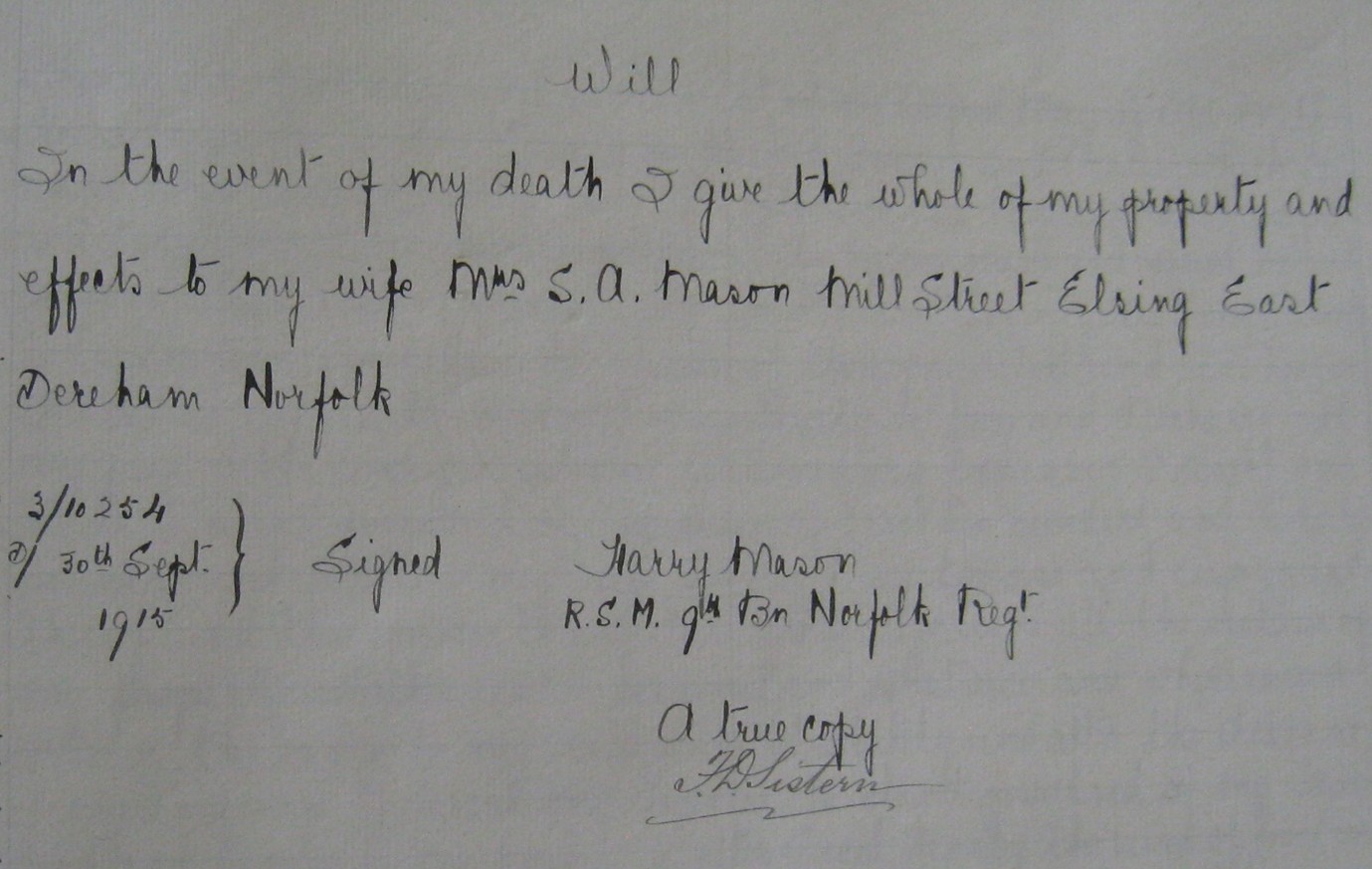
Harry had previously been a military provost and became a Regimental Sergeant Major in the Norfolk Regiment when war broke out. He went to France for a few months where he made his will. In 1916 Harry went to Deolali military camp in India and took his wife Sarah and 4 children with him. Deolali was a large transit camp connected to the port of Mumbai, it held POWs and had the 34th Welsh General Hospital military hospital. It was renowned for soldiers having to wait a long time to be shipped home and conditions in the camp were poor. Disease at Deolali was rife as was syphilis.
Syphilis can lead to a condition called GPI – general paresis of the insane. The prevalence of insanity at Deolali led to the term “going doolally”. Harry was admitted to hospital in June 1917 with GPI. Deemed unfit for military service he came back to England ending up at the asylum in Hellesdon, Norwich where he died in July 1918 at the age of 46. Despite dying in Norfolk it took 4 years for his will to be proved at Norwich Probate Court.
Cause of Death Suicide
William Thomas Steverson is the second oldest man and was 49 when he died and well beyond the conscription limit of 41. His Campaign Medal Record tells us he took his own life while at sea on 8 September 1918 just weeks before the Armistice. He was a Private in the Army Service Corps in Dar Es Salaam, the chief sea base for movement of supplies and evacuation of wounded. We do not know the circumstances that led William to take his own life.
Teenagers
The five youngest men were only teenagers. They were all Norfolk boys, four were Privates in the Army and one a 2nd Lieutenant in the RFC/RAF.
Myer Joseph Levine was the youngest, just 18 when he died. (NRO, PRDR 2/180, will 413)
On his 18th birthday, 10 September 1917, Myer joined the 53rd Training Squadron of the RFC in Stamford. He was killed in May 1918 when his plane collided with another over Stamford. He is buried in the Jewish section of Earlham cemetery close to his brother Cyril.
Cause of Death- Accident
Four other men died by accidents, all caused by British aircraft. These were the early days of aerial warfare. Three were in the RFC/RAF but William Pegg was not.
William (NRO, PRDR 2/181, Will 610) enlisted in December 1914. He was a Sergeant in the Army Pay Corps and later a 2nd Lt in the Royal Warwickshire Regiment. He was wounded at La Bassee, France in September 1918 and came back to England to convalesce at Caythorpe Court Convalescent Hospital in Kesteven, Lincolnshire. The hospital was adjacent to North Rauceby airfield, RAF Cranwell today.
On 18 March 1919, while still convalescing, William and a fellow officer Robin Dunn, went out in a pony and trap. As they approached North Rauceby they were hit by the wheels of a swooping aeroplane and killed. The aeroplane flew off and the pilot was unaware of the incident until he landed. William is buried in Overstrand churchyard.
Battles
The data identified those who are commemorated in the same place and their dates of death. From this we can identify groups of men who may have come from different backgrounds, regiments etc. but shared common experiences in the last moments of their lives. The main four cemeteries and memorials commemorating 49 of our 228 men; these are Arras, Thiepval, Tyne Cot and Ypres (Menin Gate).
The Royal Navy
Only 6 of the 228 served in the Navy. Lieutenant Commander Ralph Michael Mack came from the Paston family at Paston Hall, North Walsham.
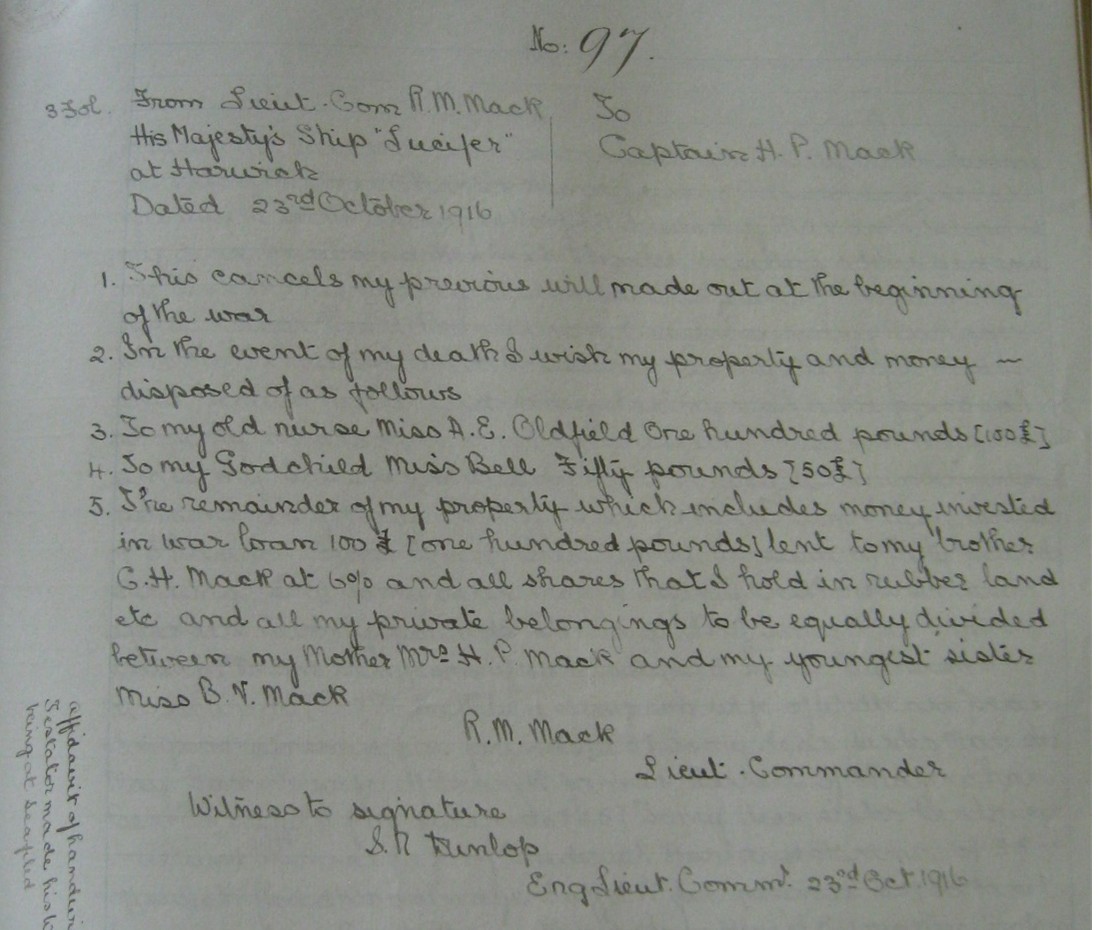
Ralph was a professional Navy man. In November 1917 he became commander of HMS Tornado which was part of the Harwich Force protecting merchant shipping off the coast of Holland. On 23 December 1917 they were close to the Maas light buoy waiting for a convoy to arrive. Unbeknown to them the Germans had recently heavily mined the area and they sailed into this minefield. HMS Torrent sank first then HMS Surprise. Mack’s ship tried to free itself but struck two mines and sank immediately with only one survivor. A 4th destroyer, HMS Radiant, avoided the carnage and returned home with the survivors.
Prisoners of War.
Five men died as prisoners of war. Claude Borrett was from Canada, he was educated in Norwich and lived in Great Yarmouth with his wife Nellie. (NRO, PRDR 2/185, will 38). On 22 March 1918 during Operation Michael, the German Spring Offensive, he was shot in the abdomen at Guise and taken prisoner. He died 3 days later and is buried at Guise (La Desolation) French National Cemetery, Flavigny-le-Petit, a cemetery used by the Germans. His wife Nellie never remarried.
Where next?
Details on this spreadsheet are available on request. This blog has given some indication of the many areas of research these wills can lead to. You may be related to one of these men. They may come from where you live. Your interest may lie in Regiments or battles. The documents held at the Norfolk Record Office can be used to help make sure these 228 men – and thousands more besides – are not forgotten.
Researched and complied by Daryl Long, NRO volunteer



what a fascinating blog. Is it possible to publish a list of the names?
LikeLike
Hi, they will eventually be included in our online catalogues.
LikeLike