
Norwich has been a city associated with rebels and radicals for centuries. Whether against the King, the Church or the Government, Norwich has always immersed itself in local and national movements of riot and rebellion. It is therefore not surprising that 100 years ago Norwich was involved in the largest strike in British history – the 1926 General Strike.
Throughout the Nineteenth and into the Twentieth Century, industrial tensions escalated alongside the development of working class labour movements. By the end of the First World War, coalminers suffered from wage cuts due to reduced coal exports which culminated in an increased number of strikes. While the Government agreed to a nine month subsidy in 1925, industrial tensions peaked again when coalmine owners announced longer hours and less pay. Unable to reach an agreement, the Trade Union Congress urged all its members across all industries to engage in a “General” sympathy strike with coalminers, beginning at one minute to midnight on 3 May 1926.
Rallying the Troops
At the annual May Day festival held on 2 May, some eight to ten thousand people attended a Labour Party-led city centre rally. Gathering at the Cattle Market, trade unions marched with banners to the market place where Labour politicians Walter Smith and Dorothy Jewson made speeches warning workers of next week’s uncertainties.
However, it was sooner than they thought. On 3 May, Norwich members of the National Union of Railwaymen met at Keir Hardie Hall in anticipation of the strike that was called later that evening. It was reported that workers agreed “to cease work” and “act on further instructions received.”[1] By the next morning, some 2000 railwaymen joined the picket and were later joined in sympathy by Norwich tram workers. In their report of activities, the TUC noted that members of the Railway Clerks Association, Building Trade workers, Bricklayers, Sheet Metal workers, Wood workers, Printing and Paper workers, Stereotypers, Lithographers and several other allied unions had also joined the strike.[2]
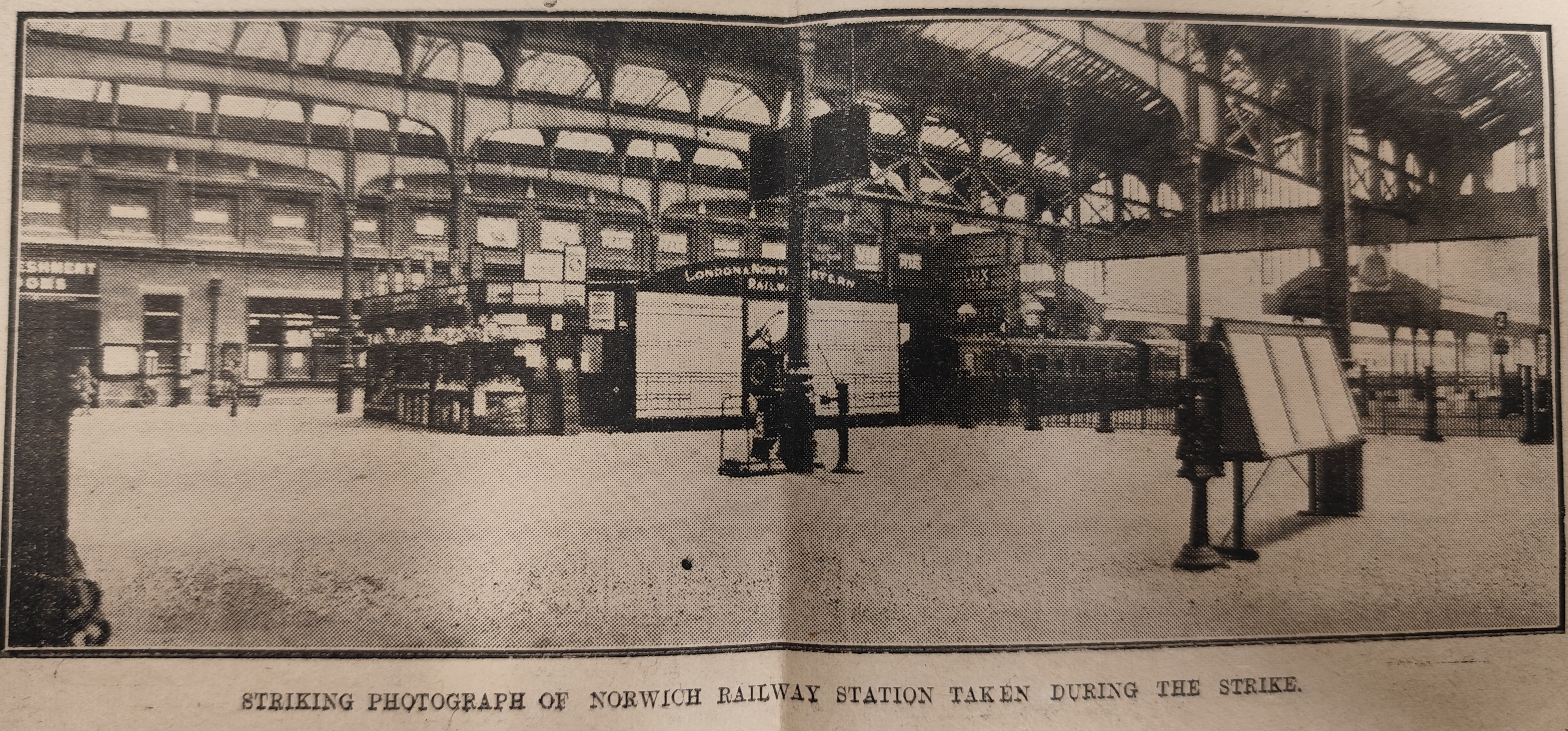
After calling the Printing Unions to strike, newspapers across the country (including Norfolk) ceased operations. While printers for the Norfolk Chronicle and Norwich Mercury remained at work and printed as normal, the Eastern Daily Press and Eastern Evening News were forced to reduce their papers to small bulletins or a one sided sheet, usually displayed in shop windows. With transport workers on strike too, there was a lack of raw materials and fuel being brought into Norwich factories, forcing managers to temporarily cease work. Consequently factories run by Caleys and Colmansstruggled to operate. A few days into the strike it was reported that up to 1500 workers had “become idle” by the closure of a number of mills at Carrow Works.[3]
Similarly, the 12,000 workers in the Norwich shoe trade also faced uncertainty with the lack of supplies. While it was hard to obtain leather, members of the National Union of Boot and Shoe Operatives in Norwich were still working as usual until they were eventually asked to work half-days by 13 May.[4]
By 8 May, the government-led paper British Gazette, estimated 3000 Norwich workers to be on strike across the city, although TUC reports claimed as many as 4500.[5] While this is just a fraction of the total workforce of Norwich, it was enough for anti-strike volunteers to take to the streets.
The Anti-strikers
While thousands of Norwich workers went on strike, others in the community did not share their sympathies. Created in 1925, the government-led Organisation for the Maintenance of Supplies (OMS), called for a volunteer force to assume the work of strikers. At the outbreak of the strike, the group had already registered around 100,000 volunteers nationally, made up of mostly young middle-class men. The OMS continued to gain volunteers over the course of the strike and by the end it claimed to have had over 500,000 recruits.
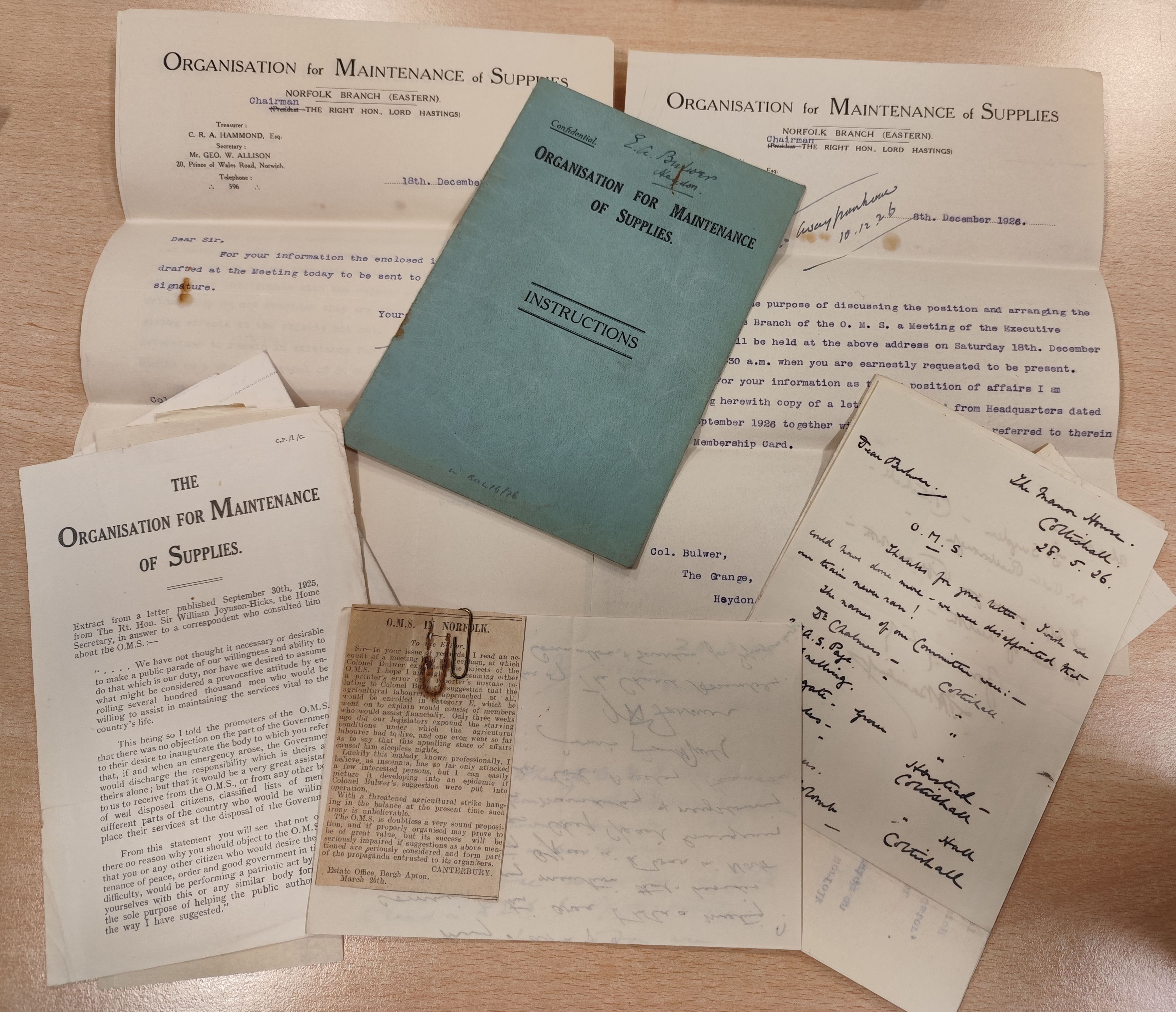
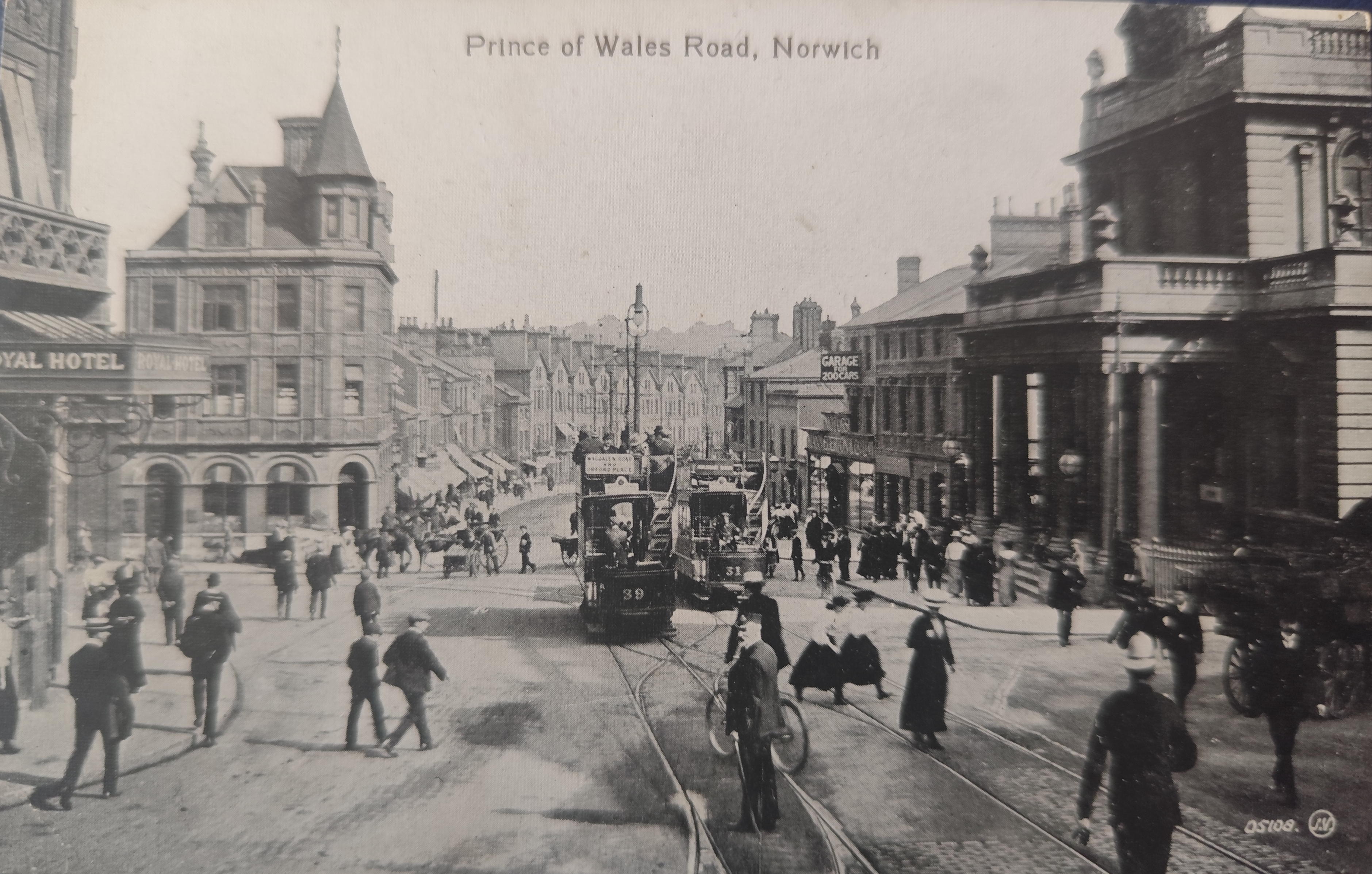
In Norwich, the OMS established their headquarters at the Agricultural Hall on Prince of Wales Road. By the end of the strike, its Chairman, Herbert P Gowen (later Lord Mayor 1928-9), claimed there had been a “steady flow of volunteers each day” suggesting that Norwich “compared favourably with all the big centres” as there had been more applicants than available work.[6] With a large number of volunteer train and tram operators, lorry drivers, canteen workers and shorthand typists, the response from the nation was, according to the Government, “particularly good.”[7]
While 100% of Norwich railwaymen were reported to be on strike, volunteers continued to operate LNER train services to London on a reduced schedule of two per day. Meanwhile, a Prince of Wales Road motor firm seized the opportunity and “advertised the commencement of a service of motor coaches to and from London.”[8] Matching the increased use of motor cars, the Michelin Tyre Company temporarily used the Bell Hotel for the sale of cars and car parts.
In the skies, light aircraft “rendered assistance in solving the transport problem.” In order to deliver freight across the country, “a temporary system of inland airways to meet urgent demands was put into operation.” This included the civilian aerodrome at Mousehold Heath which became an important airport during the strike.[9]
By 10 May, nearly all tram and bus services were running as normal due to OMS volunteers and 200 Special Constables who were enrolled in Norwich for the “protection of volunteer workers” at whatever the cost.[10]
Strike Day – 9 May 1926
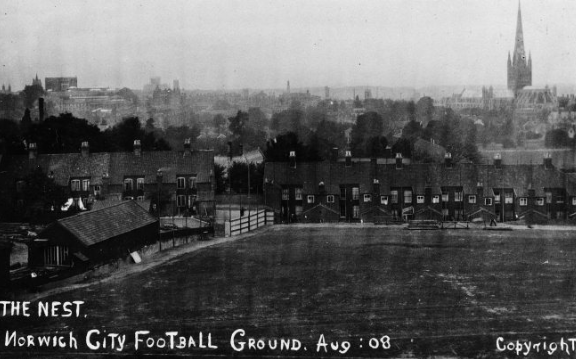
The biggest meeting of strikers occurred at the Cattle Market on Sunday 9 May, when some 10,000 trade unionists gathered with their wives and children. Men who had not been members of any union also “downed tools” to strike in sympathy.[11] The Norfolk Chronicle later suggested that “the members of the different societies assembled under their respective banners” and “went by way of Tombland and Bishops Bridge to the Nest” which had been offered as the strikers headquarters by the Norwich City Football Club. There, prominent TUC officials and Labour politicians (Thomas Mardy Jones, Walter Smith and Dorothy Jewson) delivered speeches in “demonstration of their solidarity.”[12] While the Nest became a base for strikers, activities still occurred across the city. When the strike was called, the TUC assigned General Strike Committees to arrange “meetings of all kinds” to be held “at street corners and public halls” for “educational purposes on the strike.”[13] On the evening of 8 May, the Castle Gardens was used as a meeting place for around 500 people in support of the strikers. According to the Norfolk Chronicle, there was “an atmosphere of seriousness” but “a marked absence of enthusiasm.”[14]
Violence and Peace
At the commencement of the strike, the Government assumed the country was on the brink of a civil war. Expecting large riots and violent outbursts, they ensured maximum police presence, OMS special constables and even the armed forces who were on standby in armed vehicles across major cities. Over the course of the strike, buses and trams were overturned and violent clashes broke out nation-wide, resulting in only a few recorded injuries but over 9000 arrests. In Norwich, events remain relatively calm. However, on 8 May a group of “women strikers” decided to “hiss” at a lorry driver delivering a load of beer to a restaurant on White Lion Street.[15] Violence in Norwich ‘peaked’ a few days later when a small group of strikers reportedly threw stones at OMS workers at the Silver Road tram sheds.[16]
Meanwhile, there were many friendly interactions between the police and strikers too. In London, football matches were set up between both sides of the picket to increase the morale of strikers. In Norwich, an Entertainment Committee was created to arrange concerts and athletic events for those on strike. Notably, the Nest was used for sporting contests between strikers and police which led the Strike Committee to comment on the relationship as being of “most amicable character.”[17] Additionally, on Sunday 9 May, a united intercession service was held at St Andrews Hall that brought together strikers and OMS volunteers in a moment of worship and peace. Reflecting the Lord Mayor’s comments on the strike, the Norfolk Chronicle exclaimed that “Norfolk had behaved itself and it was proud of it; for with the exception of a very few isolated instances there was not the slightest rowdyism.”[18]
End of the Strike
The strike lasted for just nine days, officially ending on 12 May, when almost all sympathy strikers returned to work. Although some firms in Norwich were only on strike for a few days, some remained out of work until the following week. However, both nationally and locally, normality had mostly returned. By 15 May, the EDP was printing daily again and the usual LNER train services between Norwich and London resumed.
Nationally, miners sought “not a minute on the day, not a penny off the pay” and remained on strike until November 1926 when they were forced back to work without any success. The following year, the Trades Disputes Act was passed which banned mass picketing and sympathy strikes for the next two decades.
The General Strike saw over 1.7 million workers across all industries protest in sympathy with coalminers. As the largest strike in British history, historians agree that it was widespread and its impact could be felt in the far-reaching corners of the country. While events in Norwich were less severe than in other cities, the turnout of 10,000 Norwich citizens on 8 May revealed their support for the coalminers of Britain.
Researched and written by Reuben Harvey
[1] The Yarmouth Independent, 8 May 1926.
[2] Norfolk Chronicle, 13 May 1926.
[3] TUC, Report of Activities in Norwich, May 1926.
[4] Norfolk Chronicle, 13 May 1926.
[5] TUC, Route Report: Norwich, 8 May 1926. http://www.unionhistory.info/generalstrike/Display.php?irn=5001419&QueryPage=../AdvSearch.php
[6] Norfolk Chronicle, 10 May 1926.
[7] TUC, Report of Activities in Norwich, May 1926.
[8] Norfolk Chronicle, 10 May 1926.
[9] Eastern Daily Press, 21 May 1926.
[10] OMS INSTRUCTIONS, Norfolk Record Office, BUL 16/76, 705X5.
[11] Norfolk Daily Post, 11 May 1926.
[12] Norfolk Chronicle, 12 May 1926.
[13] The Yarmouth Independent, 8 May 1926.
[14] Norwich Mercury, 8 May 1926.
[15] Norfolk Chronicle, 13 May 1926.
[16] British Gazette No.4, 8 May 1926. TUC, Report of Activities in Norwich, May 1926.
[17] Eastern Daily Press, 4 May 1926.
[18] TUC, Report of Activities in Norwich, May 1926. http://www.unionhistory.info/generalstrike/Display.php?irn=5001312&QueryPage=../AdvSearch.php



A big thank you to Reuben Harvey for such a great article on Norwich’s actions in that Great Strike. It certainly helps out social perspective in our ancestors lives for that period.
Nan Bailey SE Queensland, Australia
LikeLike