This Thursday is Saint George’s Day, an event with special connections to Norwich. George is known from his legend as the dragon-slayer, but almost nothing is really known about him, except that he was martyred for his Christian faith by the Roman emperor Diocletian in Lydda (now Lod in Israel), sometime around AD 300. He was probably a soldier in the Roman army, but even this is not certain. The story of his dragon-slaying became an immensely popular one in Christian art throughout Europe over the centuries.
The story of Saint George was known in Britain from Saxon times, but it became immensely popular after people heard it while on crusade in the Holy Land. George became so highly regarded that he eventually replaced King Edward the Confessor and King Edmund as England’s patron saint. Ironically, a man who had no connection whatever with England replaced two English kings as the country’s patron and his feast day has become associated with the celebration of ‘Englishness’.
George became especially celebrated in Norwich, sometimes being thought to be patron saint of the city. Two churches in the medieval city were dedicated to him: St George Colegate, and St George Tombland. Images of him and of the dragon appeared in these churches and in other city churches as well: there is still a magnificent mid fifteenth-century wall painting in St Gregory, showing George killing the dragon.
The gild of Saint George was founded in Norwich in 1385, and its records survive in the city archives (NRO, NCR cases 8e-g and 17b). Each member subscribed a farthing a week. In the case of a member falling into poverty, that person would be given eight pence a week, but the main intention was to raise money for an image of Saint George. Within a generation, the activities of the gild extended to having a procession on Saint George’s Day, in which a rider dressed as George fought a man in dragon garb. This began at least as early as 1420 and continued for the next 120 years.
One part of the English Reformation of the 1530s and 1540s was the abolition of gilds. The gild of St George was the only one in Norwich that was not dissolved: this was because of the special powers it had obtained by having a royal charter of 1417. However, in 1548, the title of the organisation was changed from St George’s gild to the Company of St George. Another aspect of the Reformation was the belief that the saints should not be portrayed: this led to the destruction of much stained glass and other images of the saints, including the defacing of very many rood screens in Norfolk parish churches.
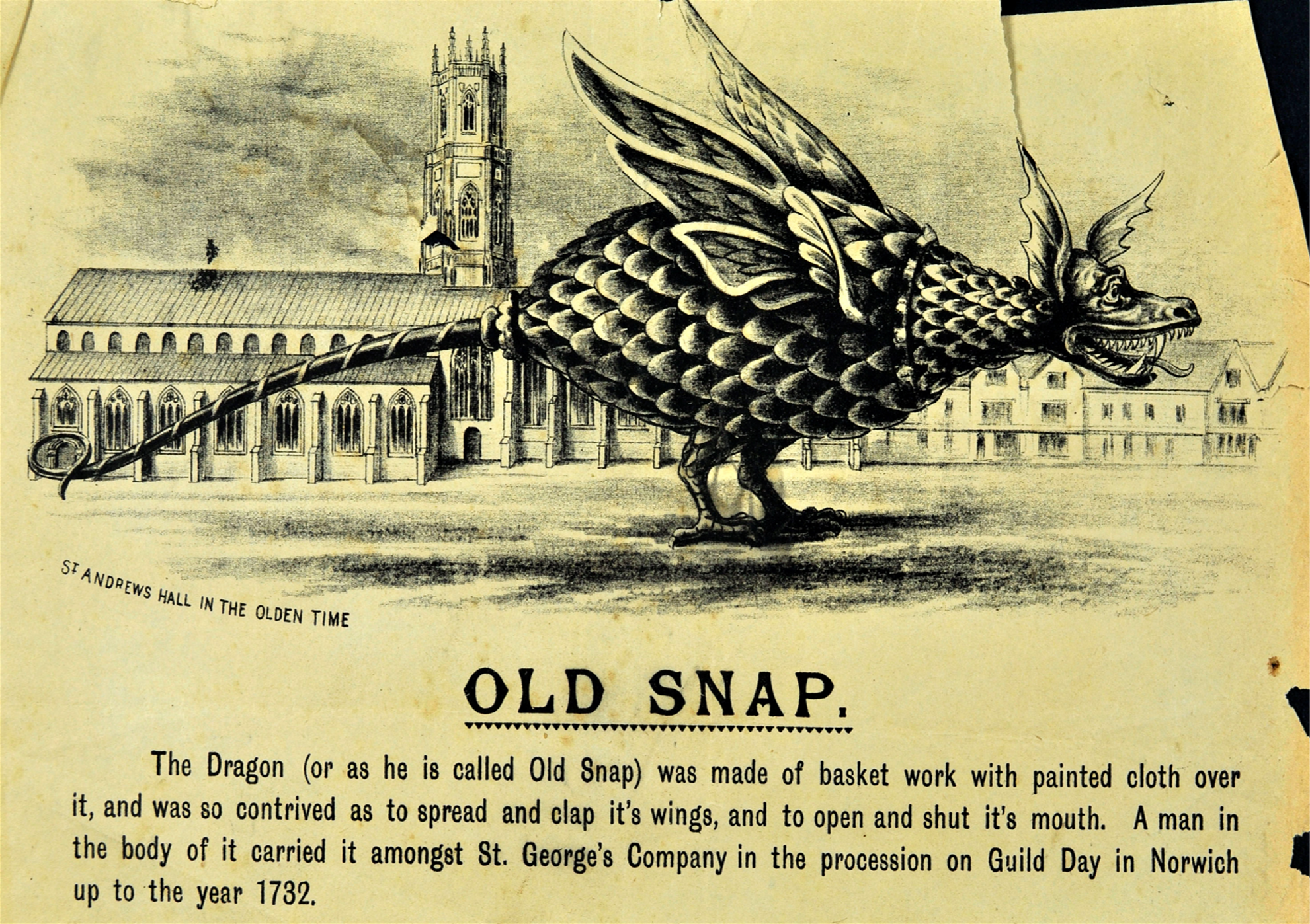
The new Company reflected this trend: in 1552, it was ordered George would no longer appear in the procession, ‘but for pastime, the Dragon to come and show himself in other years’. This is the origin of Snap the Norwich dragon who appeared in mayoral processions down to 1835, and who can still be seen in the Castle Museum. Unlike in the legend, in Norwich, it was the dragon who survived, rather than Saint George!
Taken from article originally for the Eastern Daily Press, by former archivist Frank Meeres