The diaries of William J. Dennis from 1940 give a vivid glimpse into the life of a queer man in wartime Norwich. These diaries record Dennis’s sexual experiences with men in detail, making them a rare and fascinating source for LGBTQ+ history.
Dennis was born in 1909 in Norwich, and followed his father into shoe manufacturing. By the time the diaries were written in 1940, Dennis was working at the Bally and Haldenstein factory. He lived with his parents and his brother Herbert at 182 Beaconsfield Road, between Magdalen Road and Mousehold in the northern part of the city.
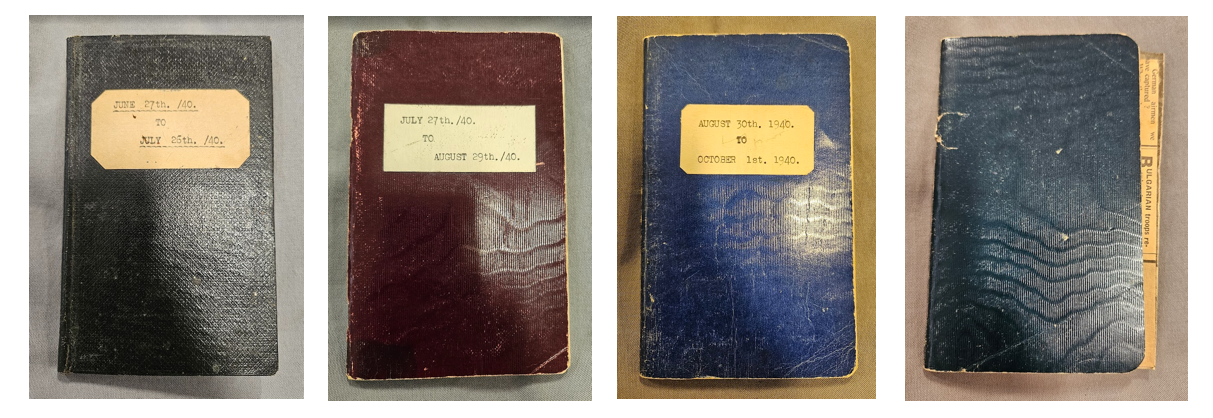
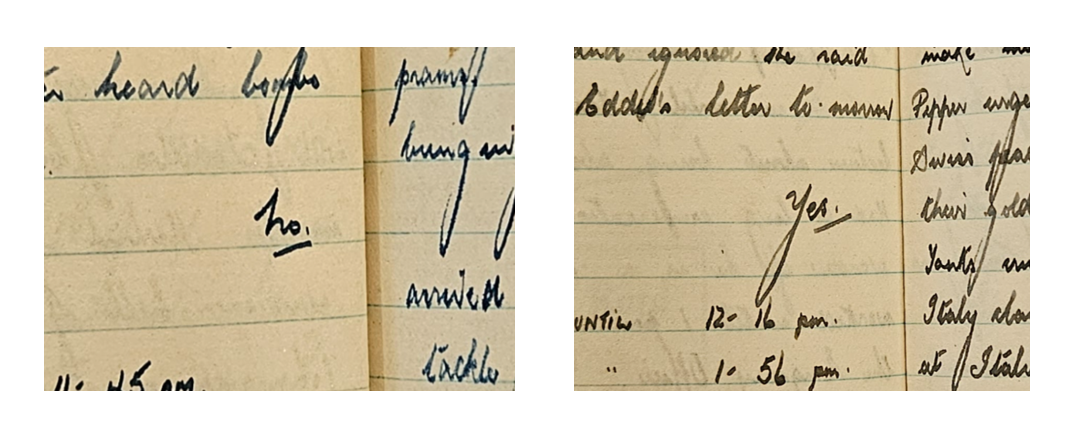
Most of the entries follow a standard format. Dennis begins by outlining the events in his day, chiefly relating to work and his personal life, but often describing local events to do with the war. In the following section of each entry, Dennis would summarise the news from the press, tracing political and military events abroad. At the end of each entry, Dennis would write ‘Yes’ or ‘No’. When first reading the diary, it’s not immediately apparent what Dennis means by writing ‘Yes’ or ‘No’. Close reading of the diaries reveals that this was Dennis’s way of recording whether or not he’d had an orgasm that day (on his own or with a sexual partner). Most days ended with ‘no’. He also used the word ‘reading’ to describe masturbation. This code was at times subtle and elegant, obscuring embarrassing references should anyone catch a glimpse of the diary. But it must be said, for anyone reading more closely, the code hardly obscures anything, as on 8 August, when Dennis wrote that he ‘“Read” twice this morning in bed’.
Dennis mostly had sex with younger men and boys in their late-teens. Many of them worked alongside Dennis in the shoe factory. Dennis records having sexual encounters with ‘the boy behind the air raid shelter’, Jack ‘the boy in the enquiry office’, and Pete ‘the office boy’. But Dennis was not exclusively interested in boys, as revealed by cross-referencing the diaries with the 1939 Register, which was effectively a full census of England and Wales undertaken as the war began, and of course less than a year before the diaries take place (from an ethical and data protection perspective, it’s worth noting that every person appearing with an unredacted name in the 1939 Register is now deceased).
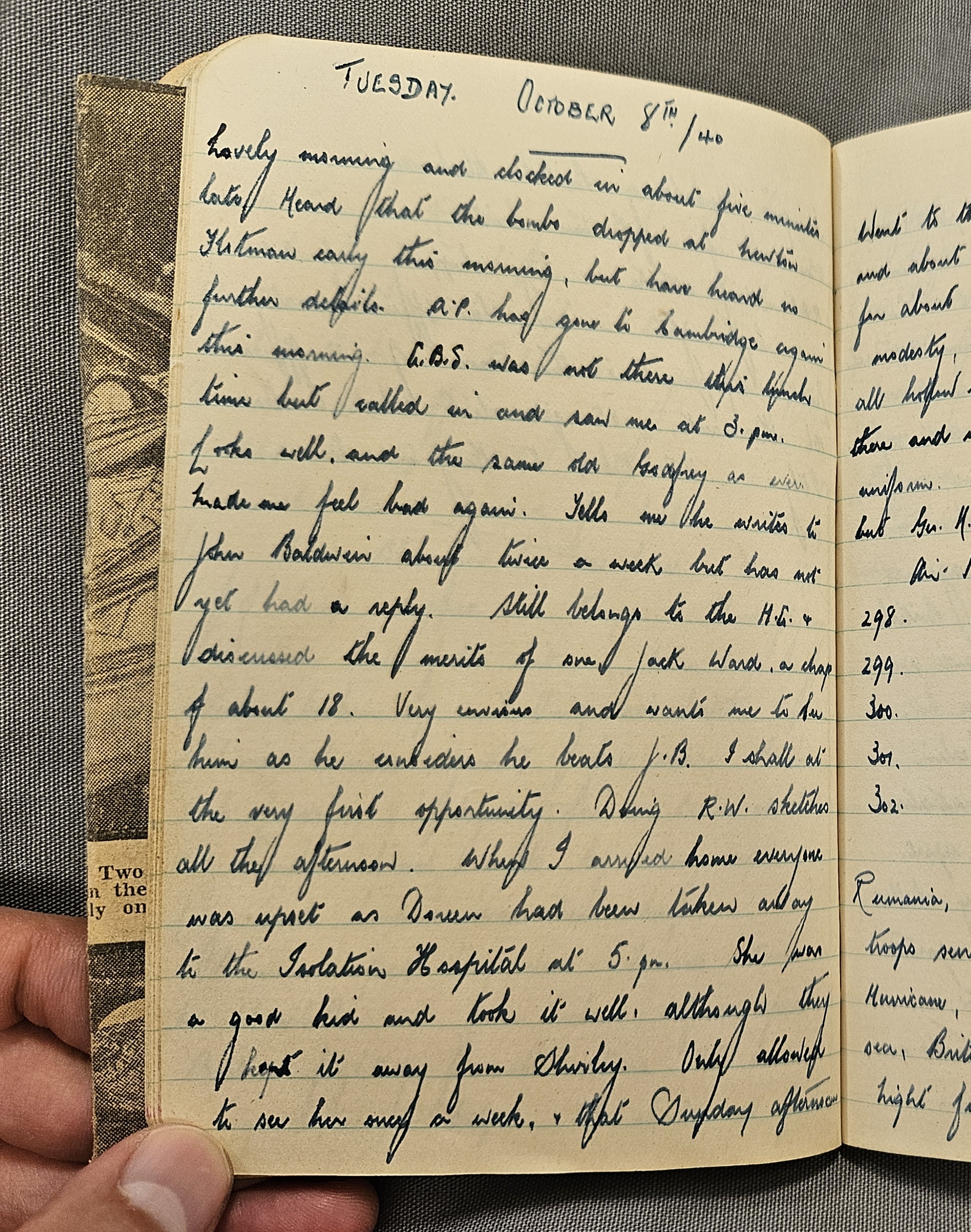
We can identify some of the characters from the diary with some certainty, and thus the age, occupations, and marital status of the men Dennis knew. Dennis had sexual encounters with a man called Charlie Pye several times: Pye, who was married, worked in the pattern department of the shoe factory and was 37 years old, six years Dennis’s senior. One of Dennis’s long-term sexual interests was John Baldwin, who was even older at 51 years old at the time the diaries were written (though he was at that time a prisoner of war, causing Dennis much anxiety). Linked to Baldwin was a mutual friend, Godfrey Symonds, who occupied much of Dennis’s attention through the course of the diaries. Symonds was 17 years old in 1940 (if I’ve identified him correctly in the 1939 Register). Dennis, Baldwin, and Symonds seem to have had shared interests in meeting new men for sex. In his entry for 8 October, Dennis wrote:
[Symonds] tells me he writes to John Baldwin about twice a week but has not yet had a reply. Still belongs to the H[ome] G[uard] + discussed the merits of one Jack Ward, a chap of about 18. Very envious and wants me to see him as he considers he beats J[ohn] B[aldwin]. I shall at the very first opportunity.
Read in context with the rest of the diaries, it’s possible that Ward ‘beat’ Baldwin because of the size of his penis. This reference and others lead us to speculate that Dennis’s sex life centred on the search for well-endowed men and boys. It’s apparent that Dennis wished a larger penis for himself, as suggested in his entry from 28 August:
Saw Harry Bowles this afternoon (no. 2) and again at 5.25 with no interruptions. (Yes. no 3 this time) Its marvellous and I envy him his pride of it. Tells me that his old school friend Mr Larkin can beat him hollow – something I should love to prove.
Dennis completes this diary entry with ‘no’, which means that Dennis did not have an orgasm that day, suggesting that he only watched or masturbated Bowles. In this context, the code could refer to Dennis’s sexual partners.
The diaries are intriguing, and give such a rare glimpse of queer life in the 1940s. Doing this kind of history, you get very used to euphemism and the shadow of legal persecution against LGBTQ+ people: you get used to the pathologisation of queer people by medical authorities, and all the shame and anxiety that come with it. Dennis’s diaries are refreshing for their openness. One isn’t left with the impression that Dennis felt constrained in expressing himself sexually: he doesn’t seem at all ashamed of himself. There’s an honesty to these diaries that you don’t usually see in this period. Either Dennis defied the homophobia of his time, or he was simply unaware it. In either case, the diaries of William J. Dennis give a remarkable perspective on the queer past and stimulate responses to the most foundational questions of LGBTQ+ history.
Researched and written by Piers Haslam