
Researched and written by Christine Shackell
The parish of Guestwick lies between Fakenham and Aylsham in north Norfolk. In 1831 the census recorded that there were 37 houses with 188 inhabitants.1 It comprised a scatter of cottages and farms with a large parish church dedicated to St Peter at the centre and a Congregational chapel which had existed since the middle of the seventeenth century. Surrounding parishes were equally sparsely populated and rural. The 1830s were times of economic distress in agriculture.2 The overseers’ accounts for Guestwick3 show increasing amounts being paid via the poor rate to support unemployed agricultural labourers and their families. Further documents provide an example of a different solution to the increasing expense to the ratepayers and landowners who had to fund the poor rate, that of emigration to the British colonies.4
The Norfolk Mercury of 12 April 1832 reported: “The mania for emigration to America seems to increase rather than diminish. Two more ships are now advertised for that destination, Syren and Miser, both coppered vessels which we think will not be sufficient to take all the passengers from this place.“ Both ships sailed from Yarmouth in May 1832 with about 100 emigrants each on board. The colony they were heading for was Quebec, then part of British North America. Many thousands funded themselves but in 1833 the Colonial Land and Emigration Commission was set up to manage programmes of emigration to the colonies. Emigrants could qualify for free passage if they were of good character, under 40 years old and had been vaccinated against smallpox; agricultural workers were particularly sought after. Workhouse inmates and those in receipt of poor relief were excluded from the scheme as they were blamed for their plight as being “idle” and therefore not suitable workers for the colonies.5 However, many parishes funded their own emigration schemes.
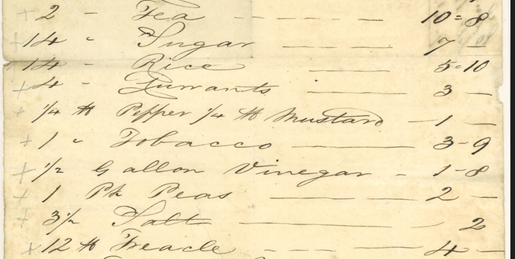
In May 1832 the Long family from Guestwick had their passage and expenses paid to emigrate. The total cost of the family’s emigration seems to have been borne by three local farmers, Richard Gay, Anthony Thomas and John Soame who contributed £20 each. The costs were recorded as follows, £30 for the ship’s passage, £1 10 shillings for their journey to Yarmouth where the ship was berthed, 10 shillings for the cost of dinner en route along with carrying luggage, 4 shillings and sixpence for a pair of shoes for “Girl Long”, a bottle of rum, gin and candles. The family also needed eight weeks provisions for the voyage as, at this time, these were not provided as part of the ticket. The total cost of the groceries was £9 18 shillings and 2 pence, itemised in a separate list.
The grocery list included 3 cwt (150 kg) ship’s bread, (known as ship’s biscuits) 10 stone (63 kg) flour, 4 stone (25 kg) of prime bacon, 14 lbs (6.3 kg) of butter, 12 packets of groats (oats) along with cheese, tea, sugar, vinegar, currants, treacle and tobacco. This presumably made up the sort of diet the agricultural workers were used to. It bears a resemblance to the meals recommended for workhouse inmates by the new Poor Law Commissioners in 1834. Breakfast for them comprised bread, gruel (oats or groats cooked in water with sugar or treacle added) with tea to drink, lunch was meat with bread or vegetables, supper was bread and cheese. The Long family were also given rice, possibly to make a sort of rice pudding, and currants to add some sweetness. Peas could have been used to make pease pudding or a broth.
Who were the Long family referred to in the documents? Jeremiah, Robert and James Long were all in receipt of regular payments from the poor rate at this time. The men were brothers who had been born in the nearby village of Hindolveston, all had young families and had gained settlement in Guestwick through agricultural work. All had clearly fallen on hard times. Jeremiah was still living in Guestwick when the 1841 census was taken, therefore the most likely candidates seem to be James, with his wife Sarah or Robert and his wife Ann, along with their children.
In 1834 the Poor Law Amendment Act came into force which directed that the Poor Law Commissioners had to give their approval before the overseers in any parish could fund such emigration. Conditions were laid down such as the amount that could be borrowed and how it was to be repaid. The archives possess a document dated 16th March 1836 from the Poor Law Commissioners giving the churchwardens of Guestwick permission to take out a loan of two hundred pounds to fund such emigration6. Signatories were Joseph Pegg, George Barber and Joshua Jackson, all farmers of Guestwick. They wasted no time in securing a loan from Elizabeth Robins, a widow and her two brothers, William Cooke and Robins Cooke, both millers, as executors of the will of Elizabeth’s deceased husband, Aquila Robins, of Bayfield Lodge, near Holt.
Aquila Robins, a former miller of Gressenhall mill, had moved to Bayfield Lodge to farm in about 1823. He had died, aged 55 years, in 1833 and left his second wife, Elizabeth, with their four children, Catherine 14 years, Robina 12 years, Emma 11 years and Walter aged just four years to support. Elizabeth and her two brothers were executors of his will and empowered to “manage and conduct my affairs and business …………..for the benefit of my family.”8 His wife was to have the sole management of Bayfield Lodge farm, near Holt, which was leased. The Robins and Cooke families both attended the Congregational chapel at Briston and Guestwick as did two of the overseers Joseph Pegg and Anthony Woodhouse Ireland which is presumably how the connection was made. Further documents in the archive show that the loan was repaid with interest on the appointed dates.
Two hundred pounds is a large sum of money but we do not know how many inhabitants of Guestwick parish this funded to emigrate. Overall from June 1835 to July 1836, 91 parishes in Norfolk sent 3,068 paupers mainly to Canada at a cost of £15,198 under this scheme. By far the greatest number of any other county.5
Sources:
- 1831 census data www.visionofbritain.org
- https://norfolkrecordofficeblog.org/2022/05/07/he-will-have-the-dance-of-swing-norfolks-involvement-in-the-swing-riots-of-1830s-england/
- NRO PD 5/33 Overseers’ account book 1835-38
- NRO PD 5/21 papers regarding financing of pauper emigration in Guestwick
- www.workhouses.org.uk/emigration
- NRO PD 5/21 1 Emigration document from Poor Law Commissioners
- RG4 1344 Briston and Guestwick Independent Chapel records Burial of Aquila Robins
- NCC will register Cubitt 406 Will of Aquila Robins



A very interesting piece of social history, I hope that their descendants are thriving in Quebec area,
LikeLike
A great read Christine, thanks.
LikeLike
I always look forward to these regular blogs from the Arcive. And this article does not disapoint. It is an excellent and well reseached article backed up with data on population movements. Perhaps it could e complimented by a post exploring the reasons for the pauperisation of the rural labourers (enclosure, new farming/weaving machinery, etc.)?
Many thanks.
LikeLike