
Searching up ‘flood 1607’ on google will bring up results about the dramatic Bristol Channel Flood, in which much of the West Country was inundated, which some theorise may have even been caused by a tsunami (although this is unlikely). Even searching ‘flood 1607 Norfolk’ will bring up many of the same results. However, by searching through ancient, crinkled files of parchment and deciphering handwriting nearly unintelligible by modern standards, we can discover a shadowy flood that struck the Fens the spring of that very year.
Marshland is a now little-used term referring to the part of the Fens that lay at the westernmost extremity of the county of Norfolk. At the start of the seventeenth century, the Fens were unrecognisable from today’s expanses of grass and field, interspersed with a line of trees and a few houses. In the summer the Fens were most similar to today: the open expanses of the fertile fields provided for great cultivation, as well as grazing of livestock such as cattle. However, during the winter, the Fens, Britain’s flattest and lowest-lying landscape, would flood: great marshlands and swamp superseded the fields of summer, drowning the country of Marshland in both fresh and saltwater as the rivers and sea burst their banks. Sometimes over the bogs and waters a flickering bright light can be seen in the distance; say you are walking across the Fens at night or on a foggy morning, whistling to yourself to cheer yourself up in spite of the bitter cold, the light draws nearer. Attracted by whistling, this is the fabled Lantern Man, and it draws closer and closer, beckoning you in to guide you back home, you lost traveller, to safety; but do not follow the Lantern Man! Its light will only lead you to a watery grave, drowned and sunken in the reed marshes of the Fens. The only way to ward it off is to lay face down and suck on the mud underfoot (I think I’d take the reed beds!) and hope for the light to drift off, to torment some other traveller, or indeed the people of poor flooded Marshland.
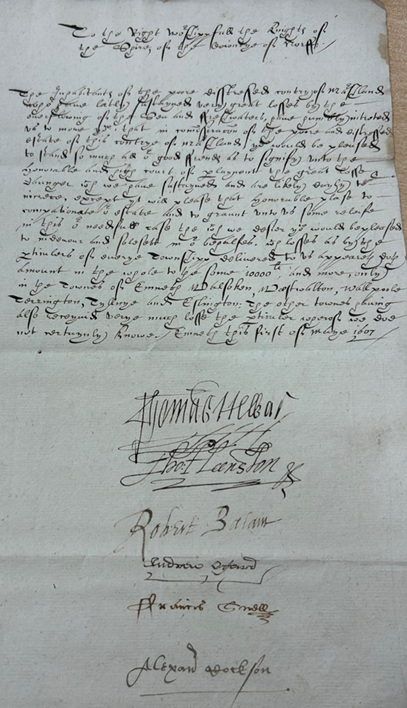
In 1607, naturally disturbed by this state of affairs, local gentlemen Thomas Hewar and Thomas Hunston reached out for relief with two letters. Hewar was a gentleman from Castle Rising who was greatly involved in the village of Emneth, in Marshland – in fact he and his father (both called Thomas) and their wives have their own ornate mausoleum in the parish church of St. Edmund in Emneth. There is altogether less information about Hunston available, but his family seem to have been established around the Marshland area just under a century at least, with documents relating to a ‘Henry Hunston, of Walpole, esq., son and heir of Thomas Hunston’ dating from 1521. Both letters were written on ‘this first of maye [May] 1607’ from Emneth. This suggests that the flood lasted over a month, as documents relating to the drainage of Marshland in this period (BL/DR7) say that ‘The Sea Bankes broke the 1st of Aprill 1607’, and the floods would not have immediately subsided once the letters were written.
In the first letter, Hewar and Hunston request that the MP for Norfolk at the time, Nathaniel Bacon, makes a motion in ‘the parlayment howse [Parliament]’ to provide aid to the people of Marshland. Bacon, known better as Sir Nathaniel Bacon of Stiffkey, was educated at both Cambridge University and Gray’s Inn, a knowledgeable Puritan who was clearly dedicated to the county – while his political career began as MP for Tavistock in Devon from 1571-1583, he also had four terms as MP for Norfolk, including from 1604-1611, as well as a term from 1597-8 as MP for King’s Lynn; on top of this, he was High Sheriff of Norfolk twice – in 1586 and 1599 – and was knighted by James I in 1604. He was clearly the man for the job.
Hewar and Hunston reference similar motions of aid being made for ‘Somersetshire, Monmothsire, of Wales, and some other parts of the west countrye’ following the Bristol Channel Flood, and argue that ‘this countrye of Marshland’ is in ‘as great and daungerous estate [i.e. in a similar condition] as the other places’. They describe in frightening terms that Marshland is ‘daylye distressed both with the ragnig [raging] of the Sea and freshwater’ and that the locals fear for their estates.
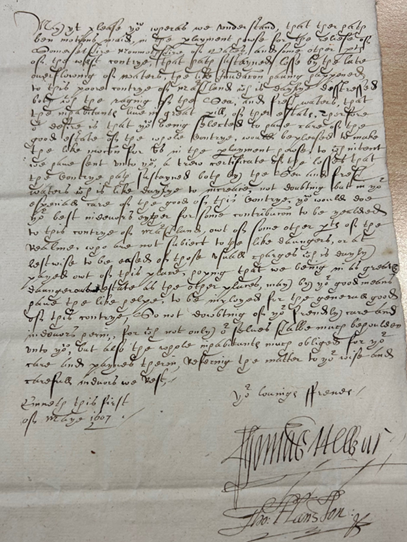
This was no irrational fear: in the second letter Hewar and Hunston, along with four other seemingly notable locals, write to the knights of the shire of Norfolk, and ask them to go to Parliament for aid, saying ‘the inhabitants who have lately sustayned very great losses… have humbly initiated us to move you [to express the conditions to Parliament]… and to graunt [grant] unto us some releife [relief]’. They describe heavy losses that add up to £10,000 (according to the Bank of England inflation calculator this is equivalent to £2,550,000 in June 2025) in ‘the townes of Emneth, Walsoken, Westwalton, Wallpoolle (Walpole), Terrington, Tyllnye [Tilney] and Eslington [Islington]’, adding that other settlements have experienced heavy losses but that the particulars of which are unknown.
It is tempting to say Hewar and Hunston are exaggerating. It is possible they did so in hopes of receiving a comparably large sum; even if none of this sum was to go into their own pockets, such a large amount of aid would allow for great improvements and compensation for the area, which would elevate Hewar and Hunston’s standing – they would be greatly respected and admired as philanthropists. However, a striking document relating to conditions described by the parson of Clenchwarton makes this lofty sum of £10,000 seem very much possible.
The document describes an application by Thomas Howes, the parson of Clenchwarton, again in Marshland, to receive relief funds. Clenchwarton, at the time, was almost permanently surrounded by water, so it must have been a horrendous place to be when the flooding came and conditions became even worse; as such the document uses almost apocalyptic imagery to describe the flooding – ‘whole estates wer [were] wholy devoured with those two furious inundations’. The document describes the damages to the parson’s estate – ‘Thomas Howes parson of Clenchwarton… sustayned very great damage and losse in his tithes, bankes, corne [corn], overthrow of his parsinage barn [i.e. the parsonage barn was destroyed]… to the value [of] £300 at least.’ That is equivalent to £76,600 today. This may be exaggerated, but in seeing the evidence provided in the list of losses, I believe it is likely accurate; when we consider that the same story would be repeated in a similar, if possibly less severe, way in all the other parishes and estates of Marshland, Hewar’s and Hunston’s value of £10,000 seems increasingly plausible.
We get further details of conditions in Clenchwarton following this. The town of King’s Lynn had decided to provide aid of £20; it appears that the expectation would be for the inhabitants of the parish to help the parson, but the town had compassion for ‘this empoverished estate and seing [seeing] little hope of helpe out of [Thomas Howes’] benefice [as] the parishioners [were] unable to forke their groundes [i.e. unable to perform any agriculture due to the conditions]’, thus deciding to contribute this small aid.
On Hewar and Hunston’s side of the story, we come to a dead-end. There are no documents I could find which explained whether or not they received their funding for the relief of Marshland, despite Bacon’s prowess and the two desperate letters sent out. But for the parson of Clenchwarton there appears to be a happier ending. What I have not yet revealed is that the document has 18 signatures, and an unclear section which appears to say ‘we allow… to be paid’, which while not clear enough to provide a value, does let us know that the signatories of this certificate have agreed to provide the parson the aid he needs. One signature is from John Atkin (‘John Atkyn maior’), mayor of King’s Lynn in 1607 and 1615. It is therefore possible that this document actually dates to 1615, rather than the flood described by Hunston and Hewar, but the National Archives website dates it to ‘c. 1607’. Even if this document does not refer to the flood that I have presented it as relating to, it still gives a fantastic insight into conditions in flooded Marshland, which would have been very similar in 1607.

The story of this obscure flood in 1607 has been very difficult to reconstruct, but what can be found paints a picture of destruction and hardship. However, significantly, this was certainly not the only severe flood that happened in the region: the aforementioned documents relating to the drainage of Marshland list another flood in 1613 that ‘drowned the whole country’ and another in 1620. The 1607 Marshland floods play into a much larger story – with frequent Fenland flooding of similar or even more severe effects the region would remain poor and continue to struggle; the potential wealth and fortune that summer in the Fens, as I described at the start of this tale, gives a glimpse of would never come to fruition if matters were to remain. Instead, a campaign of draining took place during the early modern period, with its greatest efforts taking place in the 1630s under Charles I, destroying traditional ways of life that relied on the waterways, but, by the 19th century, creating the Fens as we know them today.
Researched and written by Benedict Leeder
Bibliography
NRO Sources:
Thomas Hewar and Thomas Hunston, Emneth, to Sir Nathaniel Bacon: beg that motion be made in parliament for relief of inhabitants of Marshland for losses sustained by flood. NRO, BL/BC 6/19
Petition of inhabitants of Marshland to the knights of the sire for Norfolk: beg for relief as losses by flooding amount to £10,000. With 6 signatures. NRO, BL/BC 6/20
Certificate on behalf of Thomas Howes, parson of Clenchwarton, that he had suffered loss to the amount of £300 in his tithes, banks, corn, and the overthrow of his barn following two years of severe flooding in Marshland. NRO, PHI 622, 578X6
Documents concerning the drainage of Marshland, and 20th-century transcripts and notes. NRO, BL/DR 7
Other Sources:
Clench Warton church history https://clenchwarton-church.org.uk/history/
The meaning of later and former rains https://www.neverthirsty.org/bible-qa/qa-archives/question/what-is-the-latter-and-former-rain/#:~:text=James%205:7%20%E2%80%93%20Autumn%20and,and%20those%20who%20are%20thankful.
lantern men of Wicken Fen https://www.sarahcoomer.co.uk/post/100-ghosts-the-lantern-men-of-wicken-fen
Lantern men https://en.wikipedia.org/wiki/Lantern_man
Nathaniel Bacon of Stiffkey https://en.wikipedia.org/wiki/Nathaniel_Bacon_of_Stiffkey
Castle Rising https://oxborough.org.uk/hewars-and-hammonds-charities/ (Unclear if both Hewar’s lived in Castle Rising)
The Fens in Lincolnshire, (also apply generally to the Norfolk Fens) https://theascoughsofeastfen.weebly.com/the-seventeenth-century.html
https://theascoughsofeastfen.weebly.com/the-landscape.html
FEOFFMENT by Henry Hunston, of Walpole, esquire, son and heir of Thomas Hunston to John…Northamptonshire Archives Service, F(M) Charter/1794
Extra Reading
Even now, Fenland is at risk of flooding, but in the early modern period this was a much more frequent threat.https://www.youtube.com/watch?v=VNeO6NN46dU&t=234s
More information on the Lantern Man. https://astonishinglegends.com/astonishing-legends/2024/10/14/the-lantern-men



 Norfolk Record Office
Excellent piece, well researched & written. As a keen historian, I am always pleased to lean more & I learnt a lot from this post.
LikeLike
Thank you for posting this, I’m interested in a wet common and low fenland in East Suffolk. Not quite the same, but very interesting nonetheless.
LikeLike