
In this post we look at the history of the Norwich Lad’s Club, which was formed for the purpose
of giving many youngsters in Norwich a place to channel their natural mischievous and
energetic qualities into sport and recreations, rather than into criminal activities. Thus,
preventing crime amongst youngsters before it even had a chance to begin.
It was believed by the founder of this club, John Henry Dain, that many young boys on the
street seeking excitement felt a sense of antagonism from the police. A sense that the police
were there to suppress them and keep them under observation. The uniqueness of this Club
lies within this belief by Dain, who established the Lad’s Club and had it run specifically by the
police in a space of comfort to benefit both the youngsters and the force.
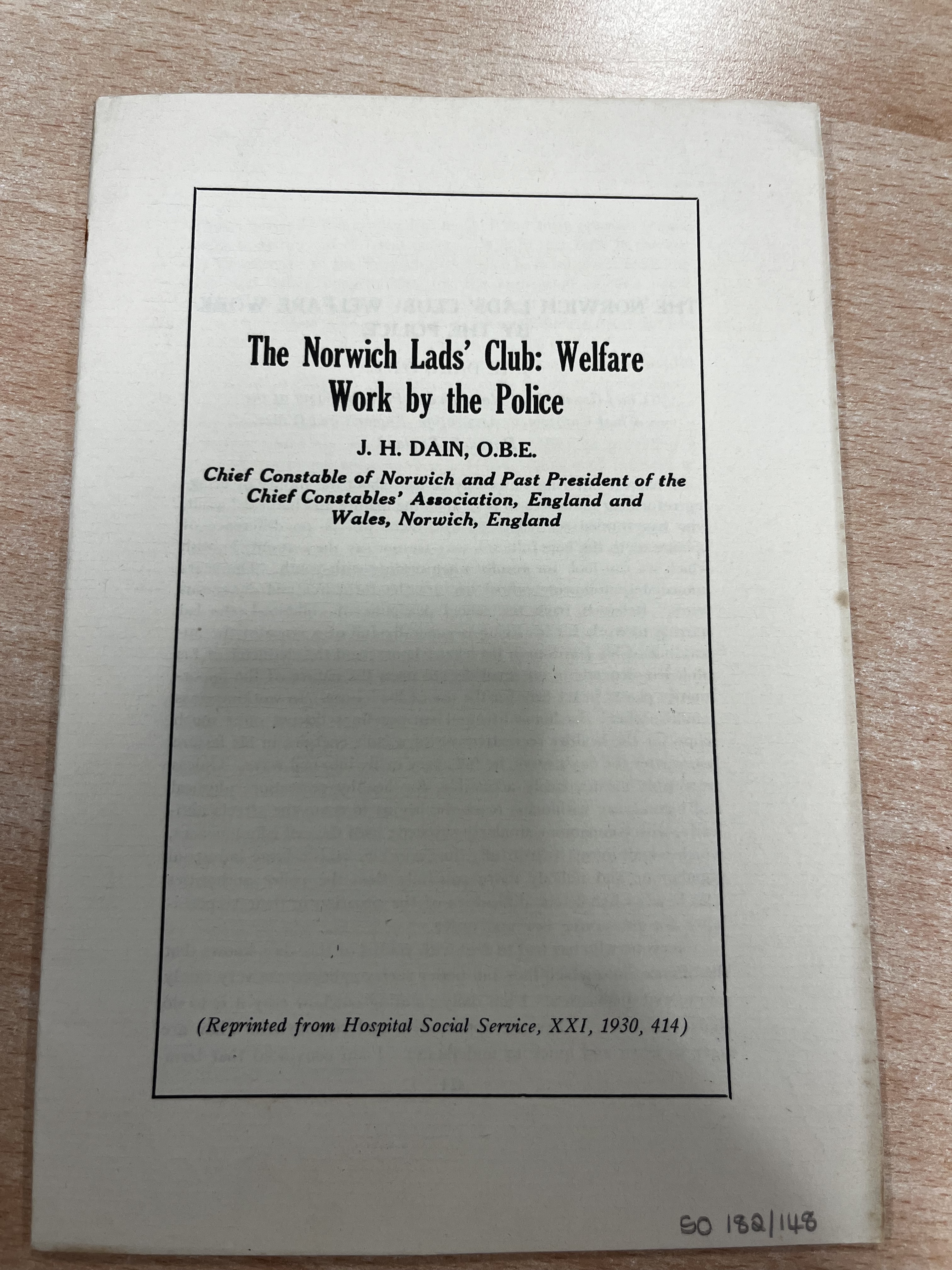
In 1988 an article about the history of the Norwich Lad’s Club was written, a task which was
completed by Robert Walker. By summarizing his account on this post, we get an in depth
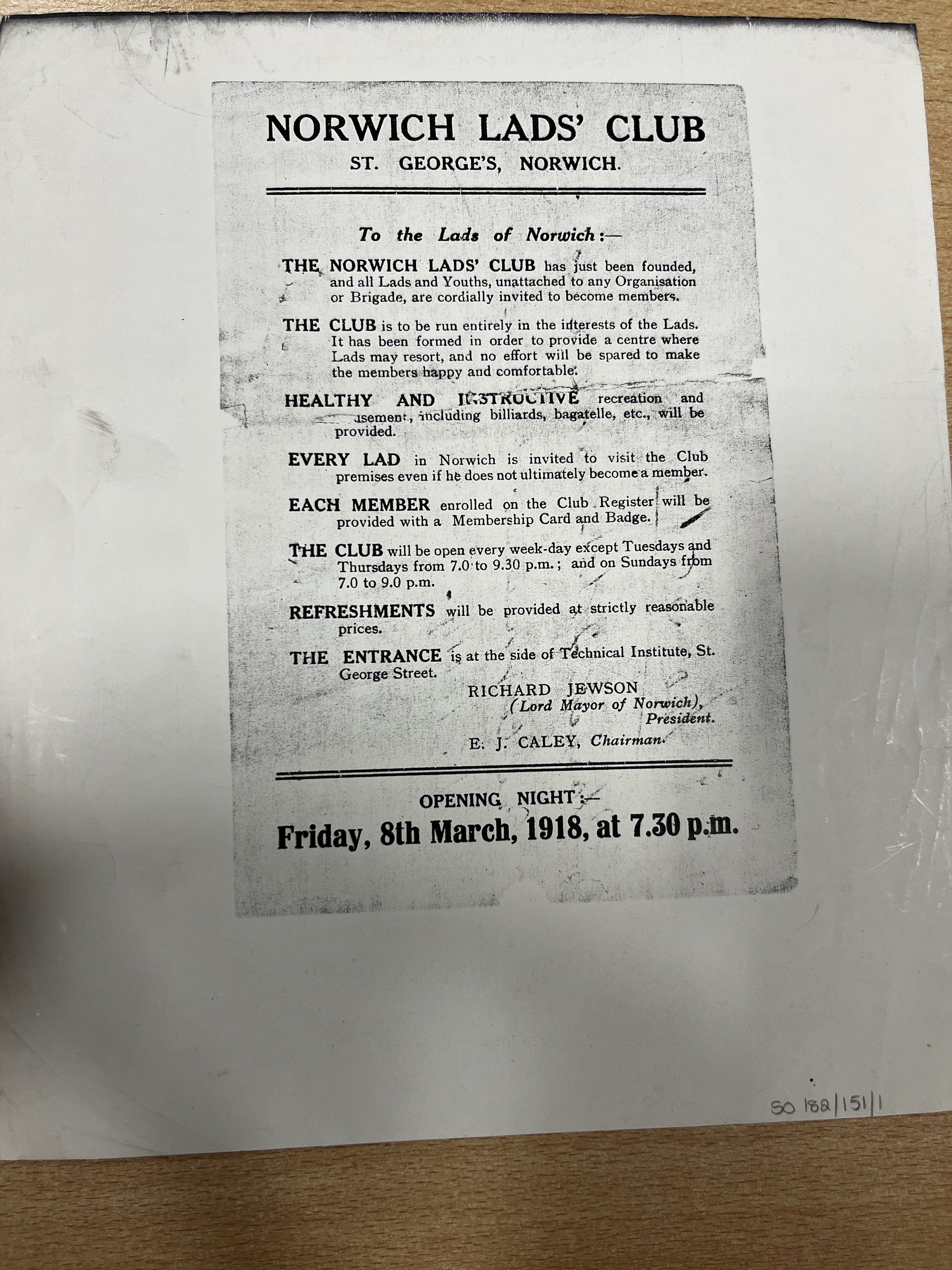
understanding of the history of the Norwich Lad’s Club. On the evening of Friday, March 8th,
1918, a group of around 30 boys stood outside the old building in St. George’s Street having
been drawn by the leaflets signed by Richard Jewson (Lord Mayor of Norwich and president of
the new venture) and E.J. Caley (the chairman). The anxiously waiting boys were promised fun
activities and games on every weekday except Tuesday and Thursdays from 7:00pm to 9:30pm
and on Sundays from 7:00pm to 9:00pm.
As Robert Walker summarised it, the two club rooms located behind the old middle school (in
St. George’s Street) were large, well-lit, and comfortable. The rooms contained three small
billiard tables, two bagatelle tables, and a variation of different table games. The Lad’s Club had
opened on March 8th ; however, the official opening came a month later by which time more
additions were made. Additions included, a Broadwood grand piano, pictures, books, and one
of the two recreation rooms and other rooms that eventually became a gymnasium. A
gymnasium that eventually became the birthplace of a thriving gymnastics team and a
legendary line of gifted boxers (NRO, SO 182/150.)
All of this was made possible due to generous gifts and donations from firms and individuals in Norwich. The building was owned by a corporation that charged only a nominal rent, which the entire Norwich police force volunteered to help. It is believed that on the opening night in March, approximately 300 youngsters applied to join and by July around 1,022 had enrolled of which 273 expressed their desires to be a gymnasts.
By the mid-1920s there was also evidence showing the success of the club in reducing juvenile
crime in Norwich. In the year from 1913 to 1919 statistics showed that just under 100 youngsters below the age of 16 were charged. A year later after the Lad’s Club was opened, in 1919 this number was halved. In 1922 the numbers were down to 12, and in the following year only seven were brough before the courts.
With the outbreak of the Second World War, however, the Lad’s Club faced major difficulties.
The most immediate issue raised was how to block out the glass roof so that activities held in
the evening could continue. Disaster struck on February 6th, 1943, when a fire broke out, which
is believed to have started in the billiard room. The new King George V Memorial Hall was saved
alongside the band instruments, and the basement which was mostly intact. The great hall,
however, which included two boxing rings, dressing rooms, stage, tip-up seating, buffet, library,
committee room, and the gymnasium were all completely burned out. Additionally, almost all
of the trophies and honours boards the Club received had been destroyed. The year 1943 was
the most important and eventful period in the history of the Lad’s Club. There was of course the
tragedy of the fire, but the year also saw the retirement of John Henry Dain as chief constable
of Norwich, which led to a major change in the way the Club was to be run.
The years that followed were by no means easy, as the Lad’s Club continued to struggle.
Considering the money that flowed in during the early eighties, it may seem safe to assume that
the Club was in a happy and prosperous state. This, however, was not the case as the Club
faced a deficit of £4,000 in 1985-6 and it was believed by the treasurer that the Club could only
go on for another 15 months. The problems occurred not as a result of poor housekeeping or
extravagance, but rather as a result of the premises demanding more and more attention. In
1980 the premises faced a leak in the roof and had difficulties tracing the cause of it. Vast sums were needed to keep the area watertight and operational. The majority of the essential works
were financed by the Anguish Charity’s grant that was completed in 1981. In the end over
£45,000 was spent on renewals and repairs, leaving nothing for running expense of the Club.
With the increase of these day-to-day costs the Club was forced into increasing the Club fees in
1981, 1985, and then again in 1986.
In the 70 years of its existence, the Lad’s Club faced major financial issues for the last 37 years.
Inevitably, the Norwich Lad’s Club of the 1980s saw major changes from the Club of 1918, as
police involvement, which was at the heart of Dain’s idea, had been reduced as a result of an
increase demand on police time.
Robert Walker wrote ‘Norwich Lad’s Club survives today as a monument to John Henry Dain, the
inspired idealist and practical policemen who, when he opened the door of his club in St.
George’s Street in 1918, also opened the door to a whole new world for thousands of
youngsters’. (reference of document: A History of Norwich Lads Club 1918-1988, NRO, SO
182/150.) Despite the struggles it faced in the later part of the years, the Lad’s Club survived as
long as it did due to money, time, effort, and dedication that was put in by generations of
people, all inspired by the idea of John Henry Dain. It in some ways represented a mini paradise
for youngsters in the 14 to 18 age bracket during a time of struggle in the country.
Researched and Written by Joshua King



 Norfolk Record Office
Some of the men interviewed for the King Street Community Voices audio history project run from Dragon Hall circa 2010 were involved with the Club in the 1950s. I hope these are now in the sound archive at NRO.
LikeLike
Hi Rita,
Yes we do have the recordings. The accession numbers are SAC 2011/34; ACC 2019/107 and ACC 2014/294. The collection has not been catalogued so it currently difficult to access, but is with us.
LikeLike