
26th September, 1921. How much can we imagine what the opening performance of As You Like It might have looked like, at the brand new Maddermarket Theatre in Norwich? Could it be possible for a theatre built centuries after Shakespeare’s time, to recreate the experience of what someone in an “Elizabethan Playhouse” might have seen? (NRO, MS 11322/1131) And can we distinguish any of this information, to put ourselves in the shoes of someone witnessing this performance in Norwich over a hundred years ago, from its programme alone?
These were the kinds of questions I wanted to investigate when I discovered this document in the catalogue of the Norfolk Record Office: a theatre programme for As You Like It, the first play performed at the newly constructed Maddermarket Theatre in Norwich (NRO, MS 11322/1131). This item, interestingly, is held under the folder “Box VI: Personal papers and correspondence of Farrell relating to, amongst other subjects, George Borrow and the Manby family, as a part of George Borrow Centenary Celebrations, 1913, and other Papers of Frank J. Farrell” (NRO, MS 11322/6 – Box VI). The Norfolk Record Office archives reveal that at the centenary celebration of the writer George Borrow’s birth, Frank J. Farrell, who was a silk manufacturer from Great Yarmouth, was selected as the Honorary Secretary of the event (NRO, MS 11322). The majority of the collection consists of documents relating to the celebration, but this programme appears within the file of Farrell’s personal correspondence. At first glance, the programme seems to reveal a few important details about what the play’s direction might have looked like.
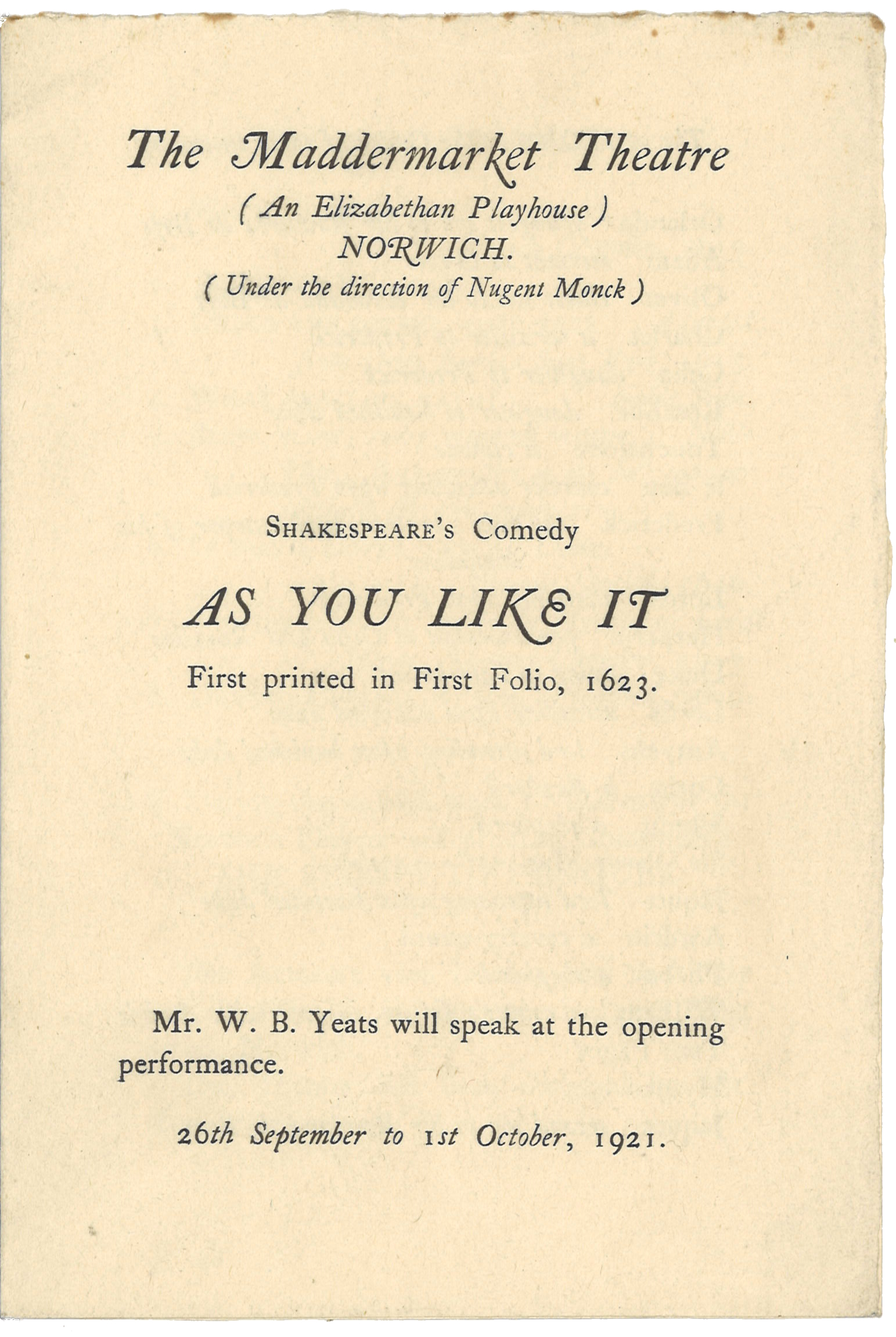
The first sub- heading, “An Elizabethan Playhouse,” references the key concept behind the Maddermarket Theatre’s design. Research about the construction of this theatre reveals the importance of acoustics to experiencing a performance, and how a unique space could be transformed to recreate the atmosphere of a distinctly different time. The building is renowned as being the first permanent recreation in the country of an Elizabethan theatre, but it also had many lives before the Norwich Players performed Shakespeare within its walls. (BBC Norfolk, 2008). Originally it was a Roman Catholic Chapel built in 1794, and since then it had also served as a general store and a Salvation Army Warehouse. It was noted by Nugent Monck that this building possessed not only a gallery, similar to an Elizabethan playhouse, but also a high barrel ceiling that would provide wonderful acoustics for a Shakespearean play to be performed. (Maddermarket Theatre, 2024.)
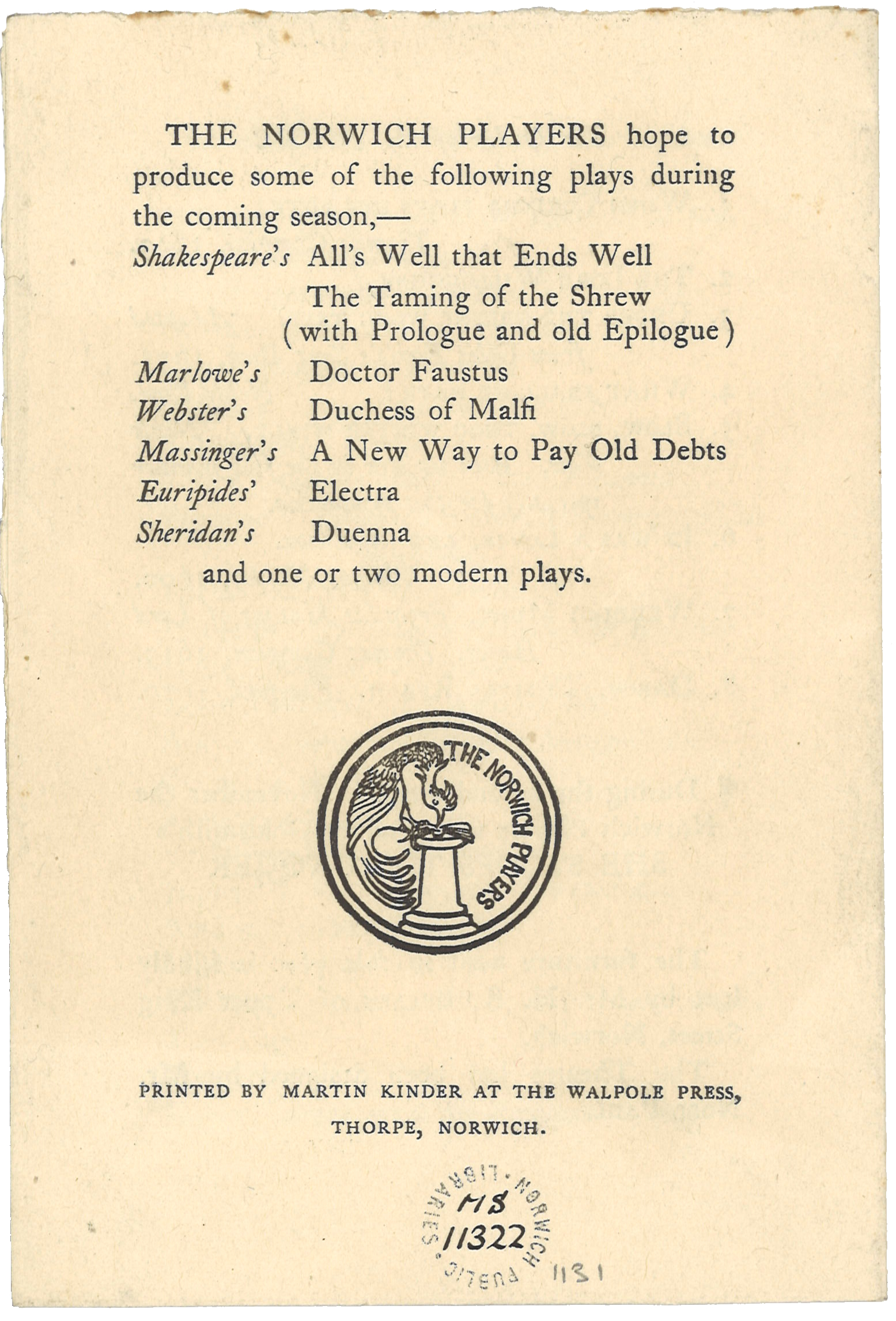
Due to the space available, the stage was constructed into an apron format, featuring a gallery. (Maddermarket Theatre, 2024). The two pillars that still feature on the Maddermarket’s stage are not too dissimilar to the design of the two “Pillars of Hercules,” which both hold up the ornately decorated canopy roof of Shakespeare’s Globe Theatre today (Shakespeare’s Globe, 2020). So, we know Monck’s stylistic vision influenced the formation of the stage, a defining addition within its high- barrelled ceilings and chapel walls, and that As You Like It took place in what Monck saw as an excellent space to experience Shakespeare’s words. The programme indicates to the audience that the “Norwich Players hope to produce” both Shakespeare’s All’s Well that Ends Well and The Taming of the Shrew, along with Marlowe’s supernatural tale of Doctor Faustus and Euripides’ tragedy of Electra (NRO, MS 11322/1131). This demonstrates Monck’s dedication to performing not only early modern but also classical tales within the space. I wonder how, over the course of his career, Monck’s vision of an Elizabethan tragedy might have differed from a classical one.
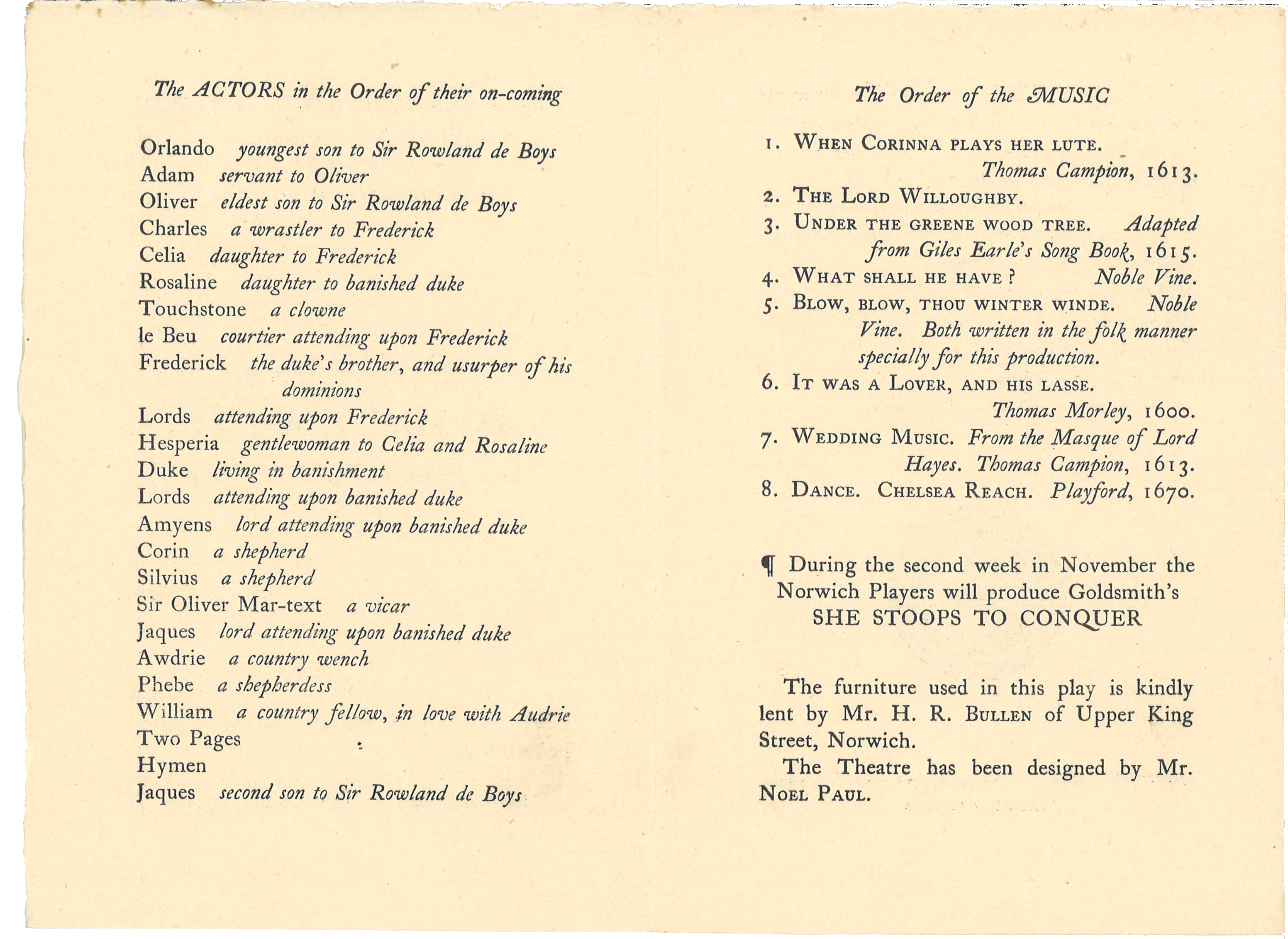
The contents of the programme might also provide a few indications of Monck’s artistic choices in his production of As You Like It (NRO, MS 11322/1131). For one, there is a tangible lack of specificity in a few areas of its contents that might give us information about the performance outside of its fictionality – for example, a list of the characters is provided, but with no detail on who they are performed by. This may have been done to remove some element of realism and engage the audience fully in its fantasy tale, one that felt as if it could’ve taken place in another time. The music list is also intriguing – if we view the play as trying to recreate Shakespearean theatre, we can see references such as “Wedding Music- From the Masque of Lord Hayes. Thomas Campion, 1613”- the traditional form of courtly entertainment and performance, melodies from a masque would make an enchanting entrance into both the disorderly forest of Arden and the imaginative world of Renaissance theatre (Shakespeare Birthplace Trust, n.d.) Only details such as under “What Shall He Have? Blow, Blow Thou Winter Winde” indicate “Noble Vine. Both written in the folk manner specially for this production,” giving a vague suggestion of what kinds of instruments may have been used for the production. There is no written description of the plot of the play, either, and perhaps this lack of detail provides an indication that even the programme incorporated Monck’s directive vision, to enhance the illusory experience of the play and completely absorb the audience watching. Given the acoustic capacity and intimacy of the space, the music of Under the Greenwood Tree, also adapted from a seventeenth century piece, would have filled the room. One autumn night, the theatre perhaps became a fantastical world of folk melodies and romance, with the power of Shakespeare’s language reverberating around a space transported to another time- just like those in the audience, we could only imagine what that piece of history might have felt like.
The Guild of Norwich Players were established in 1911, and since then have performed a dynamic range of both Renaissance and modern plays. (Maddermarket Theatre, 2024). As this is the programme of the theatre’s first performance, this gives a fascinating and invaluable look at what Monck’s vision may have been- not only for As You Like It, but how he envisioned future audiences might experience performances in this space.
Written by Rebekah Phillipson
Reference List
Norfolk Record Office archive material
- Borrow, George H. and Farrell, Frank J. 26 September to 1 October 1921. Programme for a production of ‘As You Like It’ at the Maddermarket Theatre, at the opening performance of which W.B. Yeats was to speak, printed. Item MS 11322/1131, Box VI, Fonds MS 11322. Norfolk Record Office, Norwich.
- Borrow, Geroge H. and Farrell, Frank J. 1677-1948. George Borrow Centenary Celebrations, 1913, and other Papers of Frank J. Farrell. Fonds MS 11322. Norfolk Record Office, Norwich.
- Borrow, George H. and Farrell, Frank J. 1677-1928. Personal papers and correspondence of Farrell relating to, amongst other subjects, George Borrow and the Manby family. File MS 11322/6 – Box VI. Norfolk Record Office, Norwich.
Secondary Sources
- BBC Norfolk. 2008. “Maddermarket Theatre.” Last modified July 25, 2008, at 16:46. https://www.bbc.co.uk/norfolk/content/panoramas/360_norwich_maddermarket_360.shtml
- Shakespeare Birthplace Trust. n.d. “Time to Play: Dance and Performance – Masques.” Accessed 11 December, 2024. https://collections.shakespeare.org.uk/exhibition/exhibition/time-to-play/object/time-to-play-dance-and-performance-masques
- Shakespeare’s Globe. 2020. “#WorldTheatreDay.” Accessed 10 December, 2024. https://www.shakespearesglobe.com/discover/blogs-and-features/2020/03/27/worldtheatreday/#:~:text=Pillars%20of%20Hercules,one%20is%20English%2C%20one%20Scottish.
- Maddermarket Theatre. 2024. “Our History.” Accessed 10 December, 2024. https://maddermarket.co.uk/our-history/



 Norfolk Record Office
What a perceptive, interesting and well – written piece! It shows how valuable a piece of archival material can be and how much can be derived from it. It pays tribute to Nugent Monck’s pioneering work in Norwich, first at The Music House (aka Wensum Lodge) and then at The Madermarket. I suspect that it’s not widely realised in Norwich how influential he was nationally in restoring Shakespearean productions to something like their Elizabethan style with an open stage. And I also noticed on the programme that no less a person than the famous poet, W.B.Yeats was present on the first night, no doubt because of his work with the Abbey Theatre in Dublin.
One very small ‘black mark’ however – which I’m sure was a typo! – for “its'(sic) programme” in para 3.
LikeLike
Thanks for your comments, which I will pass on to the writer. I suspect you may be correct in thinking that not many people realise how influential Nugent Monck was. I have (I hope!) corrected the typo.
LikeLike
Well done Victoria and the author. I go for walks with a friend and we are always looking for new places to visit on our adventures. Your piece has inspired me to revisit The Mademarket theatre and look at it in a completely new light.
LikeLike
Thanks for your comment Jules, I’m glad that it has inspired you. Enjoy your visit!
LikeLike