
Prince of Wales Road was built in 1860s as a grand thoroughfare for visitors from Norwich’s new Thorpe Railway Station to travel into the city centre. Old photographs show it lined on one side mainly by grand houses with shops and businesses opposite. The research for this tragedy comes from reports held by the Norfolk Record Office that contains newspaper reports, Norwich City Council records, police and court documents compiled at that time.
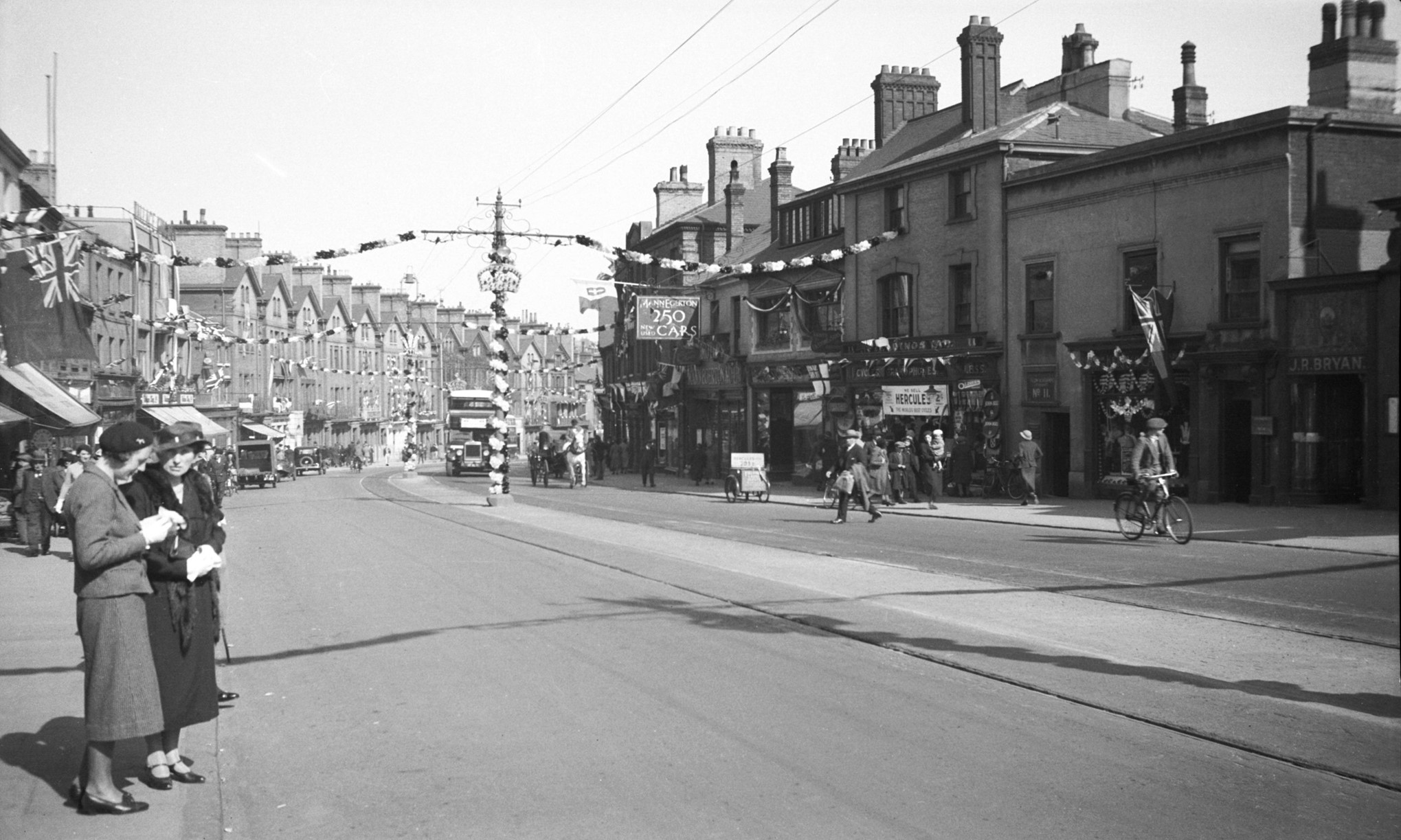
Photograph by George Plunkett
Prince of Wales Road, east view towards Thorpe Station,1935.The decorations were to celebrate the Silver Jubilee of the reign of King George V and Queen Mary. Willmott Stores was on the right-hand side, facing the tall houses. Photograph by George Plunkett
In 1923, no.51 was a cycle shop owned by Mr Charles Willmott; established in 1910. Mr Willmott had submitted architectural plans to Norwich City Council to convert the empty properties next door, nos.47-49, into a shop and warehouse to expand his business. The plans were deposited with the council on 3 April 1923 by the architect, Mr. W.J. Dunham of Bank Plain, Norwich on behalf of Mr. Willmott.The houses formed part of a terrace of high buildings facing onto Prince of Wales Road. The contractor employed to carry out the work was Mr Hipperson whose address was Trowse House, Trowse, which was located on the outskirts of Norwich. The work was to involve the virtual demolition of the ground floor and basement, with the first floor being shored-up to enable the conversion into one business premises. There were detailed plans to strengthen the side walls between the premises to be demolished with iron tie-bars, which were to be encased in concrete.
The Disaster: Thursday 20 September 1923
Work had commenced and excavation of the basements was undertaken along withthe support girders being erected, stretching from the floor level of no.45’s garden wall upwards to the adjoining wall of nos.47 and 51.The upper part of the building was left standing, being propped up by the girders.
Two warnings were flagged-up at this early stage that castdoubt on the quality of the work under way. The first came from Mr. Albert Holmes of 45 Prince of Wales Road; the new adjoining wall for no.47 was to be built up on his dividing garden wall. In his opinion,this wall was not able to carry the extra weight; it was “an evident danger”. The second warning came on 19 September 1923 when Mr Willmott visited the site and noted, with some concern, that the support girders fixed to the top floor appeared to have “given way about 2 inches”. As a precaution, he reported his concerns to Constable E. Grand of Norwich City Police. His senior, Sergeant Watts, informed Mr Hipperson’s site manager, Mr. C. Kettering. The concerns were passed on to Mr Hipperson who visited to inspect the site and left saying that,“the shop will be alright for the night, and I will attend to it in the morning.”A police officer was detailed to patrol the area that evening.
There appears to be a discrepancy here with the dates in the police record report of concern and the incident itself. The police report dated 22 September 1923, states that Mr. Willmott reported his concerns to P.C. Grand at “8 p.m. Friday, 21st September 1923”. It continues that, Mr Hipperson inspected the site that same evening. The date of the collapse of the building in the city engineer’s report, newspaper reports and backed up by the Coroner’s Court records is it happened about 4.15pmon Thursday 20 September 1923. (See Footnote 2)
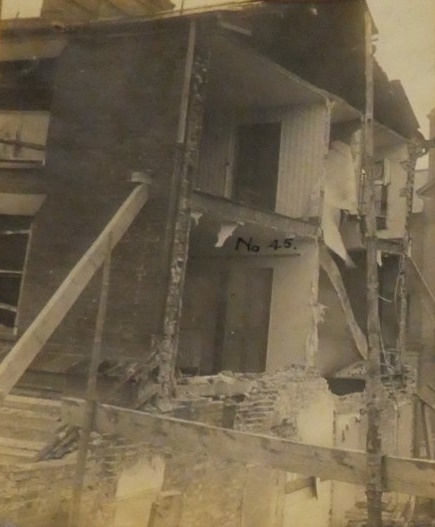
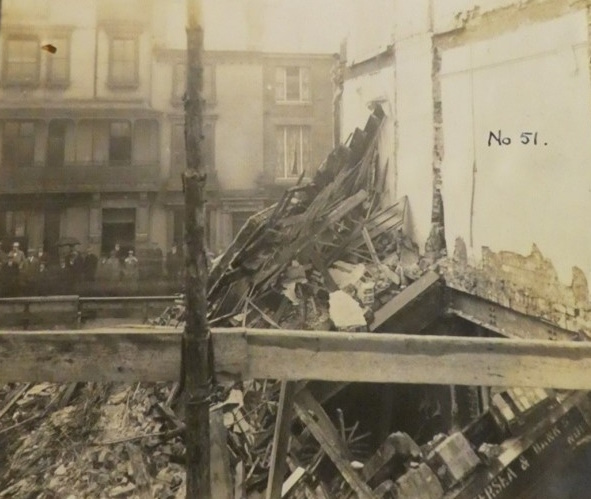
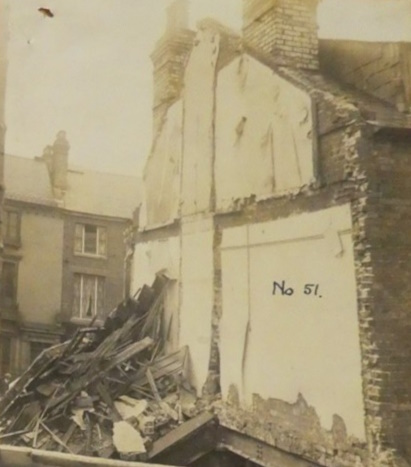
The bottom photograph shows the girders supporting no 51 gave way and the whole building collapsed down to the basement. A line of bystanders can be seen looking at the rubble.
On the day of the accident, 10 workmen arrived for their day’s labour on the morning of 20 September 1923. A police report, taken from eyewitnesses, stated that at around 4pmin the afternoon:
“Without warning the crash came. People who happened to be in the vicinity state that the fall accompanied by a loud roaring sound, and that in a second or two a great cloud of dust almost obliterated the scene.” The girders and remaining walls collapsed. Tons of debris fell against no.51 and, “the front girders were lodged on the partition walls”.
The Rescue
It soon became clear that fiveworkmen were buried under the huge pile of fallen debris. Many on-lookers gathered, some helping with their bare hands to try to locate and release the men. The police, ambulance and firemen soon arrived on the scene and, “Corporation motor wagons were hurried to the spot with ladders, ropes and boards to be used in thework of helping rescuers.” Three men were soon located and quickly brought out. The first, George Tyrrell of 2 Tunns Yard, King Street, Norwich suffered a broken leg. He, along with the second man rescued, Frederick Ling, a 37 year old bricklayer from 5 New Road, Sheringham who had suffered a fractured skull, were taken to hospital by motorised ambulance. Sadly, Mr Ling died the following day in hospital, having not regained consciousness. The third casualty was Alfred Pointer a bricklayers’ labourer, aged 32 years, of 4 Cheshill Place, Southwell Road, Norwich. He was taken to hospital in a horse-drawn ambulance but died of his injuries before arrival at hospital.
By 5pm the fourth man, Isaac Harvey, 57 years old, was rescued suffering from shock. He lived in Norwich at 80, Muriel Road, Norwich. The rescue of the fifth man, Phillip Matthews, took another hour. The rescuers heard his calls for help and were, “guided by his cries of distress in locating his precise position……. “Gradually his head was disclosed and afterwards, the upper part of his body freed, but he appeared to be getting weaker and weaker”. He had been buried under much rubble. “He was lifted clear of the fallen material by two constables and dispatched to hospital.” Once there, he was found to be suffering from shock. Luckily, a board had fallen across his body which had offered him some physical protection. Mr Matthews was 52 years old and from Costessey.
After the rescue operation, minds turned to how and why this accident had happened. The matter was referred to the coroner who set up an inquest to investigate this dreadful tragedy.
The Coroner’s Inquest
The inquest opened at 3pm on 28 September 1923 at the Sessions Court held in The Guildhall, Norwich.
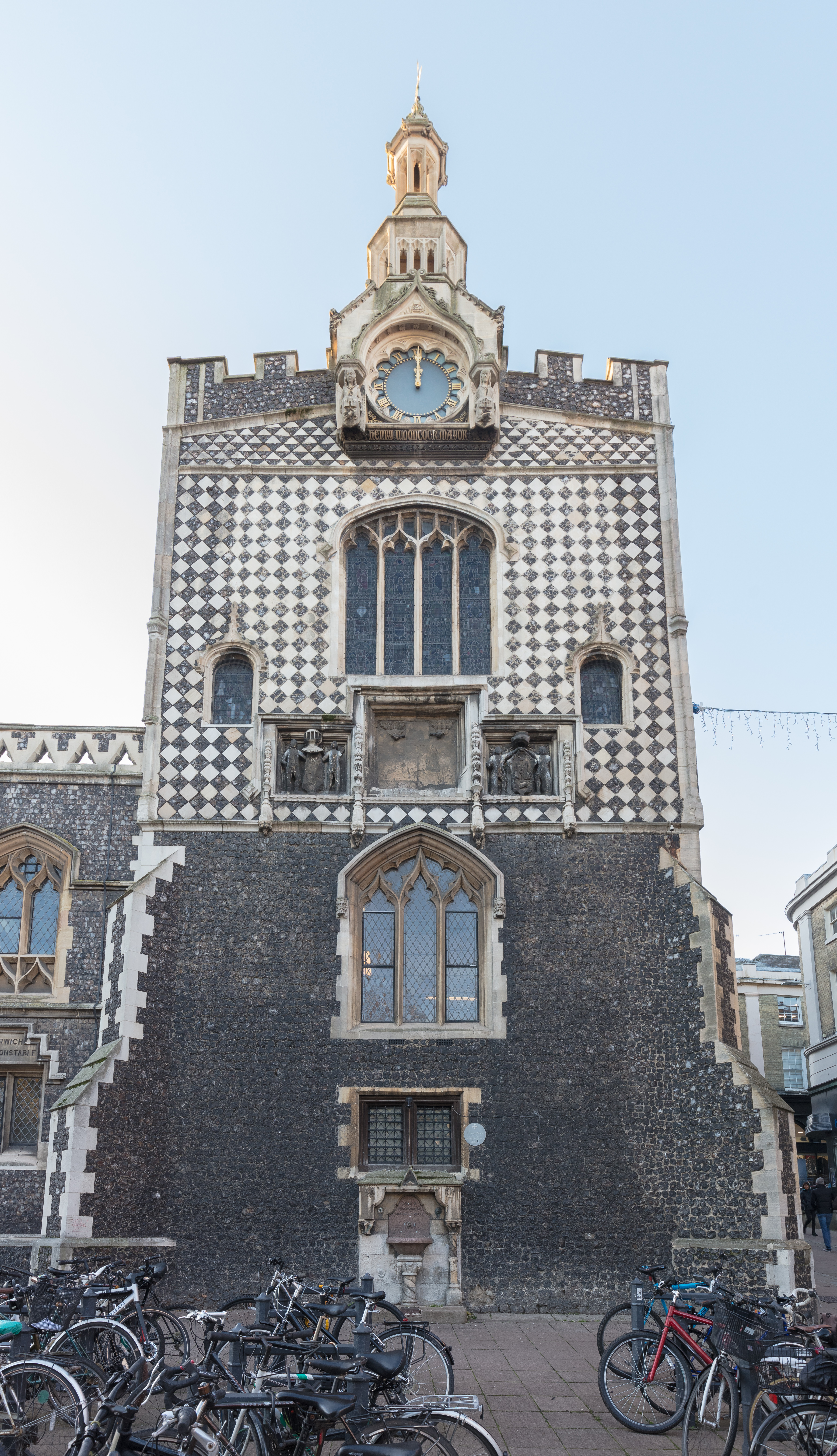
The City Coroner was W. N. Ladell Esq. Also in attendance was Mr. A. E. Collins, City Engineer, who had had oversight of the application and building work from the outset. Since the application had been submitted and approved by the City Engineers office, Mr Collins had made statutory site visits, when all had seemed to be going to plan. He prepared a full report for the inquest. He had arrived on site shortly after the collapse of the building and directed council workmen in their rescue effort. The Chief Constable, Mr J. H. Dain was also present at the hearing. The police had been alerted to the disaster by a passer-by, Mr Frederick Johnson of Duke Street, Norwich, who had witnessed the collapse.
Mr Edward Reeve appeared on behalf of the widows of the workmen who had died. Alfred Pointer had married Ivy Crouchen just 2 years earlier in 1921. The 1921 census return gives Alfred Pointer’s occupation as a builders’ labourer working for Hipperson’s Builders. The 1921 census entry for Frederick Ling shows that he was married to Emily and their daughter, Beatrice aged 15 years, was living at home and worked as an errand girl.
Mr Collin’s report contained a full inspection of the site and responsibilities of those in charge of the work. His views regarding the safety of the construction work before the collapse was central to the inquest. It underpinned the questions posed by the Coroner to those involved in the planning and management of the work. Mr Collin’s report described how no.47 had been shored up with “only 2 girders under first floor level. 1 girder had been inserted in the party wall between numbers 45 & 47, a 2nd girder was placed from a column in the centre of the building between 47 & 49.”
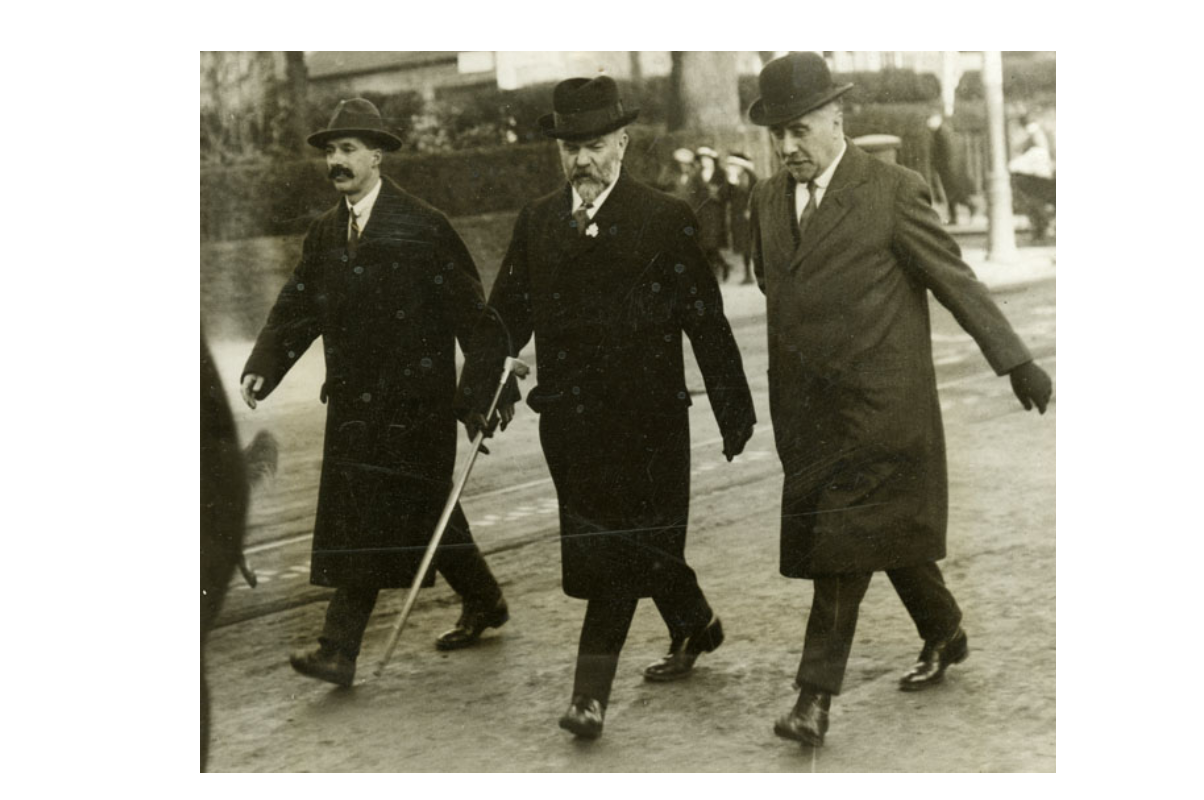
The coroner focussed his questions on whether or not these measures had been deemed sufficient to ensure the safety of the site and thus, the safety of the workmen.
Mr Walter Bussey was the general site foreman for Mr Hipperson. He was asked if a calculation had been made as to the whether the girders were sufficient to bear the weight being placed on them. He replied without answering the question, by saying, “that was the architect’s job.” Mr Herbert Brown, a site foreman in August 1923, had worked from the plans drawn up by the architect Mr Durham. He was asked the same question. His reply was, “It has gone down. That’s all I can say.” Mr Hipperson was called to give evidence. He said that all had seemed well on his weekly site visits. Whilst he could not give any account for the collapse, he did concede that the weight bearing calculations had not been done. He too had gone by the architect’s plans but concluded that “it appears that the rotten old wall” could not bear the weight of the supporting columns.
The architect, Mr Durham, gave his evidence to the inquest. He told of how the site work had begun in June 1923, after his plans had been approved. His regular site visits up to the collapse had given him no cause for concern. Since the collapse, he had inspected the supporting wall at no.45 and thought the problem lie in the “unsatisfactory bonding in the brickwork of the superstructure supported by the steelwork construction.” He concluded that; “in my opinion the disaster was entirely accidental and quite unforeseen.” He expressed his sorrow for the loss of life that had occurred.
Mr Collins gave his evidence and summary of events. Four days after the structure had collapsed Mr Collins had sent a curt letter to Mr Hipperson, in which he asked for the surface rubble to be cleared so that he had clear access to examine the base structure of the site. His focus was the wall between nos. 45 & 47 which were where the struts had been inserted to rest on the wall between nos. 49 & 51. He addressed the matter of the weight calculation stating that the columns had to carry a weight of about 30 tons to support the opposite wall. His report noted the lack of pointing between the brickwork but also discovered that a rain water pipe on the side of no.47 was inadequate, “the discharge from which has been soaking into the wall foundation for some weeks…of course must have a prejudicial effect.” He summed up his report by saying that he had not known of such a collapse before.
The Verdict
The Coroner turned to the jury’s findings in relation to the death of the workmen when the structure had collapsed. It was the jury’s opinion that, “sufficient care was not taken by all those responsible to ascertain the strength of the brickwork that had to carry the stancheons or columns”.
Whilst the jury was clear that the supporting wall was not stable enough to bear the weight being placed upon it and that the building regulations in place at the time to assess the suitability of the wall, was not undertaken, but that responsibility could not be assigned to any single person or company. The testimony given at the inquest by all those concerned made it clear that, what assessments as should have been made and were not made by whoever had that responsibility. The assessment was not done and no outcome presumed, if these measures had been undertaken.
Conclusion
The inquest recorded the Coroner’s findings. The matter was closed, except that is for the families of Alfred Pointer and Frederick Ling who had lost their main breadwinners. No comment or regard was paid to the three labourers who had been traumatised by being buried under the rubble awaiting rescue and medically diagnosed as suffering from “Shock”.
Viewed now, 101 years from the tragedy, minds immediately turn to matters such as health and safety regulations and terms and conditions of employment. Quite apart from consideration of compensation for the victims given the inquest found that insufficient care had been given to the placement of those support beams. Was this an unforeseen accident? There is one comment that stands-out that maybe, could have made a difference. Mr Hipperson inspected the site following the observation from Mr Willmott that one of the supporting beams had shifted and said;“I’ll tend to it in the morning.”It would appear that Mr Hipperson allowed the labourers to begin their day’s work without attending to it that morning. The question as to why this did not happen was not put to him at the inquest.
Willmott’s Stores 1924-1966
Following the inquest, renewed plans were quickly drawn up and presented to Norwich City Council. By January 1924 the council had inspected the repaired gable end wall of no.45 and found that, “it is perfectly safe, it is in fact stronger than before.” Mr Hipperson continued as the contractor employed by Mr Willmott to combine nos.47 to 51 into one large store which opened in 1924.
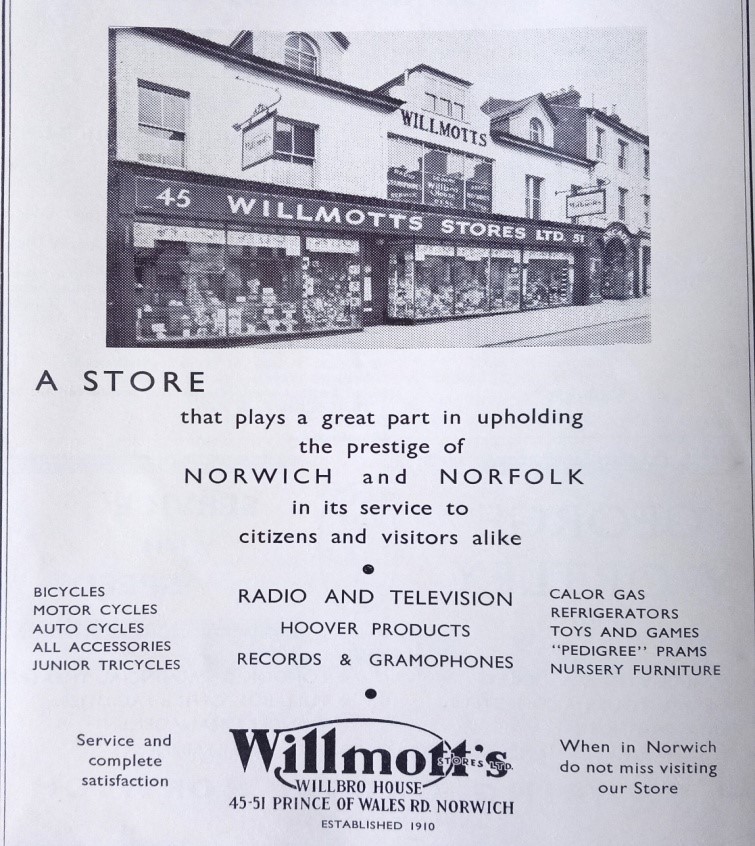
In a book published by Norwich City Council in 1951 to celebrate the Norwich Festival of that year, Willmotts Stores took out a full page advertisement (see below ) to promote its wide range of goods. It must have been a prosperous time for the company, having survived the 2nd World War of 1939-45, and occupying a large site on what was then one of Norwich’s prestigious roads. The caption in the advertisement gives the address as Willmott’s Stores Ltd., WILLBRO House 45-51 Prince of Wales Road, offering the customer, “Service and complete satisfaction”. It would appear from this heading that Mr Willmott had developed his business to include no.45 too, he ceased trading in 1966.
Postscript.
1. The Eastern Daily Press newspaper report dated 29.09.1923, incorrectly named the Norwich man who died as Thomas Arthur Pointer, whilst he is named in the Coroner’s report and elsewhere as Alfred Arthur Pointer. The latter is the name recorded in the 1921 Census for the male resident at no.4 Cheshire Place, Norwich.
2. In respect of the date of the police report of concern of the slippage of the girders, there seems to be a clear discrepancy. It may well have occurred in the translation of the constable’s hand-written record of events and this record being typed-up at a later date. There is no mention of the discrepancy by the Coroner.
Footnote: All quotes in italics in the text are reproduced from the Norfolk Record Office document listed below.
Bibliography
Cope A.B. (Honorary Editor): The book of the Norwich Festival (1951). Published by Norwich Festival Society Ltd. City Hall, Norwich. Printed by Jarrold & Sons Ltd., Norwich.
Find My Past website: source for 1921 census information.
Norfolk Record Office reference: N/EN 12/1/8745
Williams, Matthew: The Masterful Mr. Collins. (2024) Independent Publishing Network.
Researched and Written by Jackie Mitchell,
Volunteer at Norfolk Records Office.



 Norfolk Record Office
Thank you, that was most interesting. I remember Willmott’s, bought my first record there, think they sold bikes as well.
Rosie Gill
LikeLike
Hi Rosie,
Sounds like they sold a range of different items- how lovely to remember buying your first record.
LikeLike
Great story. Thank you for sharing.
LikeLike
Thanks for your very interesting article. It is clear that modern health & safety regulations would have prevented this tragedy. Also, compensation for the victims today would have been substantial.
LikeLike
Thanks for your comment. Absolutely the world is a far different place these day in terms of health and safety.
LikeLike