
After spending her formative years in and out of the workhouse, the asylum and five periods of imprisonment in what sounds like a plot of a Dickensian novel, what were the chances that Harriet Kettle, could not only survive to adulthood, but that her life could be a long and eventually stable one.
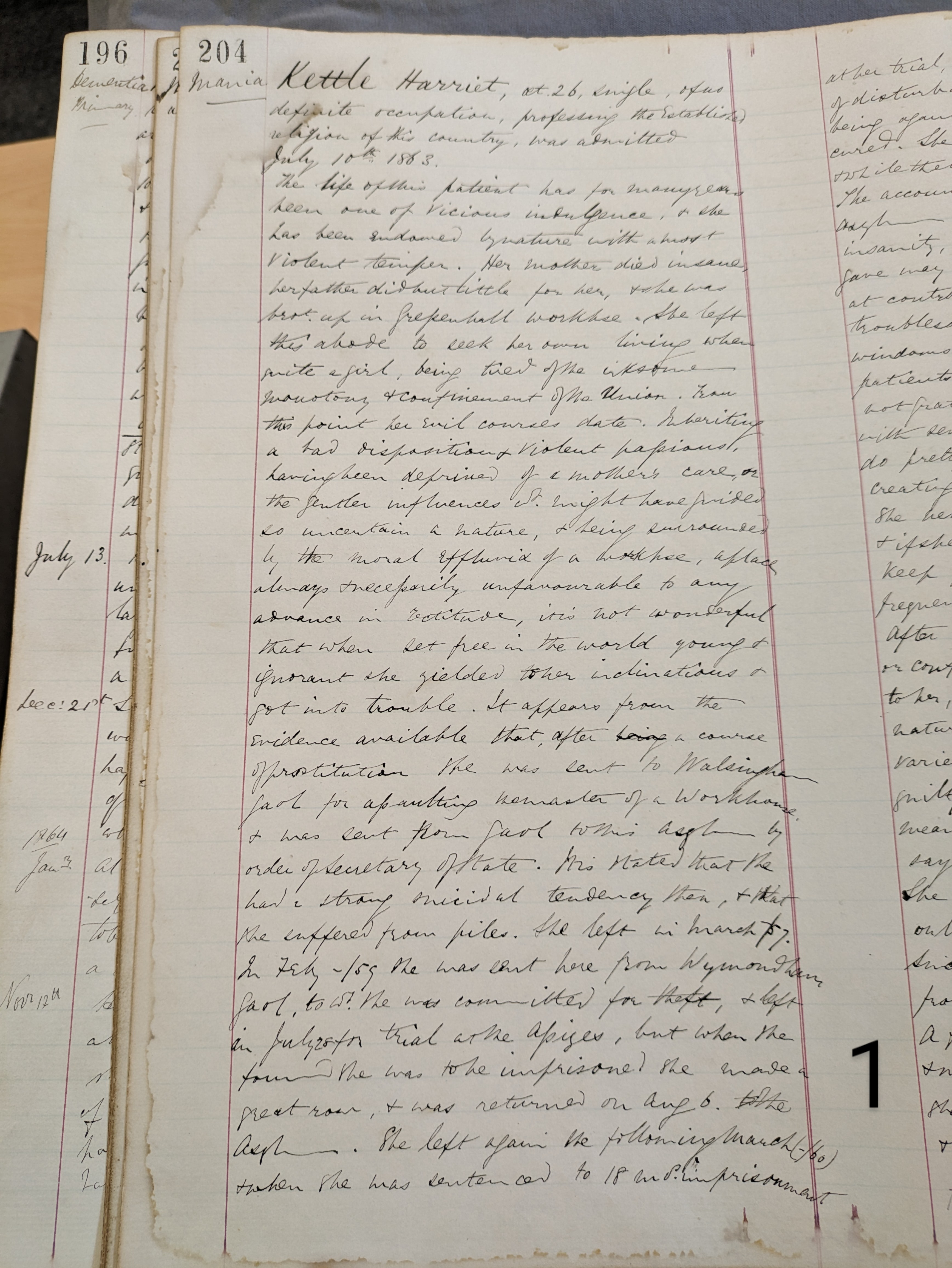
Harriet first appears on the 1851 census. Described as a pauper inmate aged twelve, she is living in the Gressenhall Workhouse, along with her 5-year-old sister Matilda. Later records from the St Andrew’s Hospital Admission Register (the County Lunatic Asylum) from 1863, state that she had not had the best start in life. ‘Her mother had died insane, and her father had done but little for her.’[1] The nature versus nurture debate is in evidence as the recorder indicates that her bad disposition was not helped by the lack of a mother’s care and the dubious morality of the workhouse.
The records contain many references to her violent and excitable behaviour. Several examples are listed, incidents of incoherence, tearing her clothes, breaking windows, screaming, attacking other patients or nurses, if she did not get her own way. Harriet appeared several times before the Board of Guardians for various crimes including violence, abusive language, destruction of property, insubordinate conduct, but the most significant charge, and the one that made the newspapers of the day, was her attempt to set fire to the Gressenhall Workhouse in November 1858. The case took some time to come to court as Harriet had been deemed insane and unable to stand trial. She spent periods of time at the County Lunatic Asylum where her state of mind was determined. The asylum’s surgeon declared that although she was subject to ‘paroxysms of rage[2]’ she was not insane. The Norwich Mercury of March 1860[3] reporting from the Assizes where Harriet was charged with arson, stated that the incident had followed an assault by Harriet on the Assistant Matron, for this she was locked in a dormitory. The Master of the Workhouse reported that after about ten minutes, he heard the striking of a match; he saw that Harriet had removed the straw from a mattress and had set fire to it. Harriet claimed that she had not wished to burn down the Workhouse but had attempted to kill herself, claiming she had been very badly treated by those in charge and by everyone else.[4]’ Whilst the Workhouse was represented in court; Harriet was undefended. She had hoped to be transported, but was sentenced to eighteen months hard labour, she was 18 years old.
What could have led to Harriet’s frequent charges of ungovernable temper and disorderly conduct’?
Looking again at the St Andrew’s Hospital Admissions Register, there may be some clues. Harriet would today be classed as institutionalised, brought up in the Workhouse, moved between Houses of Correction, and asylums including the infamous St George in the Fields, or Bedlam. She had received no parental guidance, and although in 1851 her sister was with her in Gressenhall, she does not appear to have remained there. Matilda appears in the 1861 Census in Norwich working as a cook for the Minister of the Octagon Chapel in Norwich, so appears to have taken a quite different path in life. There are references of Harriet making apparent suicide attempts including one night when she claimed to have cut her throat, after obtaining a pair of scissors with which she had scratched her neck. Another that she attempted it by taking laudanum, although she maintained she only took it to ease a cough. Her behaviour often resulted in solitary confinement; maybe this was her intention, or maybe like a child she sought attention in any way she could get it.
The records indicate that Harriet spent time as a prostitute and was sent to the Walsingham House of Correction for appropriating the master of a workhouse.[5] It was reported that she had, had several children, and was courting in Gressenhall Workhouse[6]. The Minute Book of the Board of Guardians refers to the ‘little indulgencies[7]’ given to Harriet due to the ‘peculiar circumstances of her case’ awarded to her so as not to ‘interfere with the order and discipline of the workhouse until after her period of confinement.’[8] What does confinement mean here, is it imprisonment or pregnancy? Had Harriet been seeking the comfort she had not received from family, or money, or was this something more sinister, at her trial she had declared that ‘no man should conquer her’[9], whatever the reason there are certainly no baptism records for any children.
Harriet blamed the institutions she had been in and others for her problems, certainly the upbringing she had would shape her view. She felt she could not earn an honest living as she was not strong enough for service, which is the path that her sister appears to have taken. She suffered from phthisis, a disease similar to tuberculosis, frequently spitting out blood. Another plausible reason for Harriet’s mood swings and ‘paroxysms of rage’ is hinted at in the asylum’s records of 1864. The reports state that she had been much quieter as her last menstrual period had been without any of the violent pain in the head that she usually suffered from. Could some of that emotional rage have been due to PMT?
This calmness seemed to have continued as Harriet left the asylum on May 31st, 1864, age 25, it was recorded that ‘it is probable she will be missed by ‘everybody’ regretted by none.’[10]
So, what happened to Harriet?
Remarkably, upon leaving the asylum Harriet seems to have kept out of trouble, there were no more negative newspaper reports, nor a return to the Workhouse. She married a local agricultural labourer, William Head, in 1865, and lived in the Toftwood area of Dereham for the rest of her life. By the time of the 1911 census Harriet had been married to William for 46 years, they had, had four children, although two had died by this time. So, it appears after such an inauspicious start to life, she found some stability in her later years.
Despite her early ill health Harriet died, at the grand age for the period, of seventy-four in 1916.
Researched and written by Helen Evans
[1] St Andrew’s Hospital Admission Register for Harriet Kettle, NRO SAH/263/198 p 204
[2] ibid
[3] Norwich Mercury, 31 March 1860 – from notes by Andy Reid, item 12 NRO MC 1933/27 89X9
[4] Norfolk Chronicle, 31 March 1860 – from notes by Andy Reid, item 13 NRO MC 1933/27 89X9
[5] St Andrew’s Hospital Admission Register for Harriet Kettle, NRO SAH/263/198 p 204
[6] ibid
[7] Minute Book of the Board of Guardians 5 January 1863 – from notes by Andy Reid, item 25 NRO MC1933/27 89X9
[8] Minute Book of the Board of Guardians 2 February 1863 – from notes by Andy Reid, item 26 NRO MC1933/27 89X9
[9] Norfolk Chronicle, 31 March 1860 – from notes by Andy Reid, item 13 NRO MC 1933/27 89X9
[10] St Andrew’s Hospital Admission Register for Harriet Kettle, NRO SAH/263/198 p 254



 Norfolk Record Office
Could you bring my book, ‘Harriet Kettle: Pauper, Prisoner, Patient and Parent in Victorian Norfolk’ (published by Poppyland in 2021) to the author’s attention, please? I appreciate that no one has a monopoly on writing about Harriet Kettle but there are one or two inaccuracies in her article. Thanks.
LikeLike
Hi Andy,
I have spoken to the author. Could you let us know what the inaccuracies are? Thank you.
LikeLike
Very interesting!
LikeLike
Thank you for a fascinating story. Interesting research on conditions and attitudes of the times. And heartening that she had a good life in her latter years.
LikeLike
Sadly there were numerous family groups of children housed at Gressenhall Workhouse and others in the county.
My Gt.Grandfather lived on the Thorpland Hall estate where he worked as a gardener after being discharged sick from the Coastguard Service.
He was an official visitor to East Beckham Workhouse and would take little fabric dolls,made by his wife and other little gifts to the children there
LikeLike
How lovely to know that your Great Grandfather was able to contribute to the lives of those living in the workhouse.
LikeLike
I remember learning about Harriet some years ago on a course with Andy rEid when I was teaching. It seemed to me that no-one really knew how to deal with her and so she was passed from one institution to another until she became old enough to be someone else’s reponsibility. It’s good to learn that she had a normal life in the end.
LikeLike