
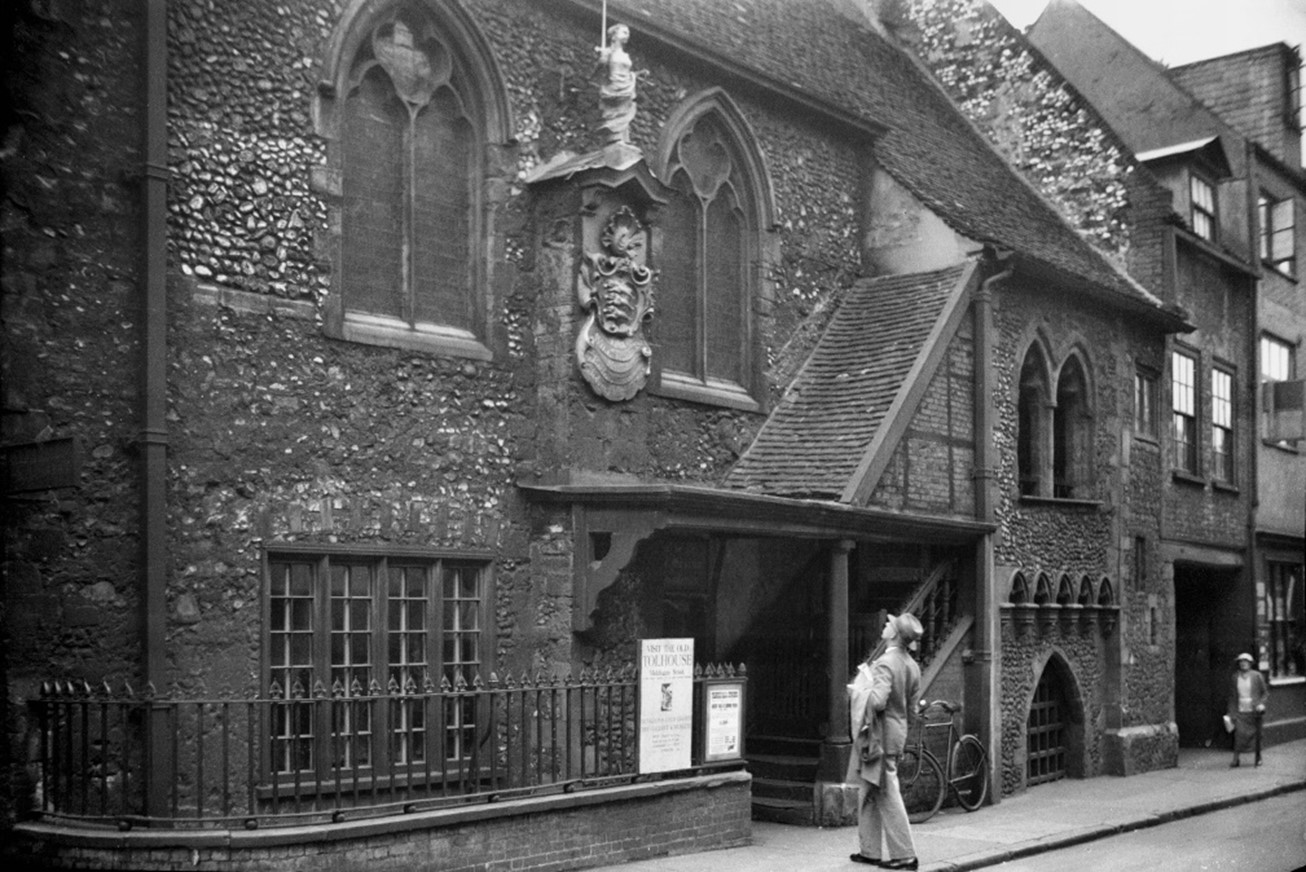
Great Yarmouth gaol was housed in the twelfth century Tolhouse for several hundred years until its closure in 1875. In 1819 the Borough Council purchased adjacent buildings and converted them into a House of Correction (aka the Bridewell) which was intended for petty offenders sentenced to hard labour.
The Register of Felonies records not only the names of those charged but also age, place of birth, last residence, offence, and sentence as well as identifying marks such as birthmarks, scars, and tattoos. It is worth noting that those charged were not always found guilty – James Liffen (48), for example, was charged with bigamy but was acquitted.
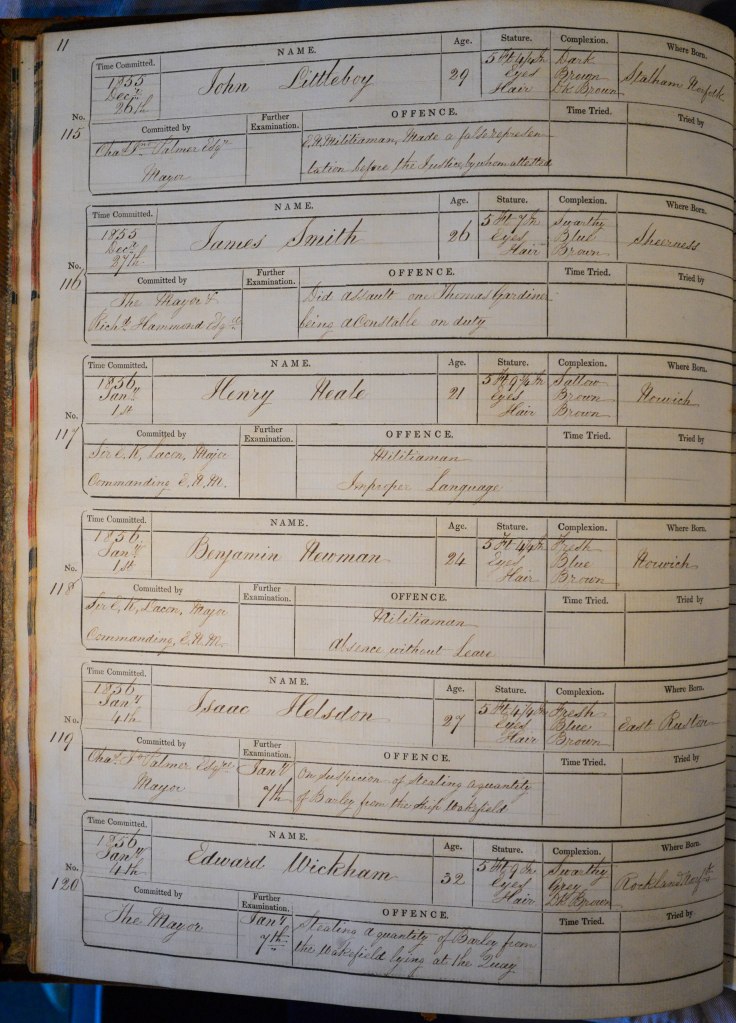
Those entering the prison came predominately from the poorest in the town and offences ranged from using bad language on the street (against the bye laws), minor damage to property and theft, to assault and murder. The age of offenders ranged from children to the elderly and sentences were harsh by today’s standards. George Harbord (9) was found guilty of ‘wilfully destroying a geranium’ and faced a fine or seven days hard labour. George, like most offenders, was unable to pay the fine. After 1854 Reformatory Schools were established for children under 16 which meant that they could be granted a pardon on condition that they were committed for a period of two to five years. John Read (10) was found guilty of stealing a pig and sent to Buxton Reformatory School for five years. Joseph Webster (70) was one of the oldest offenders, he had been in custody up to a dozen times by 1860 mostly for using bad language but on the last occasion recorded in this Register he ‘openly exposed his person to insult Mrs Todd’ for which he was sentenced to 21 days hard labour. One particularly eye-catching offence was that of Alfred Stebbens (51), a ship broker’s agent, who ‘did attempt to commit an abominable crime with a mare’!
Theft was common and often of goods which could either be used by the offender or sold. Betsy Blogg (36) and Richard (31) and Maria (27) Gregory stole a feather bed, a bolster, two pillows and a mattress and some other articles which they could have sold whilst the boots stolen by Mary Ann Wells (15) were probably for personal use. Isaac Hutchings (39), a basket maker, stole ‘luxury’ items which could be sold or pawned – silk handkerchiefs, two pairs of gloves, three towels, a waistcoat, and a petticoat. Life would have been a hand to mouth existence for many so not surprisingly food items were often stolen including herrings, meat, fruit, nuts, cheese, butter, cake, biscuits, and sweets as well as wood and coal, presumably for heating. We can only guess what brothers Ephraim (19) and Elijah (21) Hunt and Charles Wall (15) planned to do with ‘thirty, thirty-two pound shot the property of the Queen’. Just moving them must have been a challenge and an achievement.
Very high value items like watches were probably also stolen to be sold or pawned. William Cable (15), a smacks boy, stole a silver watch and a gold Albert for which he was sentenced to two months hard labour. Henry Boulter (10) stole a watch and guard, a gold ring, and a silver brooch ‘his father’s property’. There is no indication of who ‘shopped’ him or what his sentence was. Jane Riches (19), a charwoman, stole ten guineas in gold, six silver teaspoons, a silver tablespoon, a pair of candlesticks, a pair of sugar tongs, nine towels, a tablecloth, four sheets and other articles presumably from those she worked for. Her sentence was two months hard labour.
There were many thefts of money. These were usually fairly small amounts and were often stolen in the street, but John Eyles (17), a Banker’s clerk, stole about £2,000 (probably over £200,000 today) in bank notes from his employer, a banking firm in Hemel Hempstead! It was reported in the Stamford Mercury dated 28th December, 1855 that he was caught when he tried to change one of the stolen bank notes at a bank in Great Yarmouth. He was returned to Hemel Hempstead for trial. (British Newspaper Archive, British Library Board).
Young people (usually teenagers) would be apprenticed for a number of years to learn a trade and it was not uncommon for them to abscond. Interestingly the majority of these ‘refractory apprentices’ were smacks boys (apprentices to fishing smack owners) which must have been a very hard life. There are also ‘refractory paupers’ who had either escaped from the workhouse like Robert Auger (60) or committed an offence in the workhouse like Eleanor Handcock (19) – she assaulted the workhouse porter and bit his finger – or George Gibbs (14) who refused to pick oakum.
Fishing (particularly for herring) was the lifeblood of the town, and many offenders were sailors, or fisherman and some obsolete occupations connected with the industry appear. A ransacker of nets (male occupation), for example, checked nets for damage and then passed them to the beatsters (female occupation) for mending whilst beachmen would salvage boats and ferry fish to the beach from the fishing vessels anchored offshore.
Sailors sometimes refused to join a ship after signing articles and were charged with breach of contract. In 1855 the captain of the schooner Vindex found himself short of 11 crew who refused to join the ship. Apparently,12 weeks hard labour was preferrable! They came from as far afield as Scotland, Canada, France and Portugal and there are examples throughout the register of sailors from places even further afield like Mauritius (known as the Isle of France) and Ceylon.
The barracks in Great Yarmouth in this period were occupied by militias and many offenders were militiamen. The Crimean War started in 1854 and militias were re-constituted to take over home duties so the regular army could be deployed to the Crimea. There were three Irish militias – the Louth Rifles, Donegal Militia and Fermanagh Militia – as well as the Norfolk militias and there were numerous cases of drunkenness, insubordination, going AWOL and desertion. In the case of the Irish militiamen the place of birth was a challenge for the clerk recording the offences and he soon gave up, just putting Ireland! Militia uniforms were partly provided by the government and would be replaced every year, but soldiers were required to provide ‘regimental necessaries’ themselves (this included gaiters, additional shirts and neckstocks) with the cost being taken out of their pay. So, there was an incentive for them to steal necessaries like Thomas Craddock (25) of the Louth Rifles who was charged with desertion and ‘making away with regimental necessaries’.
Assault and threats to murder were frequent but there are only two cases of murder recorded in this Register – Elizabeth Rose (23) of Freethorpe murdered her infant daughter and James Ablett (51) murdered Angus Steward. In an article in the Norwich Mercury 25th July 1857 Ablett is described as ‘a pauper nurse in the workhouse’ where Steward was also an inmate. Ablett was committed for trial at Norwich. (British Newspaper Archive, British Library Board)
The gaol finally closed its doors in 1875 after the Prison Act (1865) required prisoners to have individual cells which space did not allow in the Tolhouse. Convicted prisoners were moved to Norwich and in 1878 those awaiting trial were also moved.
Researched and written by A.Baker



 Norfolk Record Office
Loved this article. Thanks for posting.
LikeLike
What an interesting read. Thank you so much for sharing your compelling research.
LikeLike