
The Browne family of Poringland, were well respected lesser gentry, with some wealth and property and good connexions. John Browne, gentleman, was secretary for many years to Sir Robert Wodehouse of Kimberly and then to Sir Arthur Heveningham of Ketteringham. His brother Thomas was secretary to successive Norwich bishops, but tragically took his own life in 1611, by drowning himself in the “great pitt” in the village. John and Thomas’s father, Edward Browne, was a substantial yeoman farmer, originally from Tacolneston who moved initially to Lakenham before settling in Poringland. John inherited his father’s Poringland properties and a comprehensive inventory following John’s death indicates a substantial property of seventeen rooms, well-furnished and comfortable.1
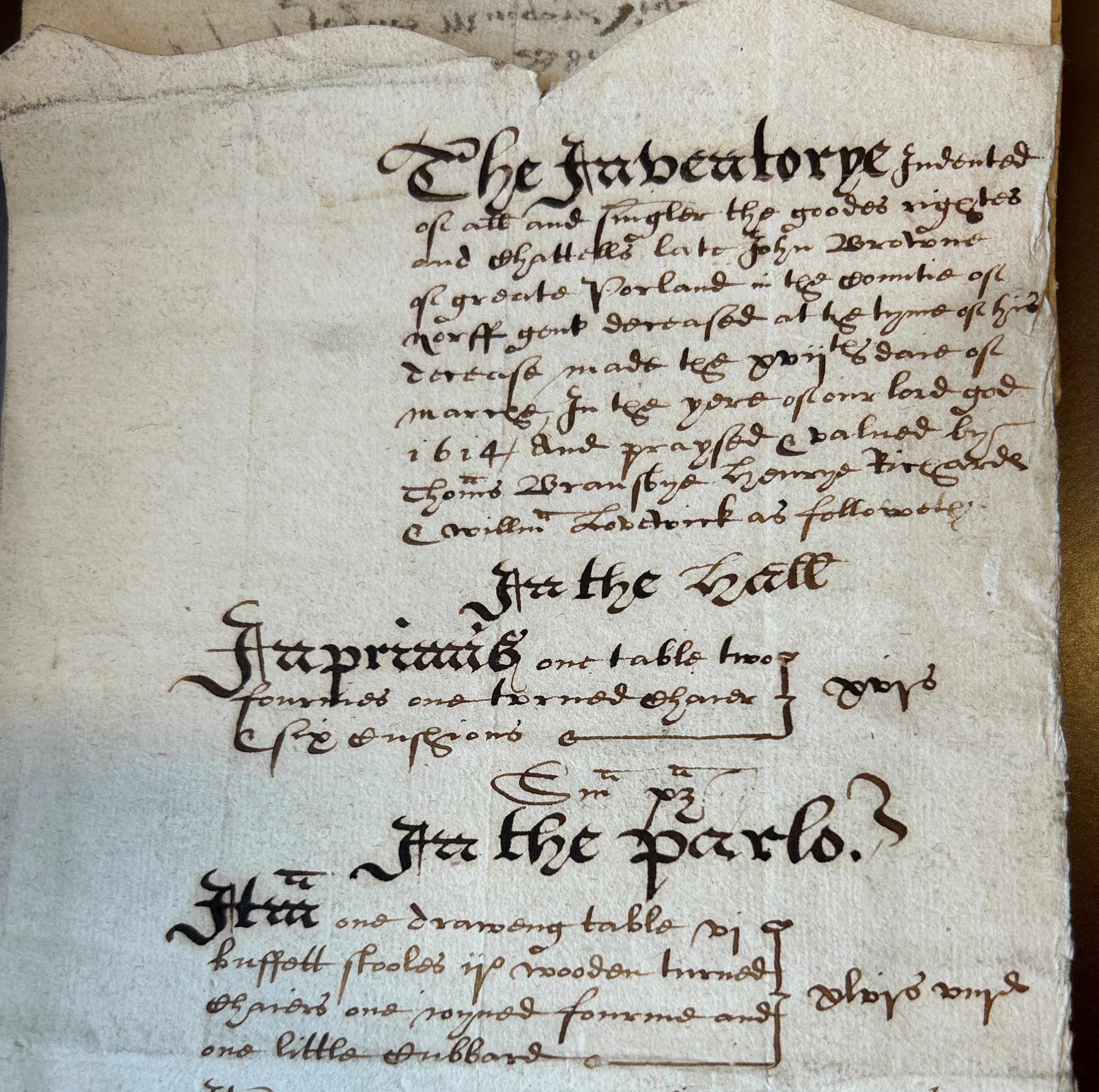
John marries Elizabeth Browne, possibly a second cousin and the couple have three children. Elizabeth the oldest is baptised on 10th November 1594 followed by the baptisms of Mary in March 1596 and John in January 1598. Sadly young John dies aged 18 months leaving Elizabeth and Mary co-heirs. Edward Browne concerned that his son was living “above the rate of his estate”2 purchased property which he bequeathed in his will to his granddaughters to provide dowries as “he would not have the girls altogether want portions”3
Little is known about Elizabeth’s childhood and upbringing. In John’s inventory of 1614 “two bagges with smale lynnen for children”, a cradle and a discarded spinning wheel in the garret, and a woman’s pillion saddle in the stable, give a small hint of children and young women having had a presence in the house.4
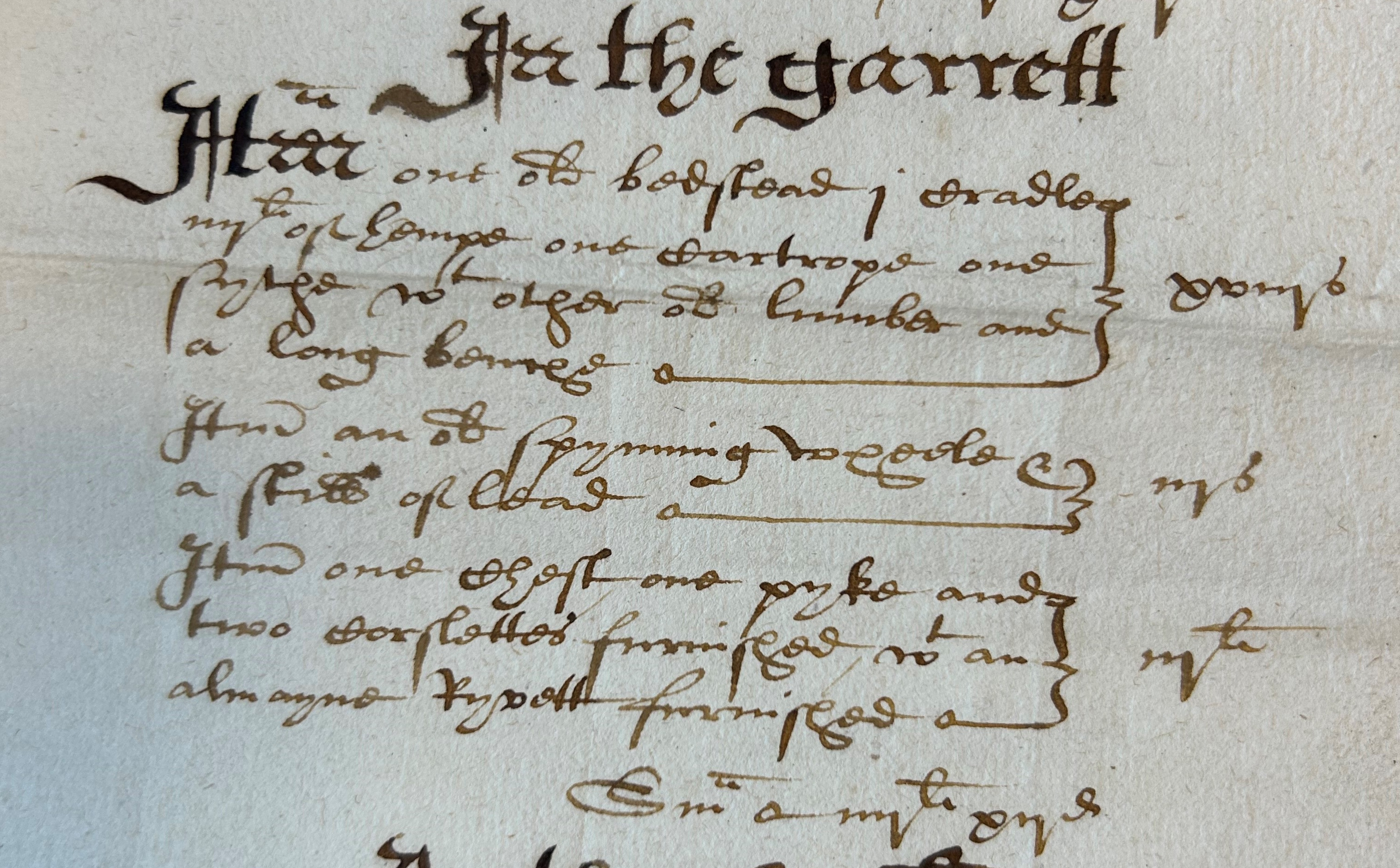
We do not know if the sisters had any formal education. Most young women of their class would have acquired some skills in sewing, music, spinning and embroidery. She may have been able to read sufficiently well to read the scriptures, but possibly not to write. In a later agreement concerning disputed property between her sister Mary and William Doughty, Mary signs with her mark, so presumably unable to write her own name. One letter to her father references Elizabeth’s “good Educacon, which you have given hir as I understand”5, but this is vague. Certainly, there are many books in the house. The same inventory lists “six score & odd of books Some of Divinities some of lawe Scollers books, books of presidente and some of Arethmatick”6 After her mother’s death, Elizabeth as the oldest daughter may well have taken on some of the housekeeping roles of the household and may have had some skills in basic accounts.
In his will made just fifteen days before her marriage, John bequeaths to Elizabeth “all such money and other thinges I gave and deliver onto her in my lifetime, and all my timber trees that are felled lyinge at or nere my sawinge pitt” and to both sisters “All my Household stuffe plate goodes and chattels whatsoever, (except my Corne Cattell some readie monie and debts) to be equallie devided and p(ar)ted between them by my executors” This is to be paid to them at their full age of 21 years or on the day they marry whichever comes first. She is then bequeathed messuages houses lands tenements & hereditaments freehold copyhold and customary land in Great Poringland, except one messuage occupied by William Haylie, and to her heirs forever.7 Elizabeth had already been bequeathed tenements, houses, and land lying in Lakenham by her grandfather.
Elizabeth, daughter of a gentleman with some wealth and property and the necessary accomplishments for a young woman of her class, attracted a number of suitors. Her paternal grandmother died when Elizabeth was young and there is no record of her mother’s burial in the Poringland Parish Register, so it is not known how long John has been bringing up his two daughters on his own and with the responsibility of guiding them through the complexities of the marriage market.
Within the Record Office Archives there are a bundle of letters written on behalf of a number of suitors wishing to secure Elizabeth and Mary’s hand in marriage.8 Some are from well-connected families, such as the Heveningham family of Ketteringham and the Gawdy family of Claxton. Neither woman is named in the letters and in some cases neither is the young man. Two have already met the young women and the rest are wishing to “have sight of them”. Elizabeth as the oldest seems to have been the first choice and only when she is spoken for, does their attention move to Mary.
Most of the letters do not have a date, so it is not possible to put them in an exact order, although a few follow on from each other. Probably the final one is from Edward Coke dated 28th November 1614
The suitors are –
a) The only son (not named) and heir of Anthony Sherdelou. The Sherdelou/Shardelow family lived at Shimpling, near Dickleborough, and were descended from Sir John de Shardelow. Proposer Edmund Browne, senior, cousin of John Browne.
b) An “old servant”, not named, of Edmund Doyley, brought up by the Doyley family at Shotesham St. Mary. Proposer Edmund Doyley, one-time High Sheriff of Norfolk, who considers himself a very good friend of John Browne.
c) Charles Heveningham, son of Sir Arthur Heveningham of Ketteringham, who wants “access” to both daughters to see “which he has the looking of”. Proposer Arthur Heveningham, who had also been Sheriff of Norfolk, related through his mother to Ann Boleyn, asking that he should have first choice, because of his good name and respect.
d) Edmund Gawdy, son of Sir Henry Gawdy of Claxton. Sir Henry had been High Sheriff of Norfolk and twice elected as a Member of Parliament. Henry had six sons and a daughter. Edmund was not Sir Henry’s heir: this fell to his brother Robert. Proposer Sir Edward Coke, who was Lord Chief Justice at the time. Edmund had already met Elizabeth.
e) Edward Colfer, writing on behalf of himself, also seemed to have met Elizabeth, but won’t visit her again unless he has assurance of her love and affection. Edward Colfer was born in 1592 and was in his early twenties when he was hoping for Elizabeth’s hand. He was a lawyer and qualified as a barrister. There seems to have been issues regarding his inheritance from his father, possibly around the time of his letter.
f) The brother (not named) of Gregorie Buttall of West Beckham. He is aged twenty-one and is living in Staffordshire, who asks John “to be a sutor to your youngest daughter; Mr Doughtie’s sonn beinge as I heare contracted to your eldest. Sir if he may have leave to see her; he will thinke him selfe beholdinge unto you For your Kindness”
g) The son of Arthur Browne, not named. Arthur, although with the same surname, is not related or known to John, describing himself as “your loving frynd”.
Researched and written by Jenni Southernwood, NRO Research Blogger
Footnotes
1 Norfolk Record Office, AYL 936
2 NRO, AYL 535/2
3 Ibid
4 NRO, AYL 936
5 NRO, AYL 16/2
6 NRO, AYL 936
7 NRO, NCC Will Register Angell 130
8 NRO, AYL 16/2



 Norfolk Record Office
Fascinating stuff Jenni, thank you so much for sharing. I thoroughly enjoyed reading your research.
LikeLike
This just shows the fine line between making a proposed marriage a business transaction or a declaration of affection. Really enjoyed this piece.
LikeLike
<
div>Please unsubscribe me from this ema
LikeLike
Hello Lesley, I have just unsubscribed you.
LikeLike