
Norwich District Probate Registry records held at the Norfolk Record Office (NRO)
The Court of Probates Act 1858 abolished the church courts’ jurisdiction over wills and established the Principal Probate Registry. The country was divided into districts and the NRO holds copies of all wills proved in the Norwich District from 1858 to 1941. Not all wills of Norfolk testators would have been proved in Norwich as from 1926 the place of residence of the executor became more significant in determining where a will was to be proved.
Volunteers are currently indexing the 228 volumes held at the NRO to enable historians to trace wills proved in Norwich during that time. This blog covers just five indexed volumes covering a time span of only two years and 910 wills (PRDR 2/76 – PRDR 2/80). The following is recorded on the index; name, residence, address if given, status and date of death.
There are many reasons for researching a will. Each tells a story at an individual level but also at a local and wider social level reflecting the times in which they were written. Some wills are short whereas others run to many pages often with codicils attached; the will of James Walker from Terrington St Clement (PRDR 2/78 271) is 17 pages long with 6 codicils.
Of the 910 wills 285 were women’s. They largely define their status as either spinster, wife or widow. A small number had occupations – largely in the publican trade or shopkeepers although Hannah Griffiths from Norwich (PRDR 2/79 30) was a plane maker. 16 were wives usually making a will because they had themselves inherited a trust which carried certain obligations at death.
The most obvious insight a will gives is into the family history of the testator. Emily Barnard was a spinster when she died in October 1885 (PRDR 2/79 484). Her will reveals a large family of heirs; all, apart from her brother, with different surnames. It also gives her address, very useful when the person has died between the dates of the census. Some wills give former addresses too.
Reading between the lines of a testator’s bequests reveal personal relationships at all levels. Many husbands’ wills refer to my dear wife but this was clearly not the case with horsehair manufacturer Jeremiah Cooke from Norwich (PRDR 2/79 410). He left his sister £30, his brother his business and cottage and he left his wife one shilling. Similarly Eliza Dawson, who owned a printing business in Norwich, made it very clear that her husband was not to inherit anything as she had legal proof that he had deserted her (PRDR 2/76 will 441). Bachelor William Cooke, a chemist on St Giles, Norwich, did not want to see his housekeeper homeless on his death and left her his property and belongings to use during her lifetime. (PRDR 2/80 132).
What a testator valued is sometimes made explicit clear in their will through specific bequests. Elizabeth Howes of Eaton left her daughter-in-law pillows and bed bolster but not the bed (PRDR 2/78 258). While Solomon Andrews of Ormesby, previously of the Metropolitan Police (PRDR 2/80 122) made a very specific inventory of the items he wanted to be auctioned on his death.
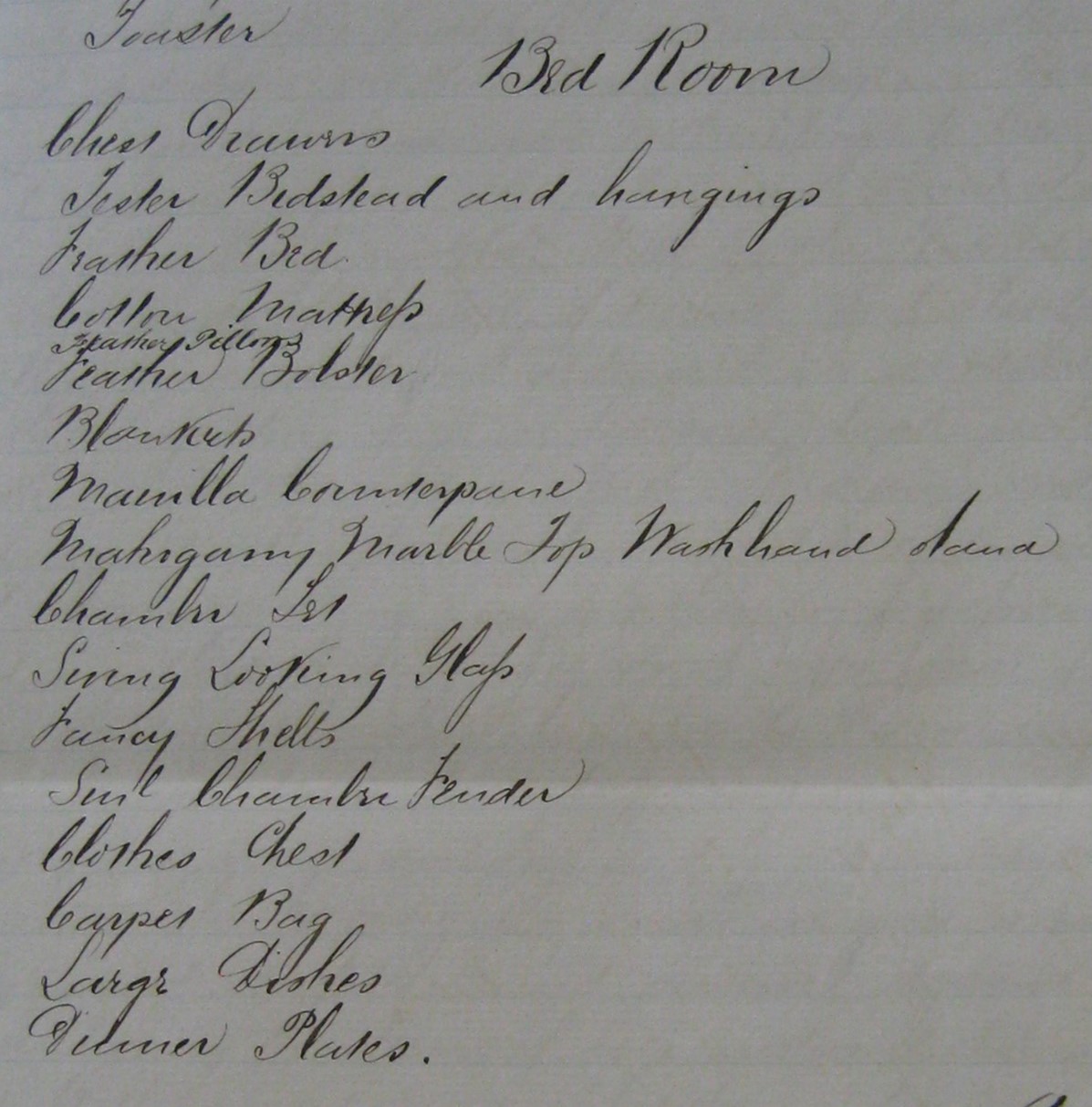
Maria Sainty (PRDR 2/80 154) was the only testator to name her mother as executor and bequeathed what little she had to her parents and siblings. The reason? Her will was made on the 3 February 1886 and she died 17 days later. Maria had made her mark to sign her will as did a significant number of others. It is interesting to note that a person who considers themselves to have an estate to leave should, in the late 19th century, still be unable to sign their name. Many of these were labourers of which 23 are listed.
Other interesting titbits from wills worth exploring are:
- Surnames. Some surnames seem to have disappeared or changed their spelling over time. Elizabeth Whincop from Great Yarmouth (PRDR 2/76 377). Matthias Philippo from Horningtoft (PRDR 2/77 1640) and Marie St Cherbinine from Thetford (PRDR 2/79 364).
- Occupations. William Leggatt of Wells was an inspector of nuisances. (PRDR 2/78 382). Robert Goddard of Great Yarmouth was a billiard table manufacturer. (PRDR 2/77 44).
- Locations. 60 of the 910 testators lived in Heigham, now just a small part of Norwich. Some testators from Norwich simply state the city whereas others mention the specific parish.
- Individual stories. Both of the Riches sisters Great Yarmouth left their estates to each other but Caroline died on 5 March 1886 and Louisa 6 days later (PRDR 2/80 175 and 176). Frances Henslowe from Lakenham stated she wanted to be buried as cheaply as possible! (PRDR 2/80 37).

Researchers of family history, local history and social history will all find something of interest in these wills. For the testators that is their final bequest.
Daryl Long NRO blogger



 Norfolk Record Office
This site is so good. The writing backs it up so well.
LikeLike
Thank you Malcom- we have a great team of Research Bloggers!
LikeLike
A really interesting article. Looking at wills has certainly helped my research
LikeLike
So glad you have found them useful in your research.
LikeLike
How interesting. Thanks for the great read.
LikeLike
Thanks, Kevin! Glad you enjoyed it.
LikeLike