
Written by Christine Shackell
The twelfth of October marks the anniversary of the death of Edith Cavell, the Norfolk born nurse, who was executed by the German military authorities in 1915 for sheltering British and Allied soldiers and assisting them to escape. Edith was born on 4th December 1865 in the village of Swardeston, near Norwich, and was baptised by her father who was the vicar of the parish. Edith spent her childhood growing up in the vicarage there.
The NRO holds a bundle of letters (MC 3308) sent to her widowed mother, Mrs Louisa Cavell, from 1914 to 1915. After her husband’s retirement in 1909 the Rev and Mrs Cavell moved to 24 College Road, Norwich, where he died a year later, aged 85 years. Louisa was very close to her daughter Edith and they were in frequent correspondence. Edith stayed with her mother in Norfolk each summer, having a well-earned rest from her busy life in Brussels running the Nurses’ Training schools across several hospitals.
When war broke out in August 1914 Edith was in Norwich, but speedily returned to her duties in Belgium, which had now been invaded by the German Army. Edith had been raised with a strong Christian faith, sense of duty to others and a strong sense of patriotism, typical of that era.
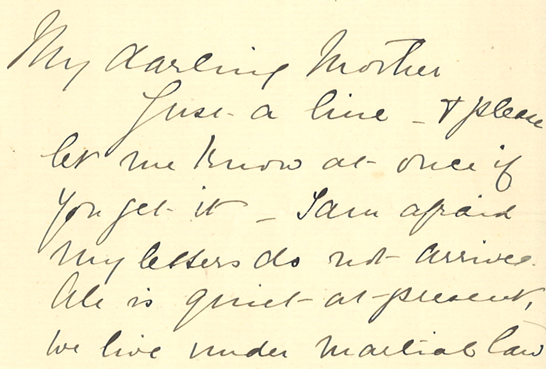
The first letter held in the archive, dated 17th August, was sent by Edith soon after her return to Brussels. She was already anxious that her letters would not get through and asked her mother to “let me know at once if you get it”. She informed her mother that the city was under martial law and the inhabitants regularly stopped in the streets to have identity papers checked. She attempted to reassure her mother, “if you hear the Germans are in Brussels don’t be alarmed” and “besides, we are living under the Red Cross”, closing, “my dearest love. I will write when I can”.
The second letter dated 13 September 1914 was from a friend of Edith’s, Helen Millar, who was living in Ghent. Edith had asked her to write to Mrs Cavell and assure her that “all is well with her and everything is quiet in Brussels”. Helen offered to take a letter from Mrs Cavell to Edith as communication with Brussels was more difficult and she doubted post was getting through.
A letter dated 22 February 1915 left Mrs Cavell in no doubt as to her daughter’s risky activities helping British soldiers to return to England. It was written by Corporal J Doman of the 9th Lancers from his home address in Stourbridge, Staffordshire. He wrote:
“I am a wounded soldier and was taken prisoner in Belgium where I escaped from. I was passing through Brussels and your daughter kept us in hiding from the Germans for 15 days and treated us very kindly. She got us a guide to bring us through Holland. Your daughter wishes for you to write to her and let her know we arrived here safe. But be careful just to put in your letter J Doman and P Chapman quite well or arrived here safe or they may visit her home in Brussels”.
Did Mrs Cavell feel proud of her daughter’s undercover activities or was she terrified that taking such risks would not end well? Mrs Cavell expressed her worries to Corporal Doman. He replied on 3rd March, saying: “ referring to it being risky for her, well I don’t think she has much to fear as when the Germans are about the English do not remain in her house but go out and hide in the town”. However, he went on to say that Edith was also involved in smuggling letters across to Holland and that she thought the last guide had been caught and taken prisoner. He noted that “when the war is over she will be highly praised and well rewarded for the good work she has done”.
On August 11th, Mrs Cavell received an even more alarming letter which had been written on 28th July, from another friend, Ruth de Borengrave, sent via the Chief Constable of Norfolk, warning Mrs Cavell about enemy spies and to particularly look out for a man with a reddish face, short military moustache and a real Cockney accent who said he had a florist shop in Forest Hill, London. This man had threatened Edith when she was being questioned by the German authorities, that he knew where her mother lived. By now, Edith was being closely watched and the authorities were closing in on the whole resistance network.
Edith and many others from her group were arrested on 5th August. Brand Whitlock, Minister at the American Legation, was asked by the British government to enquire as to her whereabouts. He received a reply a few weeks later to say Miss Cavell had admitted to harbouring and aiding French and English soldiers, and was being held in solitary confinement in the military prison. He informed the British government who decided it would “do more harm than good to intervene” and so they did nothing. No one imagined that Edith would lose her life.
Edith was kept in solitary confinement until her trial on 7th October when she was found guilty and her sentence pronounced: the death penalty. Edith was told by the German military chaplain, Paul le Soeur, that her execution was to be carried out the next morning. The chaplain, aware of Edith’s faith, went to find the Anglican chaplain, Rev Stirling Gahan, at his house leaving him a note. The Anglican chaplain, who knew Edith well, was allowed to visit her that evening to administer Holy Communion. In his letter, he quoted their conversation in detail, including Edith’s statement that “I know now that patriotism is not enough. It is not enough to love one’s own people: one must love all men and hate none.” His letter also included an account of her execution from the German military chaplain.

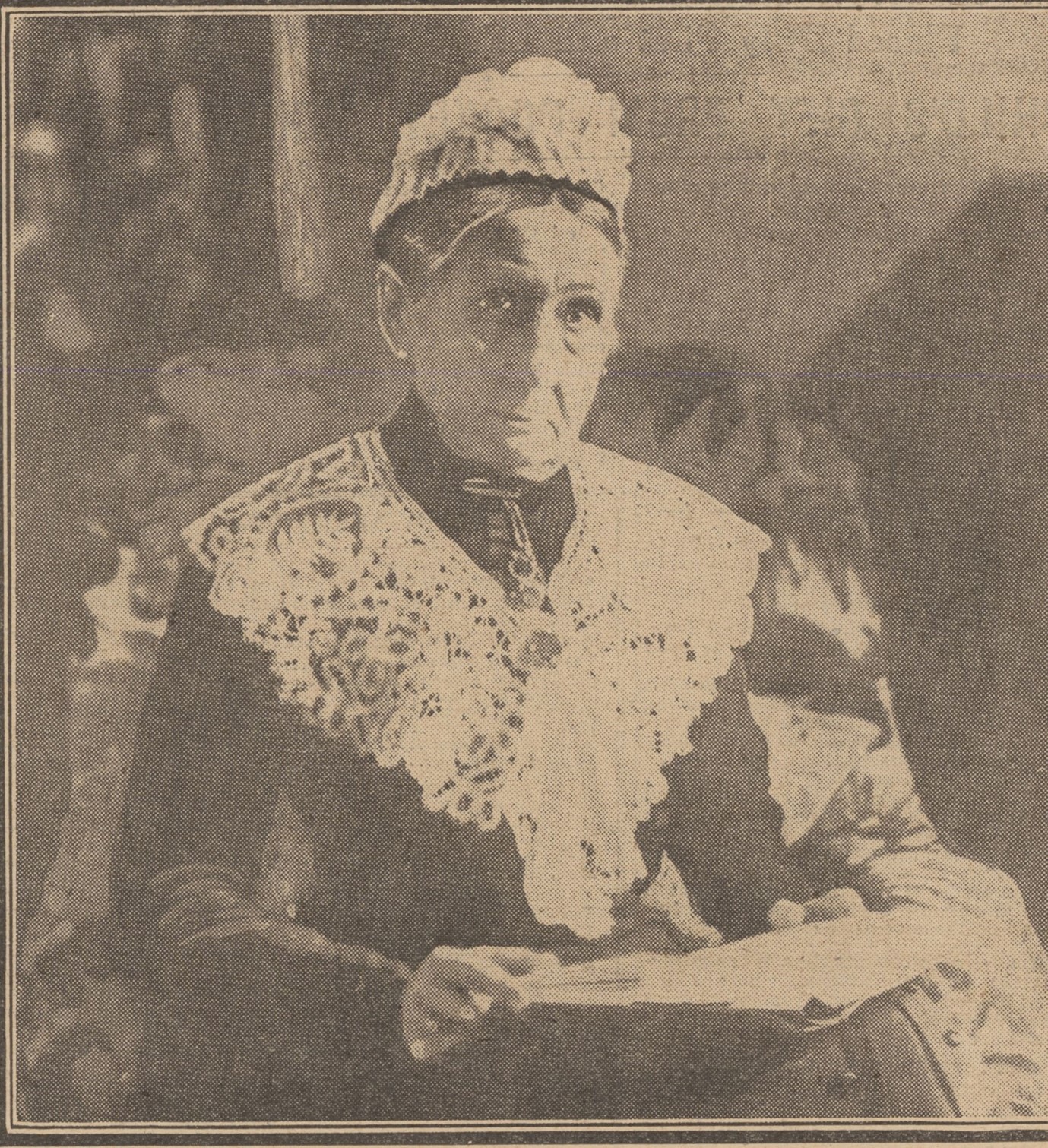
Rev Gahan managed to send a telegram from Holland to Edith’s brother in law which he received on the 14th October. The news of Edith’s death hit the newspaper headlines on Monday 18th October. The world had never before heard of the Matron of the Belgian nurses’ training school. As a woman, nurse, vicar’s daughter and devout Christian, her death as a “blameless woman” rapidly became propaganda against the “evil aggressor” and many thousands joined up as a result. Mrs Cavell became a source of interest to the newspapers and her picture as a small, sad elderly lady in a lace cap appeared in the Daily Mirror on 25th October. She was deluged with letters of condolence as a result.
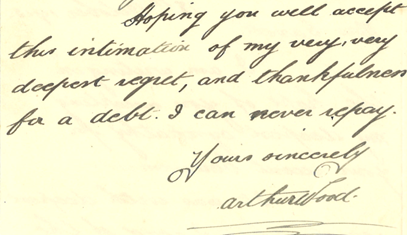
One very moving letter in the archive, dated 18th October, came from Lance Corporal Arthur Wood of the Cheshire Regiment. “It was with the deepest regret that I read of the terrible calamity that overtook your daughter” he wrote. He went on to describe how he had escaped from the Battle of Mons and been in hiding “when he got into communication with your daughter.” Edith had arranged his transport to Brussels and then hidden him for five days in the hospital before arranging his escape through Holland. He was one of the hundreds of soldiers who owed their lives to Edith and spoke for many in describing the “debt he could never repay”.
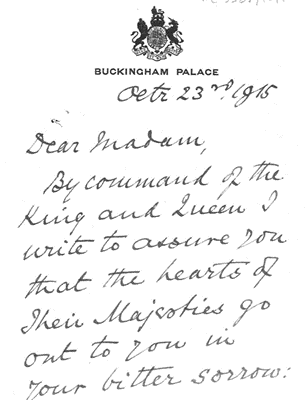
Mrs Cavell also received a letter from Lord Stamfordham written on behalf of their Majesties, King George V and Queen Mary.
Was she comforted to know that her daughter was held in such high regard as a result of her sacrifice? Did she share the nation’s anger at the death of her daughter or did she share Edith’s view that she should “love all men and hate none”? She would certainly have been distressed that Edith’s body had been hastily buried and a request to return it refused and that the last letter Edith wrote to her mother was never delivered. Mrs Louisa Cavell died aged 82 years on 17th June 1918. She did not live to know her daughter’s body was returned home to Norwich after the war, with all pomp and ceremony, to be buried in the Cathedral grounds.
Postscript
The handwritten letter from Reverend Gahan, British chaplain, describing his visit to Edith Cavell on the evening before her execution which is quoted above, gives a slightly different version of Edith’s famous statement which is inscribed on her memorial in London. The archive holds a separate typewritten account (MC 3308/8) of Reverend Gahan’s conversation with Edith which was sent from Brand Whitlock, the American legate in Brussels to the American ambassador in London and on to the Foreign Secretary. In this copy the neater, more often quoted version is given, “I realise that patriotism is not enough: I must have no hatred or bitterness towards anyone”.
Sources
Norfolk Record Office MC 3308
Edith Cavell Diana Southam 2010 Quercus



An interesting piece of research.
I hope that this is just a small sample of the letters Mrs Cavell received, from the two hundred service men, whom Edith Cavell helped to escape.
A fitting tribute on the anniversary of her death.
LikeLike
When I visited Canada in 2017, part of our trip involved driving from Jasper to Banff, passing through the Jasper National Park. We stopped somewhere for a short break & saw a sign pointing towards Mount Edith Cavell which, until that moment, I never knew existed. The view out towards the mountain range was fabulous. It turns out the mountain is the most prominent peak in Alberta and was named in 1916, previously known as Mount Fitzhugh.
LikeLike
Hi Lorraine, thanks for letting us know- it’s a real sign of how widely Edith’s death was felt.
LikeLike