
Written by Christine Shackell, NRO research blogger, July 2023
The history of Norwich shawls may seem an unlikely topic for correspondence between two Victorian gentlemen but the archive holds four such letters, written at the beginning of 1897. (Norfolk Record Office, MS 21322/1-7, 259X1)
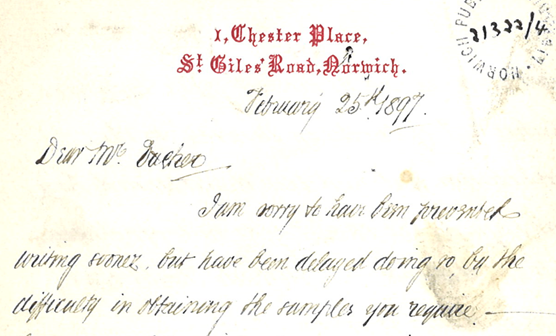
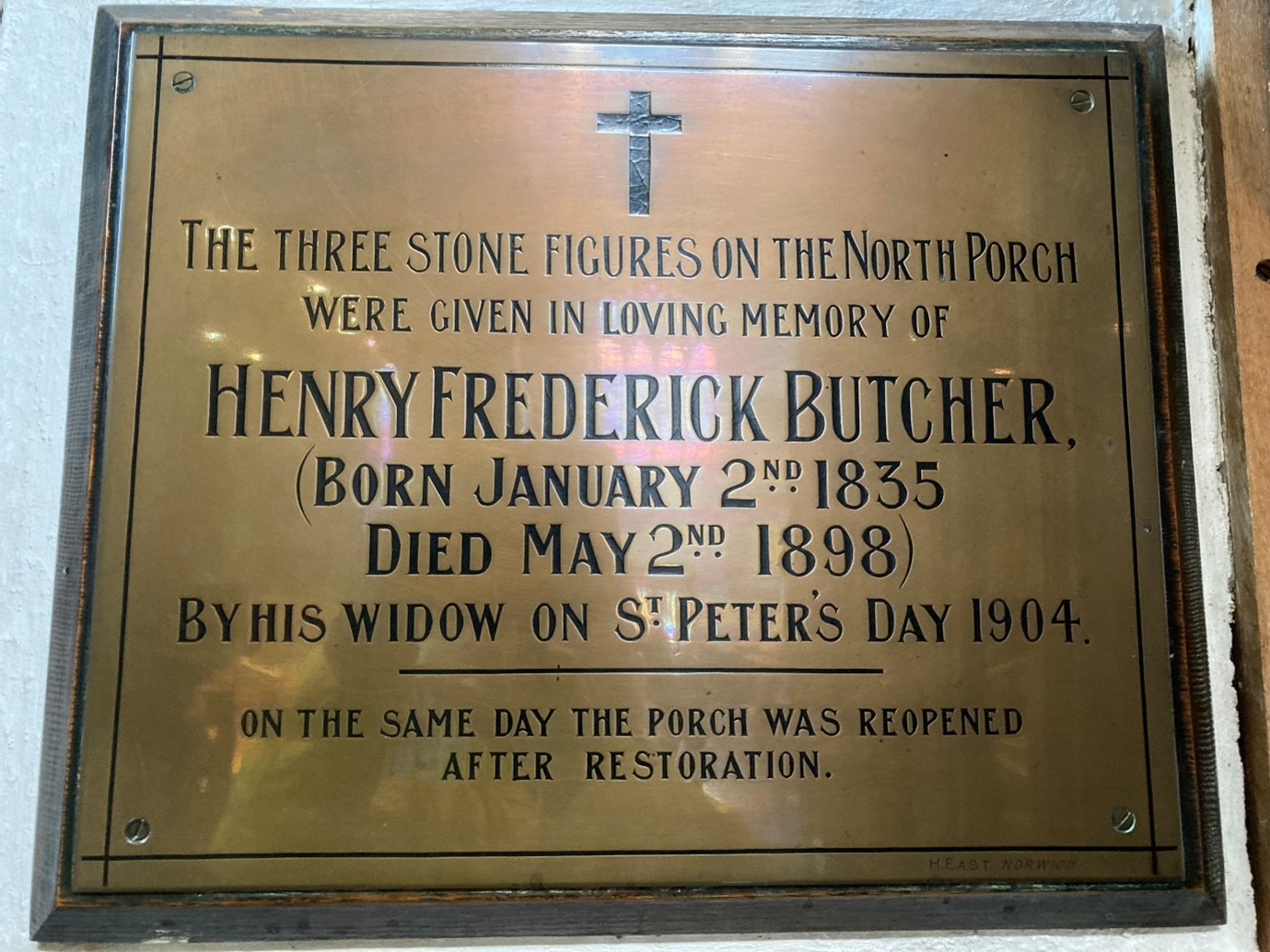
The author was Henry Frederick Butcher, a retired business man from Norwich, living at 1 Chester Place which is to the west of the city centre. Henry, now in his early sixties, had been employed in the family business as an estate agent and auctioneer then latterly as proprietor of the Royal Hotel in the Market Place, which was owned by his brother. His correspondent was Sydney Vacher, an architect living in London. Why Mr Vacher was seeking information about the Norwich textile industry and shawls in particular we do not know. In his first letter Mr Butcher explained the difficulties of the task, as manufacture of the shawls had been discontinued twenty years earlier and there was no immediately obvious source to consult. He suggested White’s Directory for Norwich for 1836 and 1845 which provided a brief history of the many centuries of Norwich’s manufacture of both wool and silk cloth, and also A General History of the County of Norfolk published in 1829 by John Stacy, both of which he advised could be found in the British Library.
Norwich had long had a textile industry. The majority of looms until 1840s were still worked by hand in the weaver’s home but then power looms in factories quickly took over the work, leaving the hand loom weavers in dire economic straits with new manufacturers springing up to take advantage of the textile market. According to White’s directory Jacquard looms were introduced into Norwich about 1833 and allowed complex patterns to be produced. A typical pattern was a pine cone shape or boteh, which we now call a Paisley pattern as the manufacturers of the town of Paisley also used it on their shawls. Kashmir shawls were a fashion item in the early 1800s and by the 1850s many firms in Norwich were making their own version of these shawls. The most well-known was Clabburn, Sons and Crisp who won a prize for a Norwich Shawl at the Great Exhibition in London in 1851 and the first Paris exhibition of 1855. By the time of Sydney Vacher’s enquiries to Henry Butcher in 1897, the shawl was no longer the essential fashion accessory.
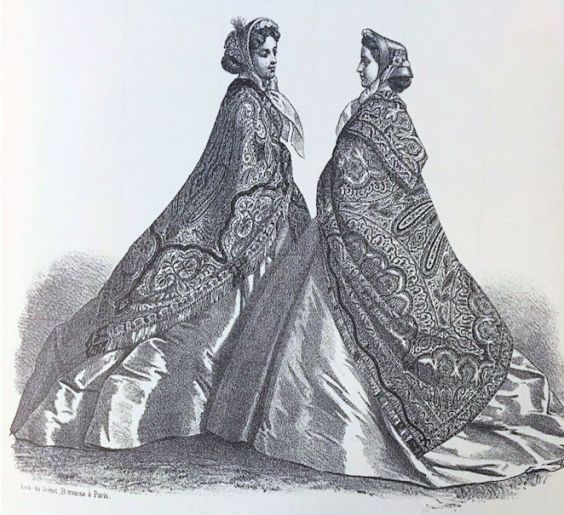
Henry Butcher sought out “two old artisans”, men who had been employed in the industry but warned Sydney Vacher that it would take time to elicit any information from them as first he had to catch them at home when he called.
In his second letter Henry described a visit to James Arnold who had been employed as a “practical weaver” in his youth by Willett and Sons and later by Clabburn, Sons and Crisp. By the 1901 census, Arnold was a silk manufacturer in his own right and described as a “veteran craftsman” by the Norfolk News of 5 April 1902, so Henry had found a credible source to answer his queries. Henry had a shawl in his possession which his wife had inherited from her grandmother which he took along when he visited James Arnold, who lived quite close by. Mrs Butcher’s Norwich shawl, he proudly reported, was assessed by Mr Arnold as handwoven by Clabburn’s around 1844 with a silk warp and a Botany wool weft and of “extra quality”. Shawls of this date, known as fillover shawls, were generally hand embroidered. It had not been produced on a Jacquard loom. Sadly for us, Mr Butcher does not describe this shawl in any more detail regarding its colour or pattern to help us envisage it.
In his third letter, Henry reported back on Mr Arnold’s view of the 3 shawls sent by Sydney Vacher. None were credited by Mr Arnold as being Norwich shawls. The first he described as a Paisley shawl, “an imitation of a Norwich fillover shawl” and the other two of foreign manufacture, possibly Turkish, the other “Oriental” possibly Persian and of “low quality”. A footnote to this letter written in a different hand which could be Sydney’s, records that the first shawl had an all over pattern similar to a Norwich shawl, the second was green and had been bought in Norwich and the third had been bought in Wales. He clearly did not have the skill to spot the genuine article from the many cheaper copies available. Henry Butcher’s shawl had belonged to his wife’s maternal grandmother, a native of Fakenham, a market town in north Norfolk and passed down within the family thus establishing a clear provenance.
The fourth letter between our correspondents moves on to provide information about other fabrics manufactured in Norwich. Henry obtained samples from another source, Mr R L Simpson of Dog Head Lane in Norwich, who like Mr Arnold was now a manufacturer in his own right, having been previously employed by a different firm, that of Fowler and Co.. Mr Simpson provided him with a sample of Norwich camlet, woven by himself, but long discontinued, which was enclosed with the letter along with a sample of poplin. Henry had owned a driving cloak of camlet, noted for being very hard wearing and waterproof. He commented that he preferred it to the new India rubber cloaks which had a dreadful smell. He had been unable to acquire a sample of bombazine, also no longer manufactured. He gives a short history of the fabrics and comments that Norwich camlet was made into dresses provided by Doughty’s Almshouses and the Great Hospital for their female inmates to wear.
Although the letters give no indication as to why Sydney Vacher was so interested in Norwich textiles, a closer look at the man himself might provide a clue. Sydney was an architect who had also exhibited work at the Royal Academy of Arts and had written a book Fifteenth Century Italian Ornament published in 1886. In researching the book he had studied the textiles in Renaissance paintings at the National Gallery in London and reproduced the fabrics in the garments worn in the paintings in two dimensions so that they could be used in fabric design, saying he wanted these beautiful designs to be used in fabrics or wallpaper in the home. Sydney’s motivation behind his research into Norwich shawls may simply have been a love of textile pattern and design.
Christine Shackell, NRO research blogger, July 2023
Further information and sources:
According to White’s directory Jacquard looms were introduced into Norwich about 1833 and allowed complex patterns to be produced. A typical pattern was a pine cone shape or boteh, which we now call a Paisley pattern as it was the manufacturers of the town of Paisley who also used it on their shawls.
https://norfolktalesmyths.com/2019/03/30/norwich-shawls-once-ahead-of-the-game/
https://norfolktalesmyths.com/2018/05/18/doughtys-hospital-its-beginnings/
https://greathospital.org.uk/history/
https://www.nationalgallery.org.uk/podcast/podcasts/the-national-gallery-podcast-episode-59
Hoyte Helen The Story of Norwich Shawls Nick William 2010
Clabburn Pamela The Norwich Shawl HMSO 1995



 Norfolk Record Office
Results of Aylsham … Unfortunately I was delayed this morning and missed this zoom session. Was there a recording, please?Kind regards, Mo
LikeLike
Hello Mo. Unfortunately the talk this lunchtime wasn’t able to be recorded due to copyright.
LikeLike
Thanks for your swift reply – maybe it will be repeated some time?
LikeLike
Hi Mo, we have mentioned to Jack that it would be good for him to give another talk sometime, so please watch this space….
LikeLike
Very interesting and informative. Thank you also for including two of my blogs in the ‘Sources’ used. It is very satisfying to have been of use. I will continue to reciprocate where appropriate.
LikeLike
Thanks, Hayden, we’re glad you enjoyed it.
LikeLike
Is the Norwich shawl collection likely to be exhibited in the near future at either the Castle Museum or another location in Norwich? Such an important collection highlighted in this latest post.
LikeLike
Hi Julie, I’m not sure of the answer, that would be a question for the Norfolk Museum Service costume and textile collection. See the link for more info. https://www.museums.norfolk.gov.uk/collections/explore-the-collections/costume-and-textile
LikeLike
Hi Julei.
The ‘Norwich’ shawl collection, apart that is, for a small selection in the Norwich Castle Museum, is currently in storage at Gressenhall Workhouse Museum. The textile collection is normally held at The Shirehall Study Centre, in Norwich, however at the moment repair work is being undertaken on part of the building, so the shawl collection has been temporarily moved.
It is due to return to the Shirehall later this year. There are plans to photograph the shawls so that they can be viewed digitally on the Norfolk Museums catalogue online.
LikeLike
Interesting research, so much Norfolk history from just 4 letters.
LikeLike
Fastinating, my 3X great grandfather was a “weaver of silk and worstead” in Wymondham 1814.
LikeLike
Thanks for sharing, Susanne. Glad you enjoyed it.
LikeLike