
I suppose the idea that a business’s life can be short and tumultuous is far from original. But there are also exceptions – ventures that succeed, come into trouble, and are reborn – and rather than blips that are replaced by fast-food restaurants, carry their story on into a new era. Great Yarmouth’s Royal Aquarium Theatre was one such building. Originally built in 1876, it oscillated rapidly between good and ill fortune, and was continually adapted to these changing conditions1. Several incarnations later, it still stands – no longer an aquarium, but ever part of Great Yarmouth’s history and charm.
A Visit to the Aquarium
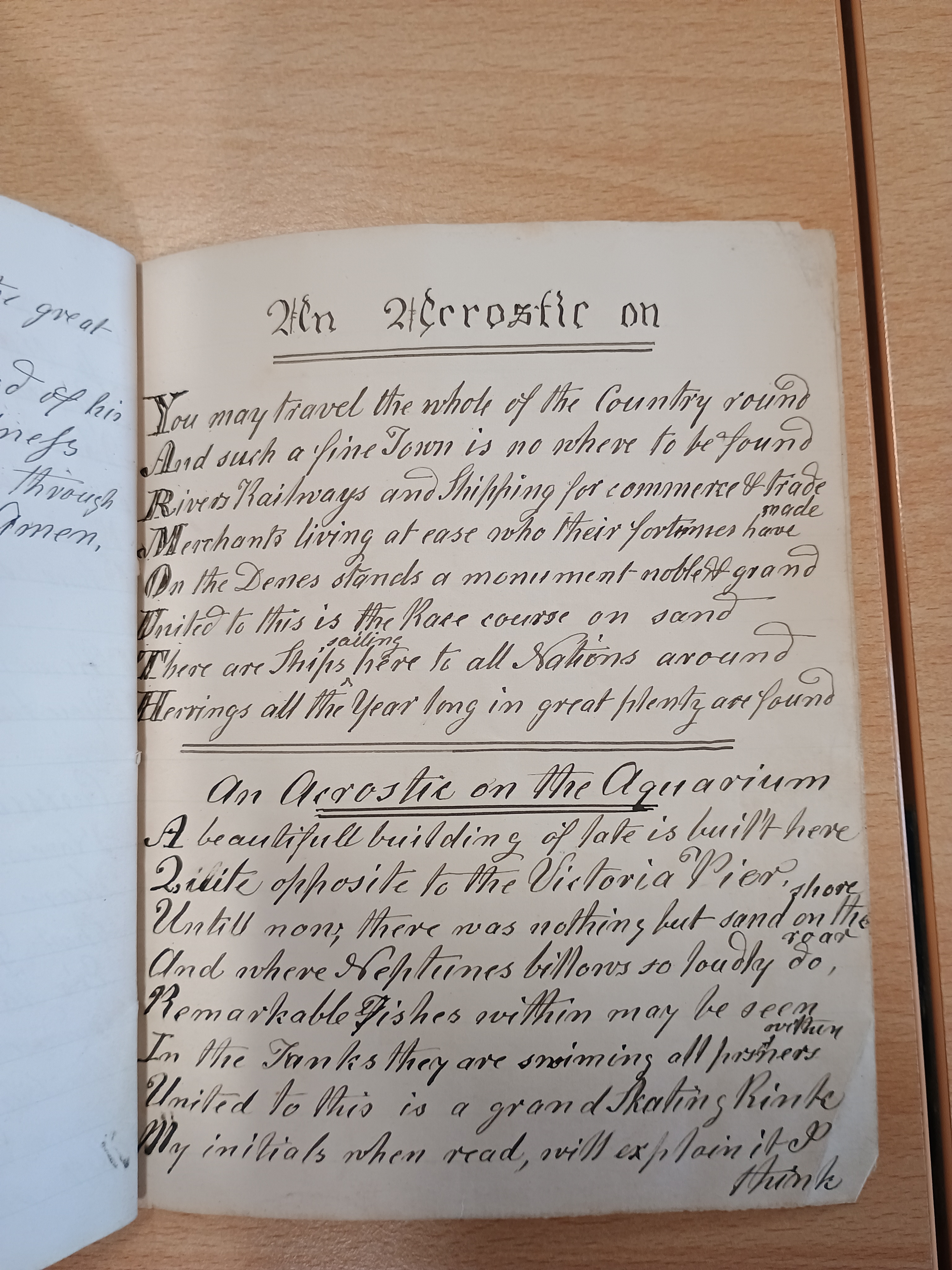
At its inception, the Aquarium was neither royal nor a theatre, although it did already show some variety in entertainment; beyond the usual exhibits, it had a rooftop skating rink, and from 1879 it also saw success hosting dramatic performances (NRO, Y/D 51/1968). One Mr J. Starling of Worstead visited the Aquarium soon after it opened and described it in his diary, now held by the NRO (NRO, PD 402/226):
…In a small cell is the curious little fish the Sea Horse, with its neck and head erect, resembling the Horse, but there is no saddle on it for the rider,
In the tanks you may see Parshe [mullet], Roach, Bream, millers Thumbs [bullhead], and a great variety of fish taken from the Broads, and Rivers
In one tank are some beautiful Lobsters, traveling about with their wondrous weapons of defence the Claws, also some splendid Coral from the bottom of the Ocean, and many more things too numerous for me to mention.
Now I ascend the staircase to look at the Skating Rink, what a pretty place it is, to my thinking, with a delightful view of the Sea…
Mr Starling wrote very poetically, but his genuine enthusiasm here is palpable. While I recommend looking through his entire diary, I will at least include here the final page.
From Fish to Theatre
The NRO holds other Aquarium records, too – this plan shows a simple, possibly early layout.
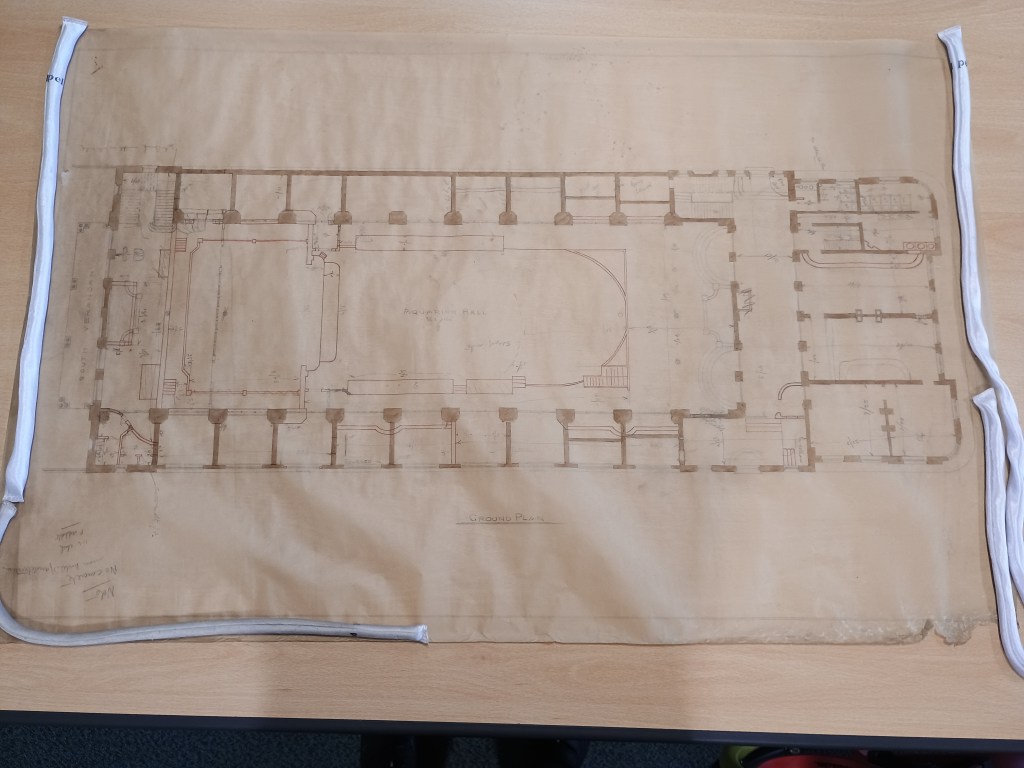
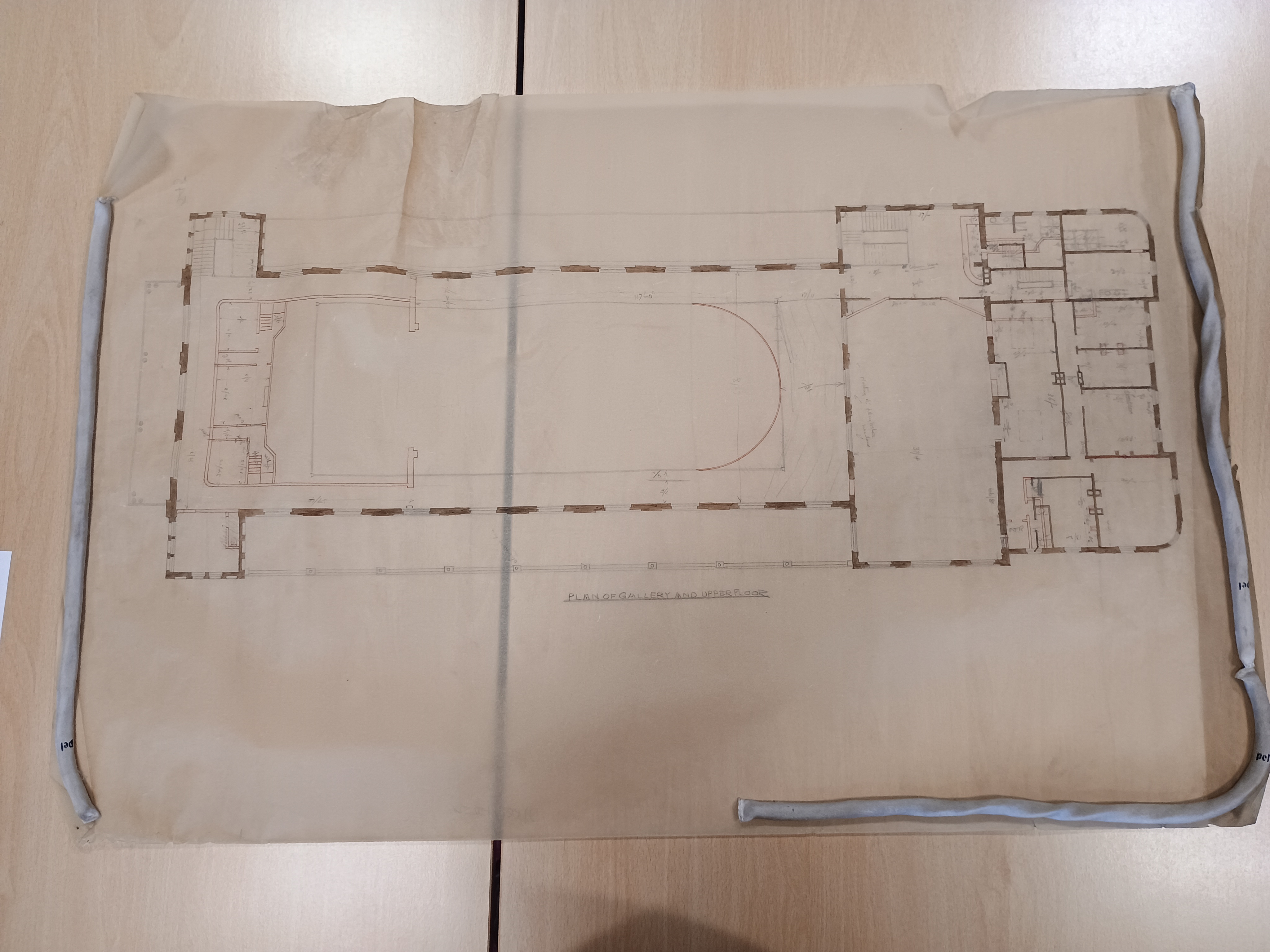
The paper is translucent and very brittle, and there are pencilled notes scrawled across it in a general hand, rather than printed as might be found on a final plan. Constructing a building requires confidence – there must have been reason to believe that it would succeed, and if we were to simply take Mr Starling’s account, it would seem as if it did.
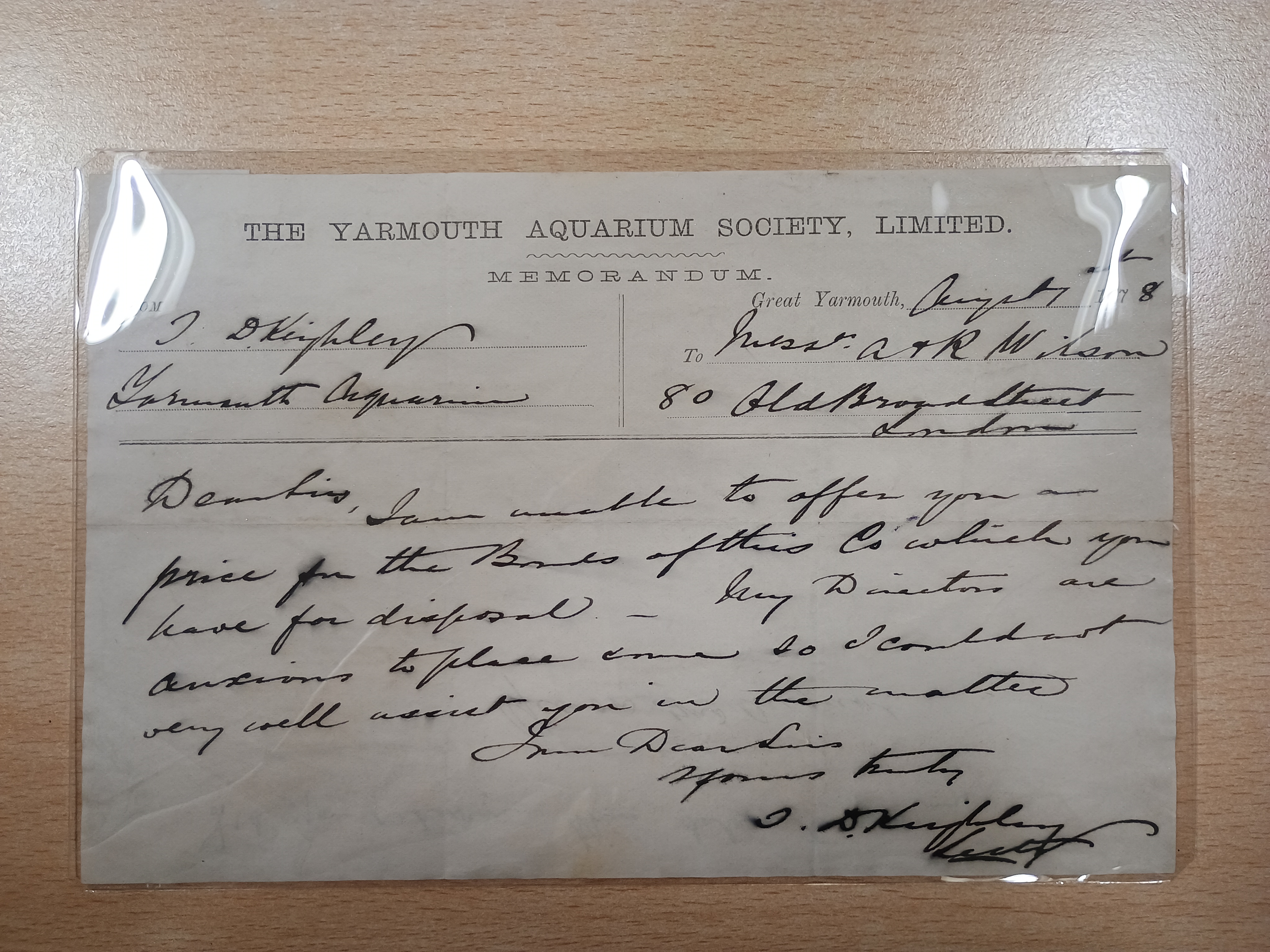
Reality was more complicated. A memorandum from a mere two years later (NRO, MC 1467/1, 812X6) shows that the Aquarium refused to purchase back bonds of the Aquarium Society, perhaps hinting at financial instability.
By 1881, a petition reveals that intercompany politics hindered the theatrical performances that were becoming the mainstay of the establishment (NRO, NRO, Y/D 51/1968).
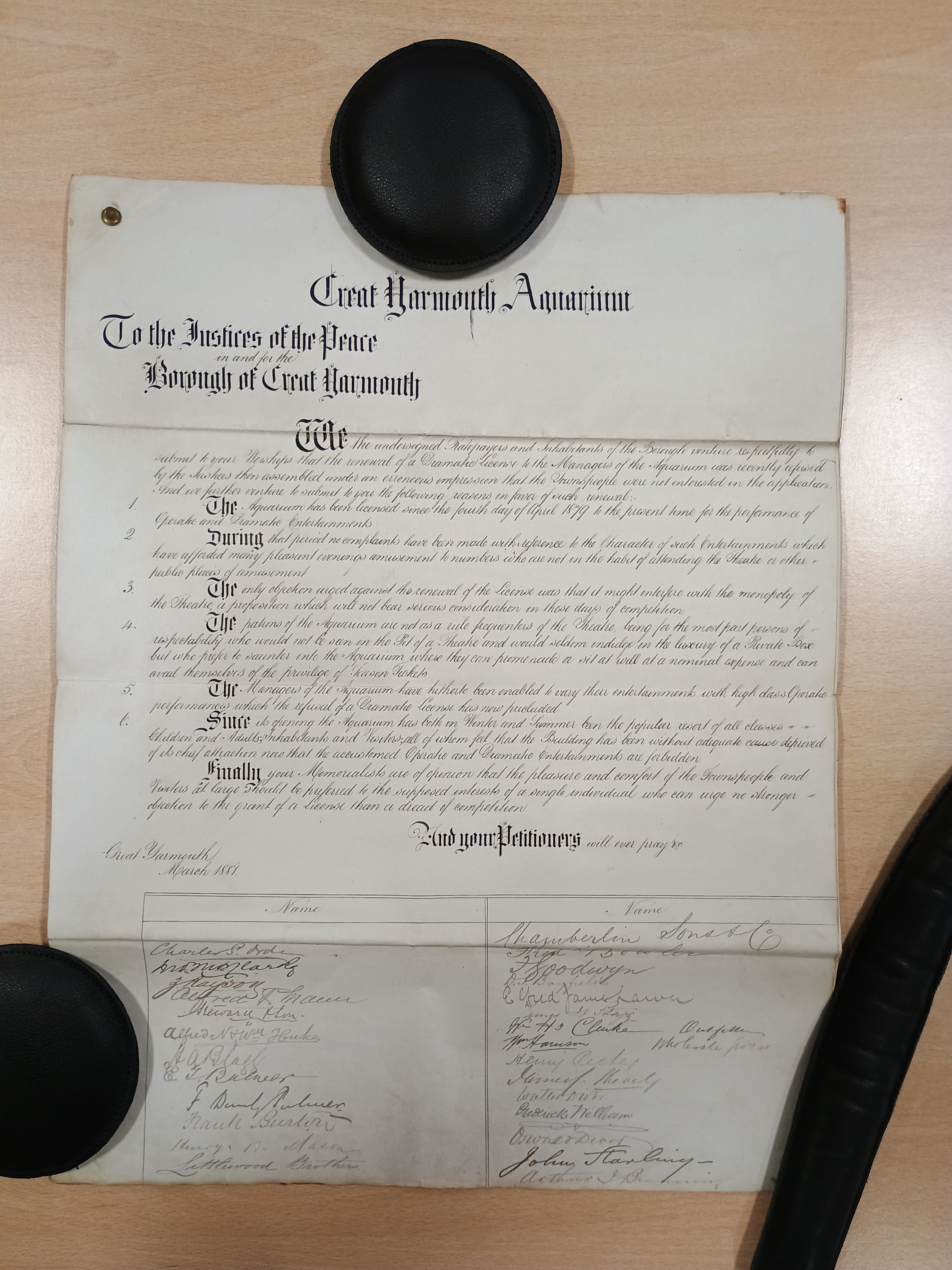
This petition argued that the Aquarium performances were very popular and filled a unique niche in the local entertainment. With more than 200 signatures, this seems to have been a common notion – and this popular support may suggest why, despite royal visits in 1881 and 1882 earning it the title of Royal Aquarium, it was redeveloped into a theatre by 1883.
Plans for Change
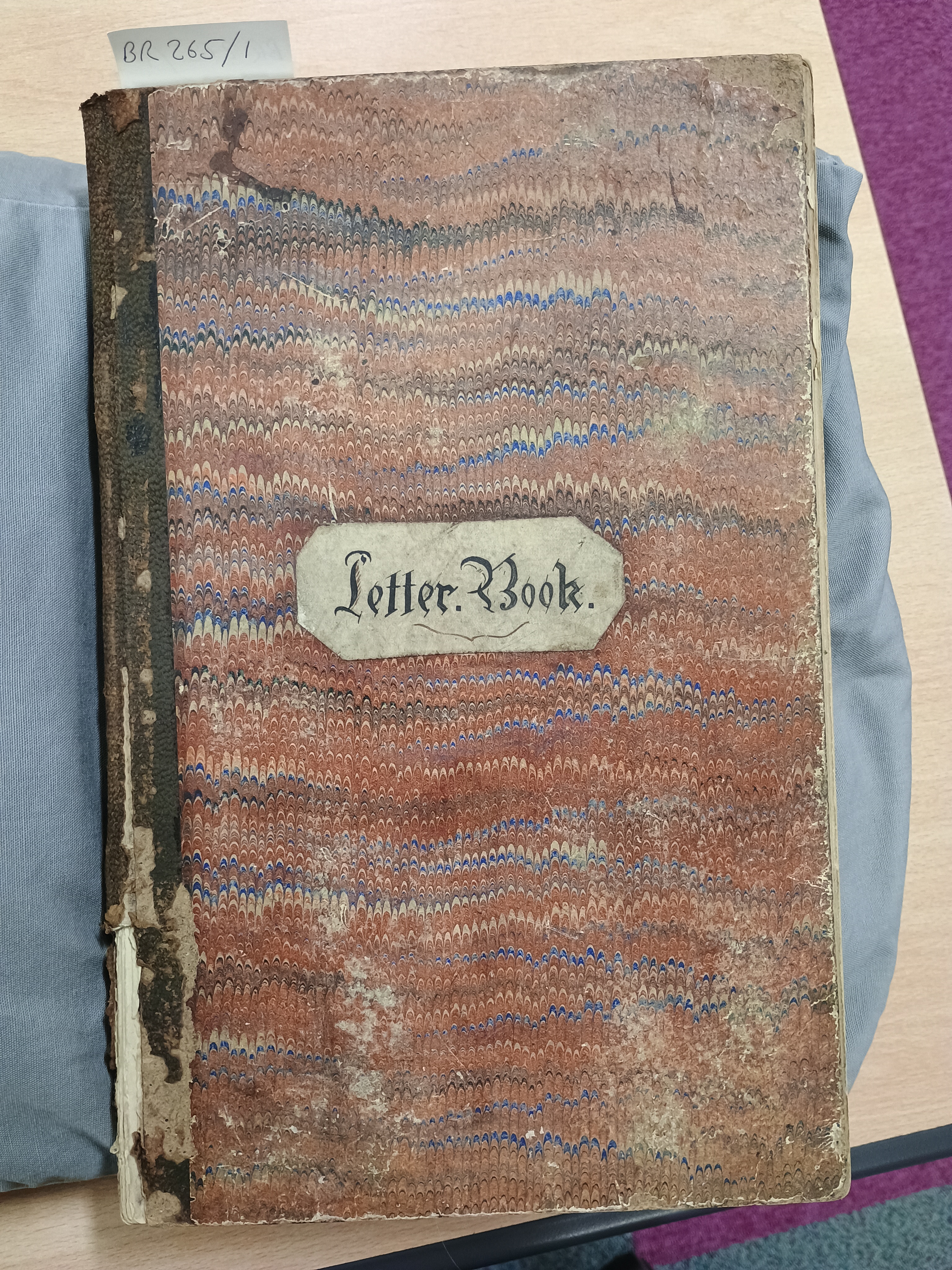
Even this redevelopment did not go entirely smoothly, however; a letter book belonging to architects Bottle and Olley (1883-84) holds repeated correspondence with the Royal Aquarium, describing the mislaying of floorboards, damaged shifting panels, and payment renegotiations (NRO, BR 265/1).
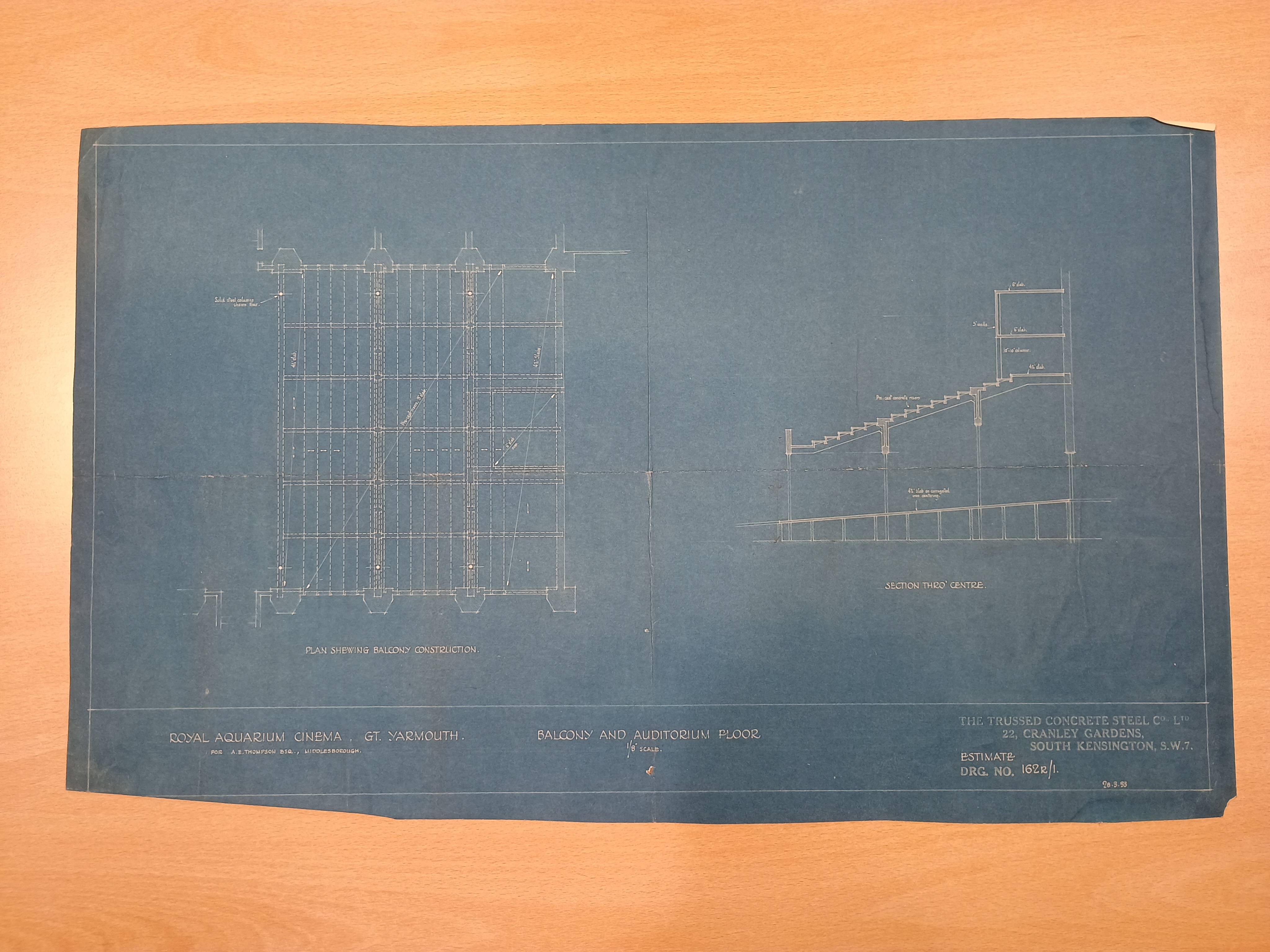
Nonetheless, it survived the development and continued on from that point fairly well, to the extent that by 1931, it was again under construction – this time with a proposed plan to add 530 additional seats via a balcony (NRO, Y/BE 2/647/1-2). The plan is cleverly constructed; an attached partial sheet displays the balcony plans, able to be rolled out of the way to show the existing capacity of 1,065 seats.
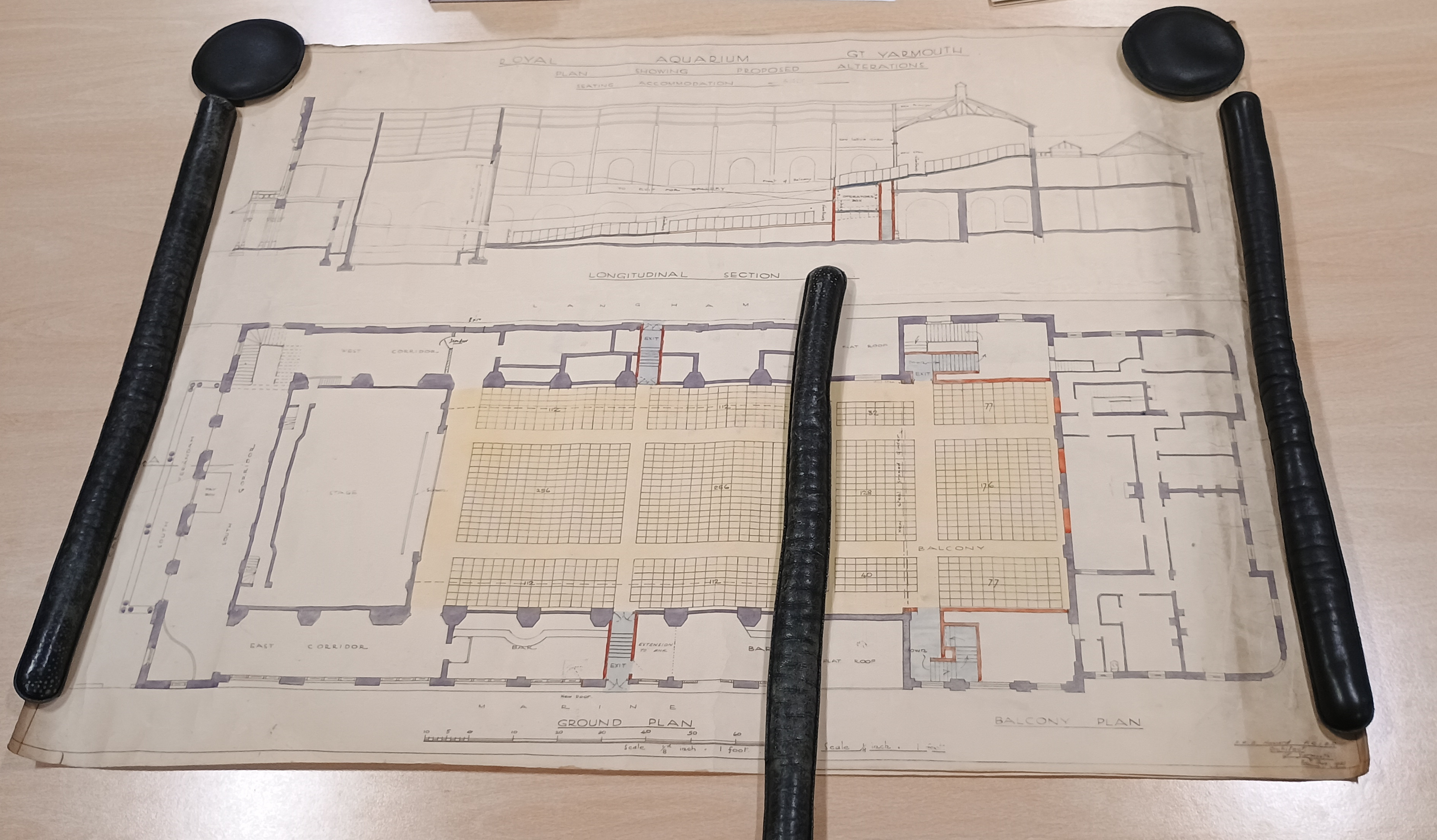
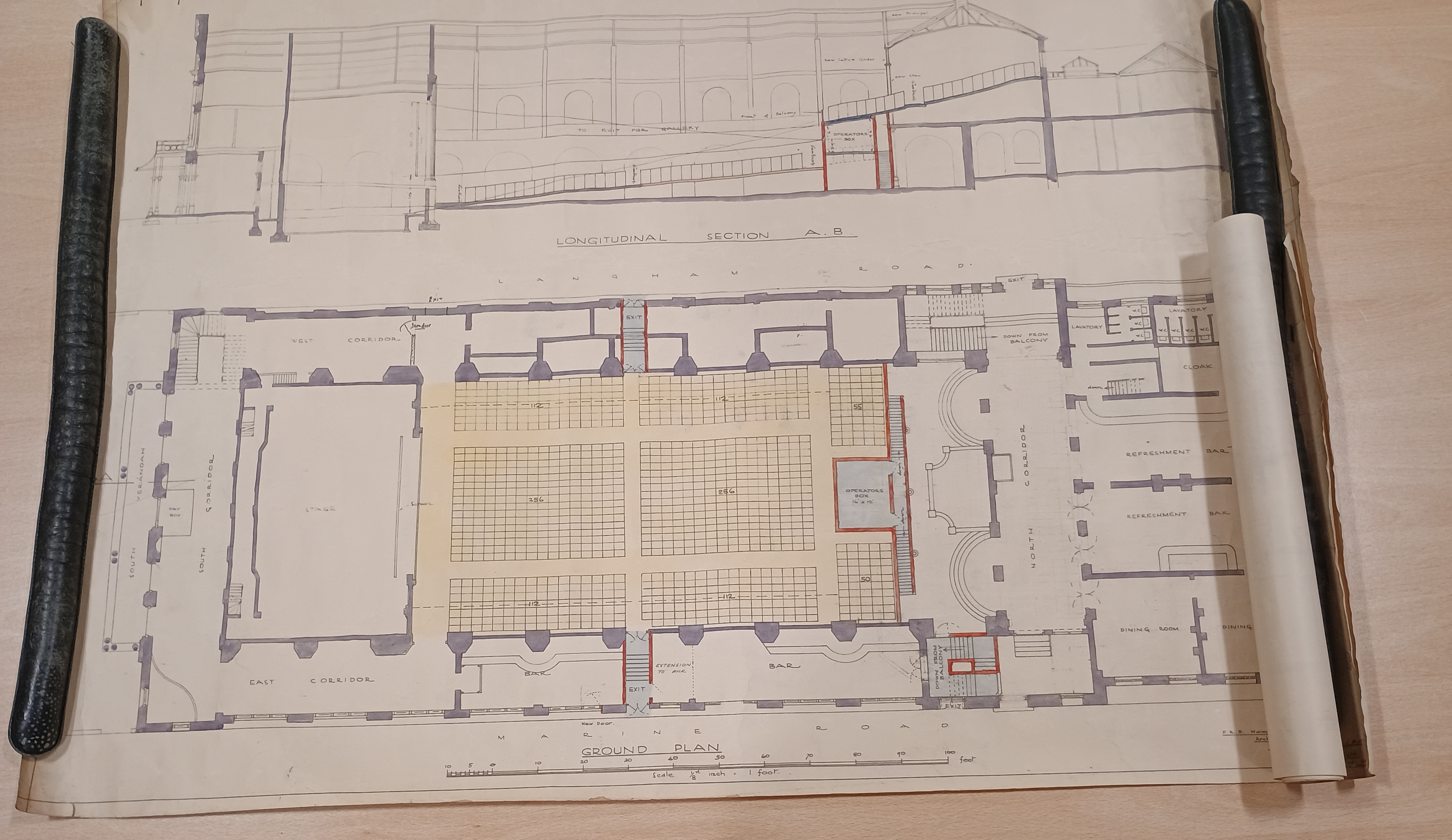
The NRO also possesses a blueprint from 1933 neatly illustrating the internal structure of the balcony (NRO, BR 35/2/36/4). Notably, the blueprint is titled ‘ROYAL AQUARIUM CINEMA , GT. YARMOUTH.’ – at some point down the line, the Aquarium had clearly transformed again. From the fact that it was necessary to increase the seating, one could assume that there was confidence in its future once more.
To the Modern Day
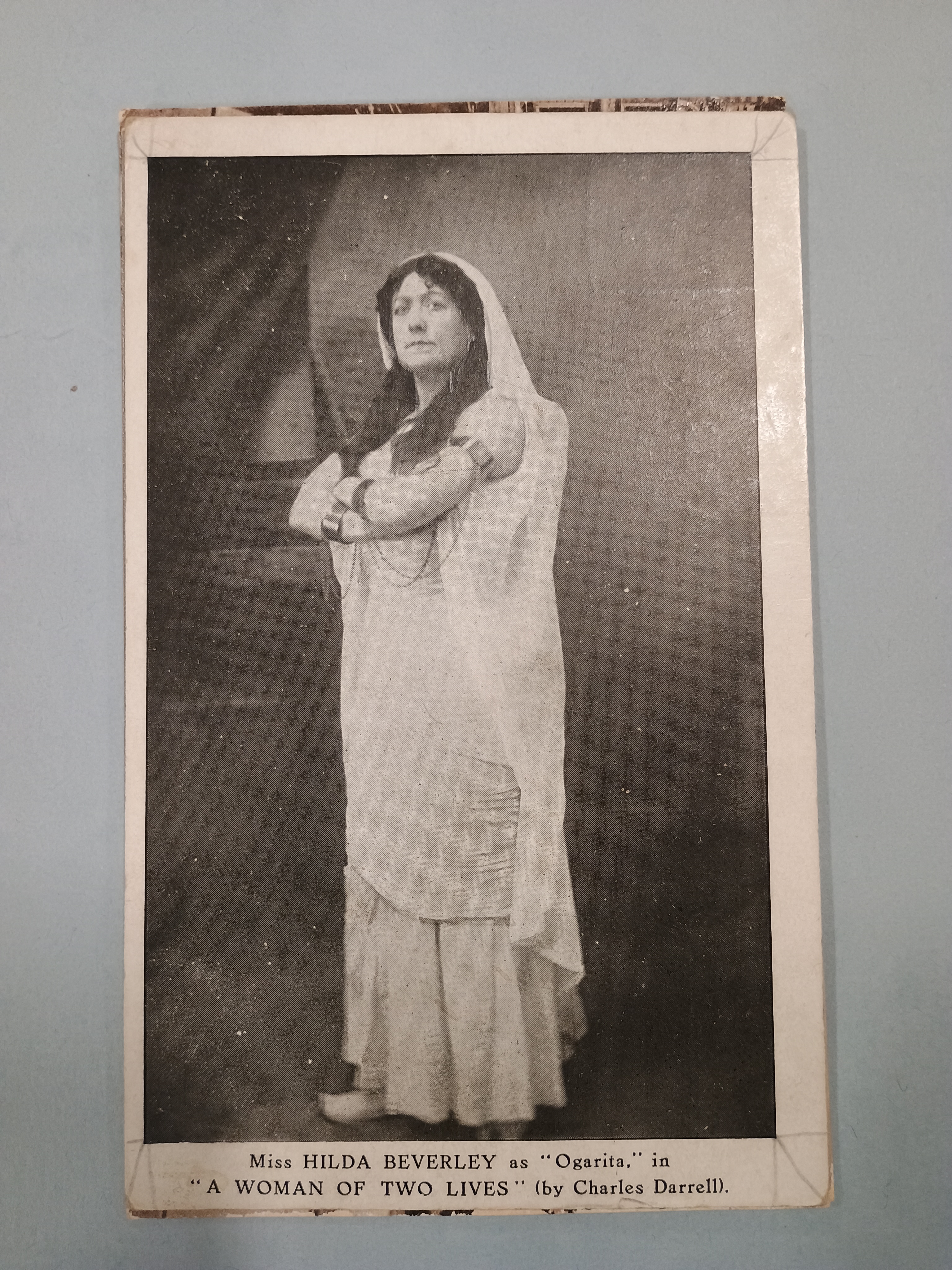
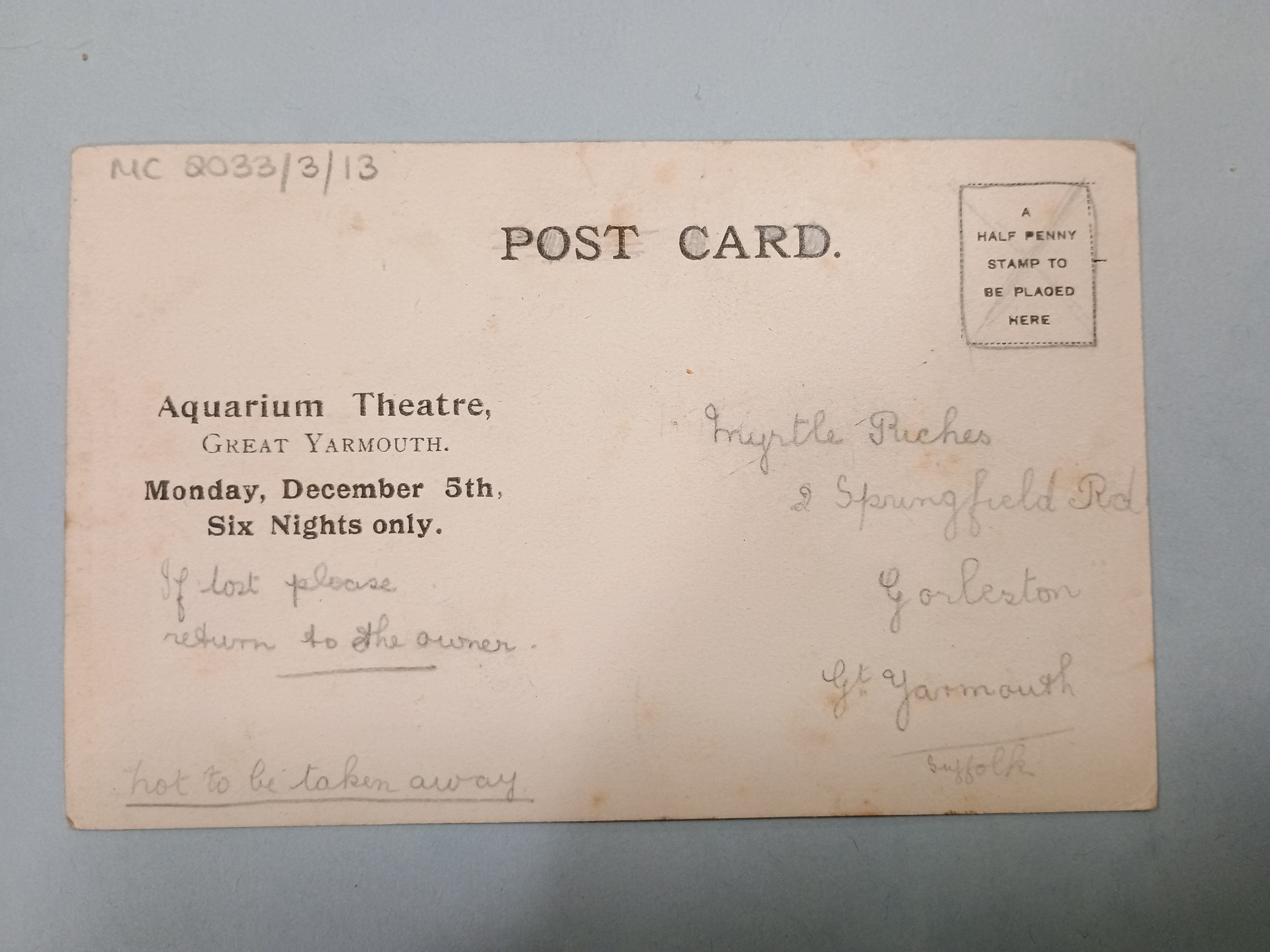
A postcard shows us a glimpse into an Aquarium performance (NRO, MC 2033/3, 901X9). A woman stands two-thirds to the camera in stage costuming, her dark hair framing the somewhat challenging expression on her face. On the reverse side of the postcard lies the owner’s address, and the handwritten inscriptions ‘if lost please return to the owner.’ ‘not to be taken away’, both firmly underlined. Here, the building still bears the title ‘Aquarium Theatre’ – was this postcard perhaps from before the cinema era, or was this a holdover? Did the owner, who seems to have valued it dearly, see this play? Or did they simply receive and cherish the postcards?
In the end, we can’t answer those questions from the NRO’s records. We’re left with a few pieces of paper, made by many different hands, spelling out how persistence and mutability could turn a dramatic license in 1879 into more than a century of entertainment. It continues even now, in fact; and albeit as part of the Arc Cinema chain, serves a similar purpose. In other words, to answer the original question of title, it seems – as with everything – that it was the people that have made it what it is.
From the 200-odd people from the petition, to the singular opponent who initially made it necessary; from the enthusiastic recollections of Mr Starling, letting us know almost 150 years later what types of fish he saw; from the carefully kept postcard, to the meticulous plans, to the everyday grievances in the letterbook – all showing us exactly where the whole process fell down, and where people decided to pick up again and keep going despite it all.
Without these people, this building may well have been another blip – and yet it remains. Without this building, we may never have thought about the lives of any of these people – and yet here we are. More than just a cinema, this formerly Royal-, formerly Aquarium-, formerly Theatre- building is a living part of history; and even were it to be demolished tomorrow, it would still have left a tangible record of the people connected to it – in a thought that brings us back neatly to Mr Starling, as he walked up those stairs in 1876:
Oh here are the Skaters flying about on their Skates with four wheels going at a rapid pace, perhaps little thinking how swiftly they are skating over their little Rink of time, into a neverending Eternity,
Those who have happened upon the Royal Aquarium Theatre may think little of it – but to the building, I think I could safely say that their part in the history of it has made all of the difference.
Researched and written by Alistair Carr
Footnotes
- Historic England. ‘The Royal Aquarium Theatre viewed from North Beach Gardens to the south-west’. Historicengland.org.uk [https://historicengland.org.uk/images-books/photos/item/CC76/00349], accessed 15 12 2025. ↩︎



 Norfolk Record Office
A simple BNA search of J W Nightingale, proprietor , formerly the lessee in 1889 ,also the guy at the New Pavilion and Royal Assembly Rooms reveals the full extent of the productions in the late Victorian and early Edwardian era in GtY. A whole new story
LikeLike
Love the acrostics, and a way with words sadly missing today?
LikeLike
Thank you for this really interesting article, but it was really quite a shock to see it popping up!
We are volunteers at RAF West Raynham, now closed, and have been researching the Merit Boards which hang in the lobby. One of those people listed was Mentioned in Despatches and was, before WW2, an actress whose father was the manager of the theatre.
If you would like the article we wrote, we would be happy to send it to you.
Best wishes Kalven & Helen Stanley
LikeLike
Hi Kalven and Helen,
That sounds really interesting and certainly would give more insight into one the people included in the post. Yes please do get in touch about the article. If you email norfrec@norfolk.gov.uk and mark it for the attention of Education, Outreach and Wellbeing we can liaise from there.
LikeLike