
While visiting a house on The Street in Poringland a member of the local Archive Group noticed signs above two doors, one with “girls” and the other “boys”, indicating that at some point the building may have been used as a children’s home. Initial research into residential homes under the care of social services drew a blank. Then while looking through the Eastern Daily Press Digital Archive, an article dated 11th March 1915 referenced a new children’s home in Poringland, shortly to be opened, instigated by the Guardians of the Henstead Poor Law Union.1 Having established this, a search through the Record Office Catalogue identified the Minute Books of both the Henstead Union2 and the Henstead Children’s Home and Boarding Out Committee.3
The Henstead Poor Law Union was established in 1834, when the Poor Law Amendment Act was introduced. The Union consisted of 37 parishes, with the Union workhouse built in Swainsthorpe in 1836, with a maximum capacity of 250 people.4 At the time of the 1911 census there were 106 inmates.5
In 1913, The Poor Law Institutions’ Order stated that children over 3 years, unless they were on a sick ward, should not remain in the Workhouse longer than six weeks. The Act classified a child as being aged between three and sixteen years old, children under three were classified as infants.6 This did mean that in some cases, children were separated from their parents and younger siblings as was the case of Florence Purdy, a widow, who remained at Swainsthorpe with her two youngest children while the oldest were moved to Poringland.
Subsequently in January 1914 steps were taken by the Guardians of the Henstead Union to purchase land for the building of a children’s home in Poringland. A plot of land on The Street, was purchased by June 1914 from Martin and Geoffrey Birkbeck for the sum of £15, with compensation paid to them for the loss of land and crops. Plans and specifications were drawn up and advertisements placed inviting tenders. A number were received from local builders and Mr. R. G. Dowe of Caistor St. Edmund was awarded the contract for his tender of £810. A loan of £900 repayable over 30 years was obtained from the Local Government Board.
The Children’s Home was built over the months September 1914 – March 1915, the construction was to be of fletton bricks coated over with a rough cast. A wet spring necessitated the purchase of extra coal to dry the building out. Walls were whitewashed, rooms “coloured” and linoleum provided for floor covering. Extra garden was fenced off to provide sufficient recreation space. Following advertisements in local papers and interviews with a number of applicants, the first appointments were Maria Watson of Shotesham All Saints as Foster Mother and Maud Hunt of Norwich as her assistant. The Foster Mother’s annual salary was to be £30 plus emoluments of £30. The children would attend Poringland Board School and the Rev. Frederic Doughty was to supervise their religious teaching. Reports were to be regularly presented by the Board of Guardians’ visitors and the local schoolmaster on the children’s welfare and educational progress.
The first children were admitted on 29th July 1915, this having been postponed from 1st July owing to an outbreak of measles in the Workhouse. A formal opening took place on 17th August 1915. A number of “kind gifts for the inmates” were received including a seesaw and prayer books from Mrs Etheldreda Birkbeck, six brace of partridges from Mr John Moxey of Framingham Hall and pictures and apples from Rev. Doughty.
The Home provided accommodation for 17 children of both sexes, including 6 from The Loddon and Clavering Union. Reasons for the children being placed in the Home were varied, many were children of single women, some had lost one or both parents and others had been deserted. In some cases, parents were asked to contribute toward the cost of their children’s care. On occasion contact with family members was permitted, if considered appropriate. At 16 years of age, children were expected to leave the care of the Committee with most of the girls going into service and the boys into labouring jobs in agriculture. Mrs. Birkbeck was often involved in the finding of suitable positions. On leaving, the children were provided with a new outfit of clothes, the cost not to exceed 50s. On occasions children were taken back into the Home if a placement broke down and if new in service, could return to the Home during holidays.
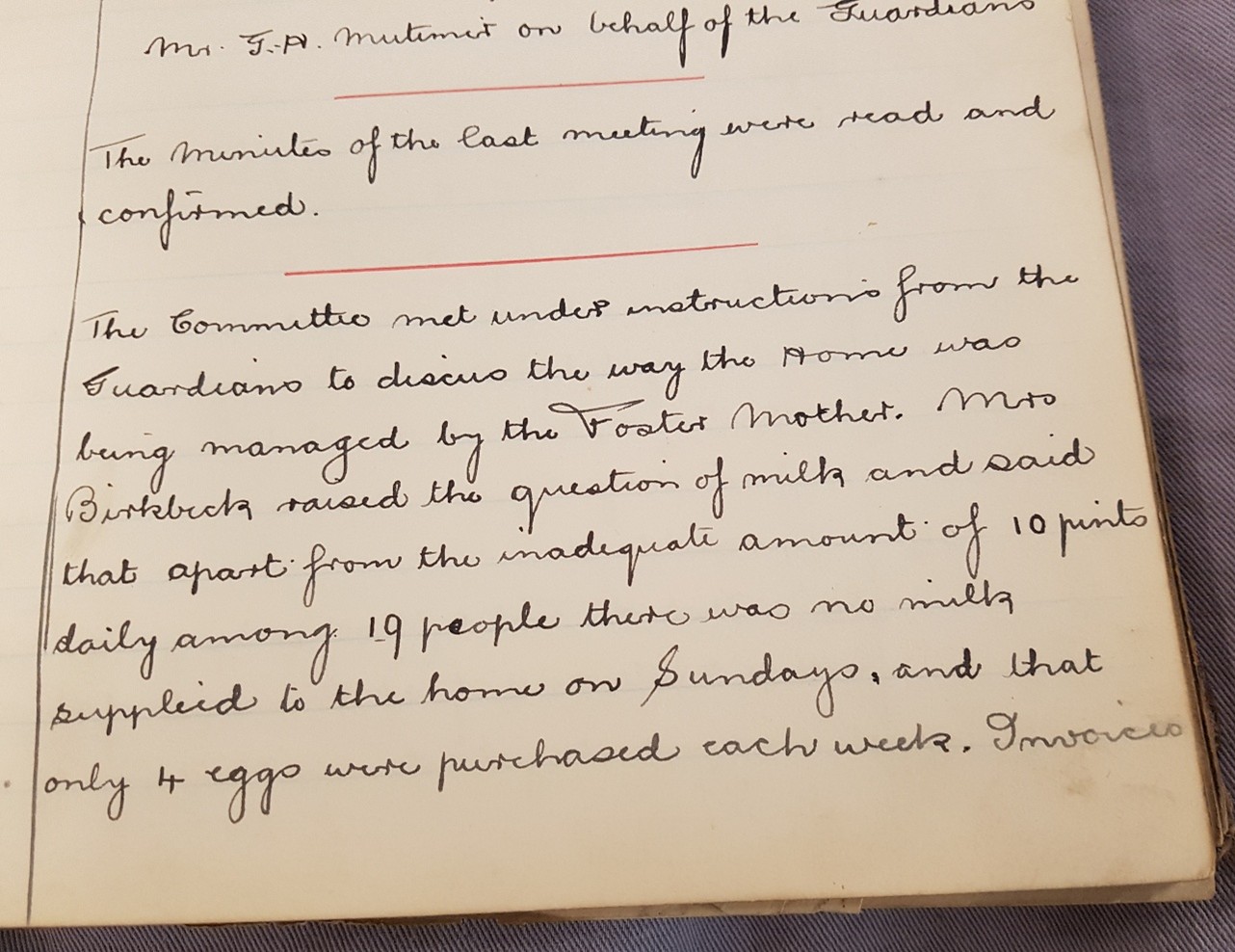
Although the Home appeared to be well run in its early years, in March 1920 the Foster Mother and her Assistant were asked to resign following concerns about the children’s welfare, in particular the children not being fed adequately and not in accordance with the dietary table laid down by the Board – only 10 pints of milk and 4 eggs a week were being provided for 19 people, meat was not being supplied and children were not being allowed to eat after their breakfast of bread and milk. The Medical Officer also recommended better nourishment and more opportunities for fresh air, exercise, amusement with toys, and less strict discipline.
New staff were appointed in April 1920, then again in the following September. Money was spent on providing the children with new clothing and re-equipping the Home. The children were encouraged to grow vegetables and to keep rabbits and chickens. By August 1921 there was some discussion and concern that the Home was no longer large enough for 17 children and 2 staff and it was resolved that another home be provided to accommodate a larger number of children and to keep the sexes separate. At the time of the 1921 Census there were 16 children ranging in age from 5 to 14 years being cared for.7 Yet, less than a year later, in July 1922, it was decided to close the Home altogether, due to the rising costs of food, clothing, coal and problems finding and retaining good, trained staff. The Loddon and Clavering Board of Guardians’ children were removed, as they now had their own children’s provision and the loss of this per capita income made the financial situation unviable.
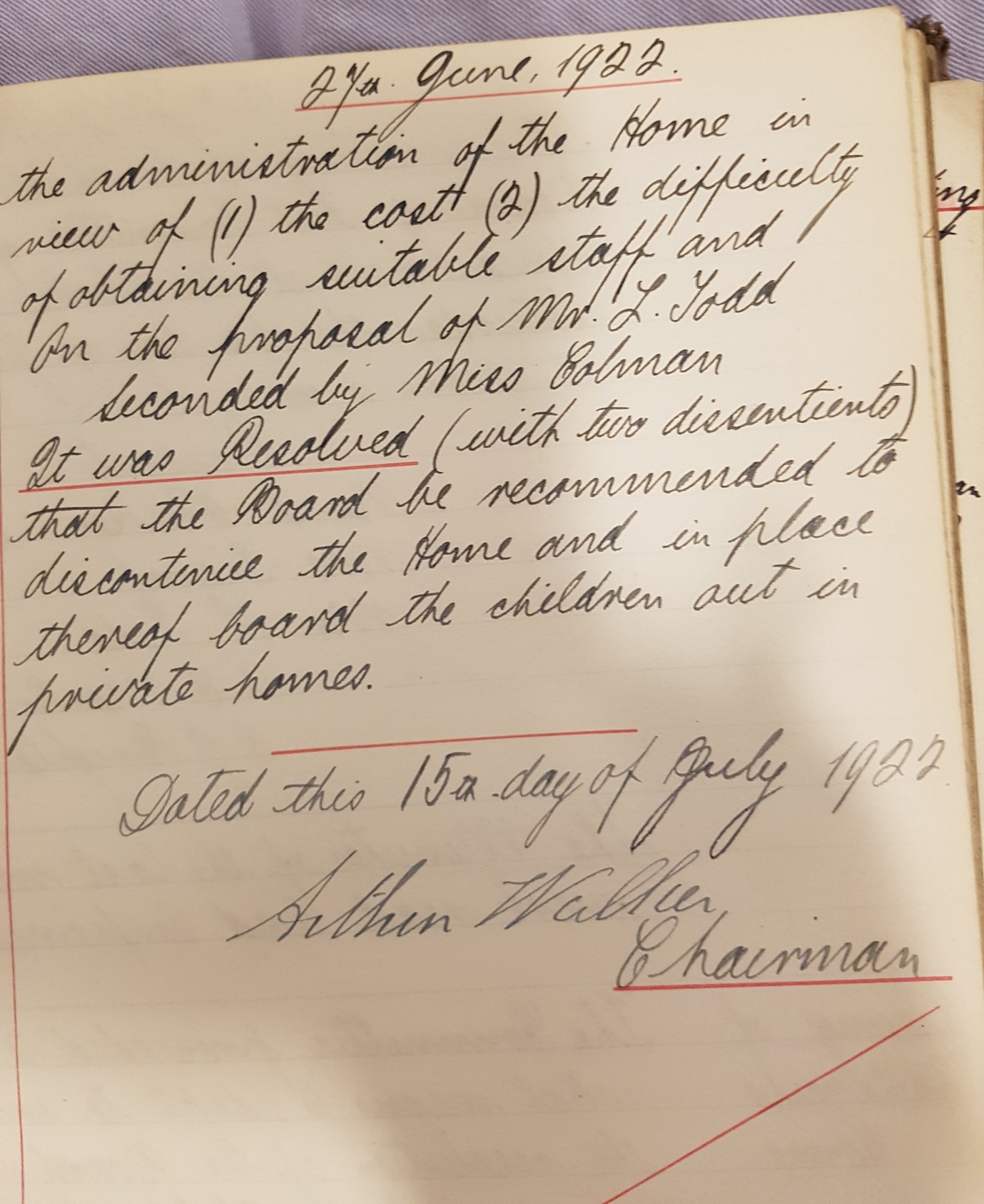
Those children remaining at the Home were to be boarded out in private foster homes, adopted by the Guardians or sent to other children’s homes, such as Hope House in Ipswich and the Girls’ Orphans Home in Norwich. Some of the boys went to Industrial Schools, such as The Red House Industrial School at Buxton, to learn a trade and a few were sent to Canada under the Barnardo’s Juvenile Migration schemes.
Following its closure Mr Sydney Lawson Chipling, surveyor for the Rural District Council, rented the property as a dwelling place at a rent of £30 per annum. It continues to be a private residence today and in outward appearance is very much as it would have been when it was first built.
Researched and written by Jenni Southernwood, NRO Research Blogger
Footnotes
- Local Recall- EDP Digital Archive ↩︎
- Norfolk Record Office, C/GP 11/32-34, Minute books of Henstead Poor Law Union 1914-21 ↩︎
- NRO, C/GP 11/95, Minutes of Henstead Children’s Home and Boarding Out Committee, 1909-24 ↩︎
- http://www.workhouses.org.uk ↩︎
- http://www.ancestry.co.uk ↩︎
- http://www.hansard.parliament.uk ↩︎
- http://www.ancestry.co.uk ↩︎



 Norfolk Record Office