
Reverend John Crawford
Crawford became the rector of 2 parishes, East Walton and Gayton Thorpe in 1886. A leaflet in St Mary’s Gayton Thorpe stated that these 2 churches had shared a rector since 1737. St. Mary’s is also the name of East Walton church.
Reverend J. R. Crawford, as he signed himself, started writing the church service register on Palm Sunday, 01 April 1886. He had a busy life as he gave a Sunday service to each parish – a morning service in one church and evening service in the other. The 2 parishes are roughly 2 miles apart along what was probably a quiet country track in 1886. He preached a different sermon to each congregation.
The Service Register is a small red hardback book held by the Norfolk Record Office which is in remarkably good condition given its age and usage from 1886 to 1899. The book contains hand written accounts of each service under the following headings: Date, Time, Place, Preacher, Subject, No. of Celebrants, Offertry, Remarks. Under ‘Place’ are the initials he used for each church, GT for Gayton Thorpe and EW for East Walton. Offertry refers to the church collection from the parishioners present; the Celebrants. There are several references to the fact that this money was distributed to the poor of the parish at regular times throughout the year. From his notes, what concerned Reverend Crawford most was the size of the congregation which fluctuated widely throughout the years and between the 2 churches. This seemed to cause him much consternation.
Notes from April – May 1886 in the service register include:
‘Small congregation…. Rain, only 8 in church’‘
‘Good congregation but lack of men and boys.’
The weather and lack of males are frequently mentioned in relation to the numbers attending church. In September 1888 he recorded in the service register that it was raining: ‘One child attended soaked, Hilda by name, 8 years her age…From the common, whose parents are about the only staunch poor church people in the parish. E.W.’
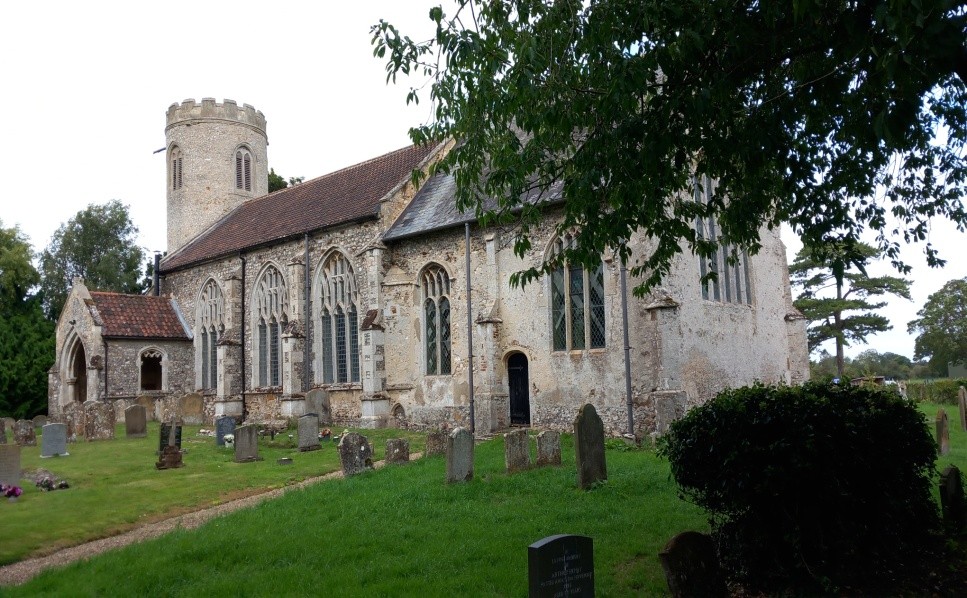
Reverend Crawford appeared to take little account that many of his male parishioners would have been farm labourers. Within farming communities, spring is a busy season with crops to be tended and animals needing attention. Norfolk has always been ‘sheep country’ and springtime is lambing time. Even with this caveat the lack of men in church was noted all year round; on Christmas day 1886 attendance was, ‘poor only 4 G.T. adults’ and at the 3pm service in East Walton the congregation was ‘fair but few men’. On 27 February 1887, ‘not a single man but Mr. W. in body of church. G.T.‘
In September 1886, he noted ‘very crowded indeed, in-fact people had to stand during the whole service. Offertory for Lynn County Hospital.’ By Easter 1887 the number attending church led to some salutary reflections by Reverend Crawford. At Gayton Thorpe, ‘Most saddening, I went up to G.T. determined to give the people the opportunity of giving. Found only Old Patterson (ex. Clerk) there. Whose fault is it? Mine.’ Later, also at St. Mary’s Gayton Thorpe: ‘Alas! I had hoped for more. I asked some specially yet they came not.’ Although, at the 7.45pm Evensong at E.W. the attendance as ‘very good’.
Everyone loves a public holiday and a national holiday was sanctioned on 20-21 June 1887 to celebrate the jubilee year of the monarch. Recorded by Reverend Crawford as being in honour of, ‘our gracious Sovereign Lady, Queen Victoria’ who had ascended the throne on 20 June 1837. He noted that there was ‘a feast for the whole village with games, prizes and Squire Hammond in attendance.’ At East Walton, there was ‘a very huge congregation indeed.’ However, the service register reflected less enthusiasm within the parish of Gayton Thorpe at a service to bless the Chalice and Paten (communion flask and platter), bequeathed to the church 200 years ago on Christmas Day 1887. ‘Alas, that the bicentenary of that gift is celebrated by the parish priest alone with but one other and that a stranger.’ However, the Christmas Day evensong and sermon at East Walton had ‘a very fair congregation’.
A most cheerful time of year for Reverend Crawford was Harvest Festival, the pews were often full. He recorded that the Harvest Festival services in 1888 were a great success for both churches. The service register records showing that there was a large increase in their respective congregations; ‘E.W. 46, G.T. 57, including some children.‘
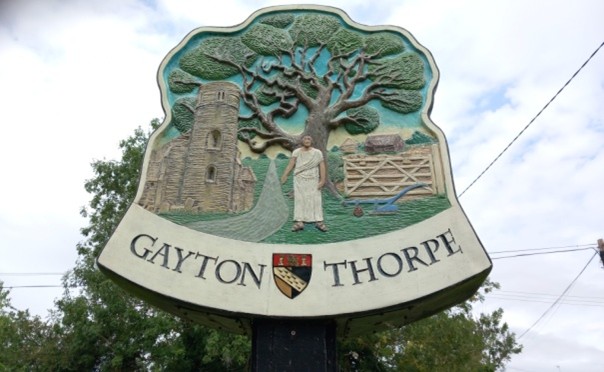
A pattern emerged between the two parishes whereby the smaller congregations were predominately at Gayton Thorpe. One explanation may be that the church at East Walton lay in the heart of the village, facing onto the village green. Also, that Reverend Crawford and his family were probably better known in this parish as they lived in the vicarage here. One note in the service register stated that the rector’s wife, Mrs Emma Crawford, played the harmonium at ‘EW‘ church whilst a Miss Elizabeth Rix played at Gayton Thorpe church. Today, Gayton Thorpe church lay just outside the centre of this hamlet on Church Lane, although there are a small line of old cottages nearby, all still being occupied. The village sign below shows the 14th century St. Mary’s Church, indicating it had been a significant village landmark.
The New Chapel
The service register noted a big change afoot in 1888 when some land on Common Lane, East Walton was designated to be the site of a new Primitive Methodist Chapel. Common Lane is a short walk from where St Mary’s, East Walton is situated. Whether or not Reverend Crawford gave any thought as to how this might affect his own congregation is not revealed at this time. However, in February 1889 in the service register, he lays out a plan to widen the scope of his services by introducing visiting rectors to hold weekday services:-
‘Again, a new departure. I have asked special preachers to address the people on a weekday at East Walton: The result I give immediately and consecutively below before notifying the other services thus.‘
He lists various rectors from nearby villages such as Grimston, Great Massingham and Castle Rising to give sermons at this church. He recorded that the ‘1st time for visiting clergy a noted success.’ The register noted that the congregation at these services ranged from a high of 52 down to 24. Whilst attendance increased at East Walton it remained poor for Gayton Thorpe, as on 6th April 1889 he records; ‘raining in torrents, 9 adults and 14 children, G.T.’ Pouring rain may have affected turnout but the figures showed that a staunch few did brave the elements with their offspring.
On Good Friday 1889 village festivities were noted in the service register at East Walton to mark the first stones being laid for the new Primitive Methodist Chapel. It opened for services on 30 June 1889 and Reverend Crawford made the following reflections in his service register:-
‘The chapel opened. Much Jubilation: the numbers at church, they represent only the true church people. I pray and have long prayed and will continue to pray that God’s Kingdom will come, in every sense of the term, in individual hearts, in the true purpose of the church (whatever that true church may be); in the general spread of godliness in the parish.’
These reflections indicated that Reverend Crawford did try to offer an optimistic and generous view towards the new chapel and its congregation.
Unfortunately, this optimistic view did not persist as an entry in the service register dated 7 July 1889 for EW reads: ‘Only one man in the choir. The children also of the Sunday School seem to have gone off to Chapel where perhaps they have begun a Sunday School.’ Reverend Crawford goes on to complain that ‘The Primitives’ services coincided with St. Mary’s. ‘They deliberately have theirs so as to clash with ours.’ However, the 10.00a.m Matins service seemed to go well, so much so that Reverend Crawford wrote quite vigorously: ‘Note. I shall give notice that we shall always have Matins in the future!!!!!’
Such were the vagaries of the church going people of East Walton, this did not always hold true. On the 15 May, the service register for Matins showed that the congregation comprised of 5 adults and 4 children, ‘all from this house and one other’; the pews being filled largely by the members of the Crawford household.
So the year progressed without further exclamation from the reverend until Harvest Festival in September 1889 when there was another clash of dates, or a calculated plot against St. Mary’s? ‘The chapel folk had a meeting and arranged for their Harvest Festival (as they call it) plus a tea on Wed: the 11th at 17.0!!!!!!!’ The same date as the Harvest Festival at East Walton.
One entry in the parish records appeared without comment or explanation, at the 3pm Whit Sunday service in 1894. It stated that the congregation at GT had 9 adults and 6 children, ‘of these 2 adults and all the children were from East Walton!!!!!‘ One may speculate that these families wanted to attend a service by Reverend Crawford but unseen by the Primitive Methodist chapel, where they had attended the morning service and were supporting both chapel and church. Who knows?
Overview by Reverend Crawford
Towards the end of the service register in 1898, Reverend Crawford fills a half page to give a summary of ‘life’ in the parish over the 1890s. His summary is that; ‘These figures are far from satisfactory. …..A desultory attendance. There seems to be no reasons for the figures. No steady improvement!’ Perhaps this overview of life as a parish rector had been communicated to higher clergy, but in July 1898 the Bishop paid a visit to mark the Festival of St. James:
‘The Bishop visited me here at E. Walton. He was most fatherly and earnest. That he & I did not see alike, with regard to the works to be undertaken in this parish & perhaps not strange. He has had great experience, and “I know” (to use a Norfolk term) the peculiarities of the people. However, he was helpful. His suggestions were (a) weekly offertry (b) teaching in the schools (c) Mens (old mens) Bible class. All these I hope to try.‘
The Service Register ended with an entry for May 1899 and showed the congregations for both parishes continued to fluctuate. Despite a lack of further records, the 1901 census shows that Reverend Crawford continued to minister to the 2 parishes and that he lived with at the vicarage in East Walton with his wife and two of his children along with a live-in housemaid and a groom. Having a groom, we could speculate that he had a horse which he used to travel between his churches.
The Final Chapter
An internet search of rectors for East Walton reveals that Reverend Crawford continued to minister in that parish until 1912. These records reveal that he took up a new post as the vicar for the Church of All Saints in the nearby village of Narborough that year. There is no explanation for the move; did he feel it was time to downsize to one parish? He is listed as living in the vicarage at Narbough in the 1921 census with his occupation being ‘Clerk in Holy Orders‘. By this time he was 76 years old and living with his wife, his daughter Kathleen, aged 42 years old and his son-in-law Charles Roxburgh aged 51 years. The household had two servants, a cook and a housemaid. It is recorded that John Robert Crawford died at the vicarage on 28 March 1924 and was buried in Narborough churchyard.
Researched and written by Jackie Mitchell, Research blogger
Bibliography and source information.
The Service Register of Gayton Thorpe and East Walton, Norfolk Records Office, PD 705/8
Census records. Find My Past
Marriage records. Free BDM
Our East Walton Rectors by Stephanie Hall circa 2023. PDF biography of Reverend Robert John Crawford.
St. Mary’s East Walton, http://www.norfolkchurches.co.uk/eastwalton/eastwalton.htm from the Churches of Norfolk website by Simon Knott, (2020), accessed 27/11/25



 Norfolk Record Office
Reference to your email…Gayton Thorpe had a smaller attendance… The Gate PH ” near the church” had a full 7 day licence. East Walton larger attendance. The Greyhound PH had a full 6 day licence although the sneaky IR did catch them out in 1901 with an undercover cyclist. Secondly, between 2010 and 2017 i lodged with a Norfolk vicar who loved to tell us how great his sermons were, he had 5 parishes. Unfortunately this was not the perception of his flock who attended in spite of the” boring old b…d ” fortunately his superiors got wind and were able to use a medical condition to retire him earlier than he had planned…Hallelujalah
LikeLike