
We have already looked into the burial of the Salthouse Parish Register and the work to conserve it. Now it is time to focus on some of the people included in it.
Some of the entries give far more detail that you would usually find for an entry in an early parish register, such as this one. Entries may contain information such as reason for death, as in the case of Sarah Waterson:
‘Sarah the wife of Thomas Waterson perishinge in the extremitye of weather the 2d Februarye betwixt Holt and Salthouse was found and buried the 23th of Februarye’
or additional information about the exact time of birth, as in the case of Thomasine Parre:
‘Thomesine the daughter of Cristofer Parre the 22º of the foresaid moneth and borne the 17º one a Thursdaie betwen the howers of Fower and Fyve in the after nonne of the foresaid daie’
Many entries related to the location of Salthouse being near the sea:

Henrie Stanforth the sonne of Henrie and Robert the sonne of Robert Stanforth beinge drowned at the seashore by helpeinge to save the men of a shippe wrecked by a storme of wind September 12th were taken up at Cromer and Runton September 15th and buried at Salthouse Churchyard September the 16th

Robert Earle of Feversham [Faversham] in Kent and servant to Robert Tomlinson boateswaine in the Kent Friggett beinge wrecked at sea the 14th of October came to shore at Salthouse on a raft with 24 other men belongeinge to the said shippe the 24th of October all the rest now liveinge, and was buried the 25th of October
There were also some notable British citizens included in the entries.
Thomas Bredcoke
Thomas Bredcocke’s death and burial are recorded in both the Salthouse and Great Yarmouth parish registers. It is only the Yarmouth entry, however, which mentions the cause of death – an accident with a ‘capstorne’ (capstan) bar. The capstan was a kind of windlass used on board ship to weigh the anchor or raise heavy sails. It consisted of a vertical cylinder, into which capstan bars were inserted, like the spokes of a wheel. A team of sailors would push against the bars to operate the lifting gear.
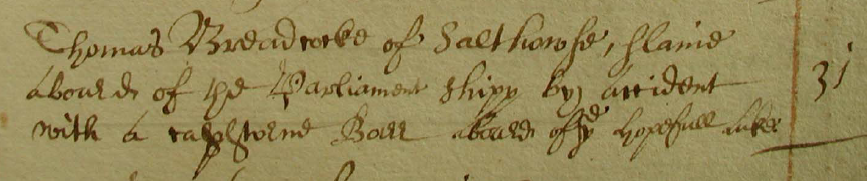
Thomas Breadcocke of Salthowse, slaine aboard of the Parliament Shipp by accident with a capstorne Barr aboard of the Hopefull Luke
The exact nature of Bredcocke’s accident is unclear. Possibly the pawls (ratchets) failed, causing the capstan to suddenly swing backwards. Anyone caught between the bars might easily have been injured. The capstan line (a thick rope) may have broken and whipped back, striking Bredcocke. Alternatively, he may have been hit by one of the enormous capstan bars, perhaps when it was being inserted into or removed from the capstan. Any of these mishaps could have proved fatal.
Bredcocke’s ship, the Hopefull Luke, is on the list of the King’s Guard (fleet) for the summer of 1642. She was a merchant vessel of 350 tons, commanded by Captain Lee, with a crew of 105 men. When the Civil War broke out in 1642, all of the King’s ships came under parliamentary control.
On 13 August 1643, King’s Lynn declared allegiance to the King and parliamentary forces besieged the town for a month. The historian, R.W. Ketton-Cremer, has suggested that at the time of Bredcocke’s death, the Hopefull Luke may well have been stationed off Yarmouth to intercept Royalist attempts to send supplies from Holland to King’s Lynn.
Christopher Myngs
Christopher Myngs was baptised at Salthouse in 1625, the son of John and Katherine Myngs. We know little of Myngs’s early career, but he probably first went to sea as a boy. In 1653 he was promoted to captain of the Elizabeth. Between 1655 and 1664 he spent most of his time serving in the Caribbean, defending Jamaica against the Spanish. Myngs gained a notorious reputation for his ferocious raids on Spanish ships and his plunder of towns in Spain’s South American colonies.
Retaining his naval command after the restoration of Charles II in 1660, Myngs returned to England, becoming a vice-admiral in 1664. His ship, the Triumph, fired the first shots in the Battle of Lowestoft against the Dutch in June 1665. Myngs was knighted for his services in this action. He died in 1666 from wounds received in the Four Days’ Battle, fought off North Foreland, Kent. He was buried at St Mary’s Church, Whitechapel on 13 June 1666.
Although Myngs spent much of his life at sea, he maintained links with his native village. He purchased houses and land in Salthouse and Kelling, which were inherited by his son, Christopher, also a distinguished naval officer. Myngs’s elder daughter, Mary, was buried at Salthouse in 1698; her grave can still be seen in the chancel of the church.
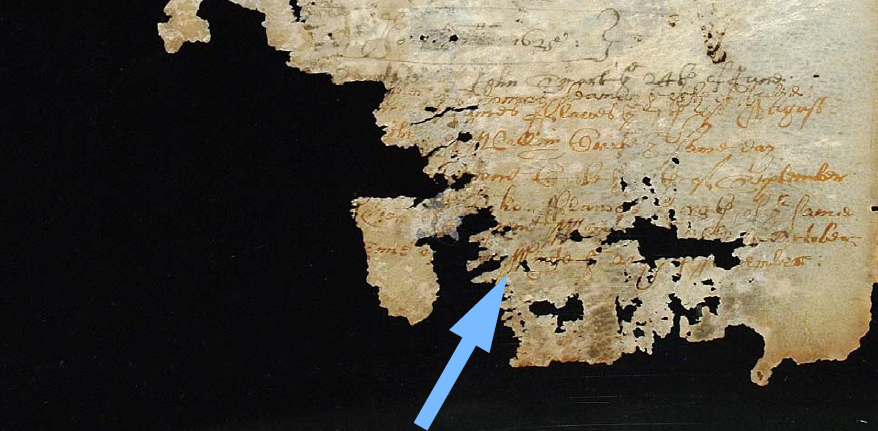
Myngs is included in the baptisms in the Salthouse register for 1625-6. The entry for Christopher Myngs is the final one, indicated by the arrow. Unfortunately, the parchment in this part of the register has badly denatured and most of the entry has been lost. Little more than the name ‘Minge’ can be read.
The Salthouse archdeacon’s transcript for 1625-6 does, however, include a contemporary copy of Myngs’s baptism entry. This transcript is also on display here. Myngs’s entry (just above the first horizontal line) reads ‘Christofer the sonne of John Minge the 21th of November’. The archdeacon’s and bishop’s transcripts are annual returns of parish register entries, which the rector compiled. We are fortunate that this copy of Myngs’s baptism entry exists: archdeacon’s and bishop’s transcripts survive for less than a fifth of the years covered by the Salthouse register.
Samuel Pepys the well-known diarist, writes about Christopher Myngs several times throughout his diary. This entry is of him meeting with Myngs in 1665.
‘…I to the office; and thither comes Sir Jer. Smith and Sir Chr. Mings to see me, being just come from Portsmouth and going down to the fleet. Here I sat and talked with them a good while, and then parted, only Sir Chr. Mings and I together by water to the Tower. And I find him a very witty well-spoken fellow, and mighty free to tell his parentage, being a shoemaker’s son, to whom he is now going. And I to the Change… So back again I, and took boat and called for Sir Chr. Mings at St Katherines, who was fallowed with some ordinary friends, of which he says he is proud; and so down to Greenwich, the wind furious high, and we with our sail up till I made it be taken down. I took him, it being 3 a-clock, to my lodgings, and did give him a good dinner and so parted…’
The Diary of Samuel Pepys, 26 October 1665.
Thomas and Edward Dawney
Thomas Dawney and his son, Edward, were successive rectors of Salthouse between 1613 and 1677. Their incumbencies span a turbulent period of English history:
Charles I’s troubled reign, the Civil War, the King’s execution, Cromwell’s protectorate and the restoration of Charles II. The two Dawney rectors are significant in the story of the Salthouse register because they sometimes include supplementary information in register entries, which allow us a further glimpse into the lives of the people of Salthouse.
Thomas Dawney was baptised at Little Walsingham in 1588 and was educated at Holt, before taking his BA and MA at Caius College, Cambridge. He was ordained by the Bishop of Lincoln in 1609 and was instituted to the rectory of Salthouse four years later. In the Salthouse register he records the births and baptisms of his seven children, born between 1615 and 1627. He died in 1643.
Thomas’ eldest son, Edward, was baptised in 1617, probably one of twins, since the register records the baptism of a brother, Thomas, at the same time. After attending a Mr Woodmansey’s school at Salthouse, Edward followed his father to Caius College, graduating in 1638 and taking his MA in 1641.
Thomas had obtained the advowson of Salthouse; this meant that he had the right to appoint the next rector. In his will, he asks his wife, who inherits the right of advowson, to present their son, Edward, to the Bishop as Thomas’s successor. Edward was ordained by the Bishop of Norwich in 1640, and succeeded to the living of Salthouse on his father’s death.
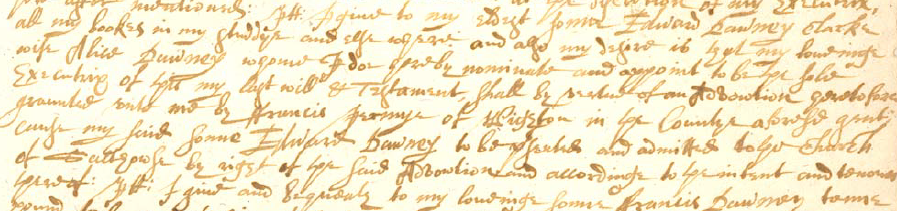
‘Ittem I give to my eldest sonne Edward Dawney clarke all my bookes in my studdye and else where and also my desire is that my loveinge wife Alice Dawney whome I doe hereby nominate and appoint to be the sole Executrix of this my last will and Testament, shall by vertue of an Advowtion heretofore graunted unto me by Francis Jermye of Wighton in the Countye aforesaid gentleman cause my said sonne Edward Dawney to be presented and admitted to the church of Salthowse by right of the said Advowtion and accordinge to the intent and tenour thereof’.
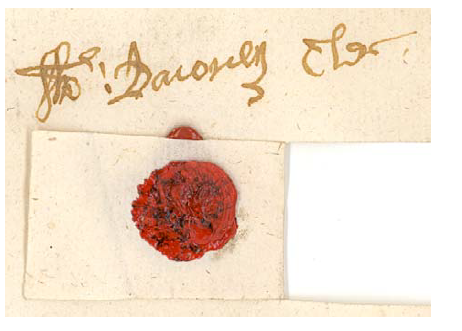
Edward and his wife, Frances, had six children before Frances’ death in 1665. Edward himself died in February, 1677. His eldest son, John, carried on the family’s clerical tradition, becoming rector of Caston and Roydon near Diss.
It is great that after so many years the parish register has allowed us to discover the stories behind some of these people.



 Norfolk Record Office