
In 2005, Record Office staff began the task of conserving the first parish register for Salthouse, allowing people to see inside the register for the first time in over sixty years. The register contains a unique record of the baptisms, marriages and burials which took place at Salthouse Church between 1538 and 1713.
Why was the register buried?
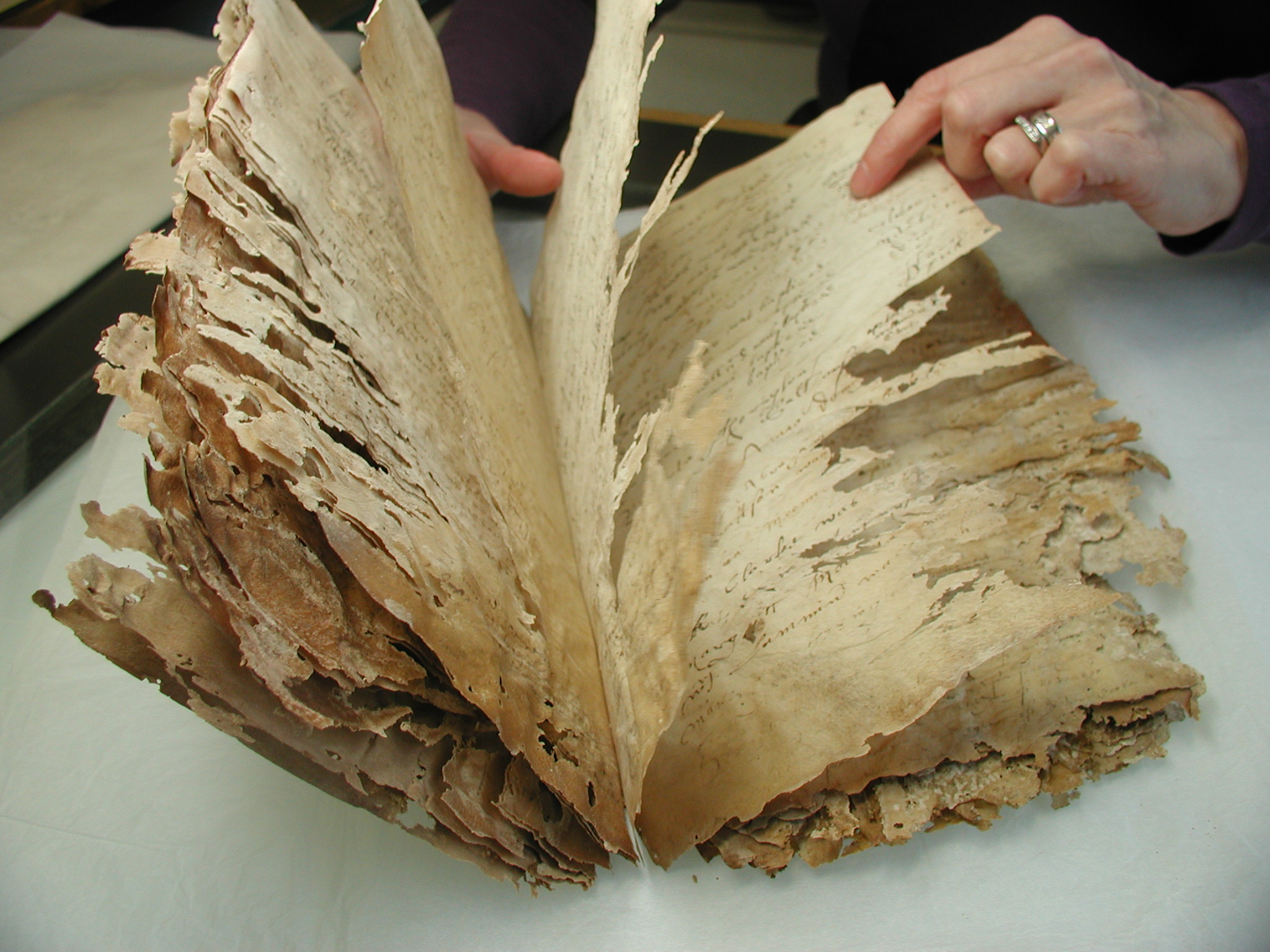
When Britain was threatened with invasion in 1940, the people of Salthouse felt particularly at risk. Their village, situated on the North Norfolk coast, was just across the North Sea from Nazi-occupied Europe. Fearing that their parish registers might be destroyed by enemy action, the Rector of Salthouse, Revd Charles Swainson, and his churchwarden, Frederick Champion de Crespigny, hid the two oldest volumes underground in Salthouse churchyard. With them they buried records from the neighbouring village of Kelling. They wrapped the volumes in newspaper and blue cloth – possibly oilcloth – to protect them whilst they were underground. By the time the registers were exhumed after the war, they were in very poor condition. The books were filthy, discoloured and distorted. Damp had fused many of the parchment pages together. In some areas, the parchment had disintegrated altogether. It was impossible to access the information that the registers contained.
What condition were the registers in?
The historian, R.W. Ketton-Cremer of Felbrigg Hall, commented that the registers: ‘emerged in a totally illegible condition, little more than a mass of fungus’ merged in a totally illegible condition, little more than a mass of fungus’.
When Dr Ian Keymer began researching his family tree in 1949, he visited Salthouse hoping to see the parish registers. Dr Keymer kept a diary in which he recorded his experiences. On 5 January 1950, he met Mr Leech, then Salthouse churchwarden, ‘a very well educated, tall, thin, and rather hearty old gentleman’. Mr Leech told him the ‘terrible news’ of how the registers had been buried during the war. In this extract from his diary, Dr Keymer describes how the former rector and churchwarden had wrapped up the records.
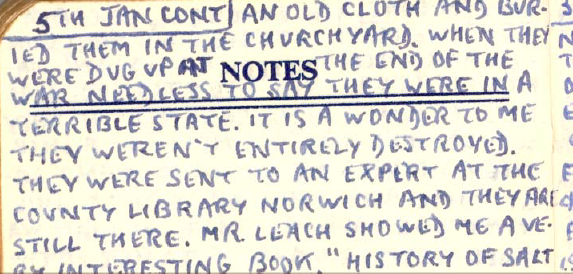
Dr Keymer’s enquiries at the Norfolk County Library in Thorpe proved fruitless (in fact, the registers were almost certainly at the Norwich Public Library on St Andrew’s Street at this point). Revisiting Salthouse in January 1951, he met the Rector, Revd Felix Young.
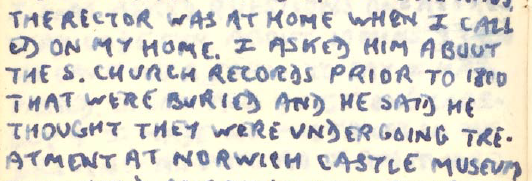
However, the museum curator also had no knowledge of the registers. It was not until after the Norfolk Record Office was established in 1963 that Dr Keymer discovered the whereabouts of the Salthouse parish registers. They had been transferred for storage in the Record Office’s environmentally controlled strongrooms helped to prevent any further deterioration in their condition.
The only accessible copies for 70 years
In the 1930s, Commander Frank Noel Stagg RN compiled a history of the village. As part of his research he studied the Salthouse parish registers, copying out some of the entries into his History of the Parish of Salthouse. These transcripts, with the archdeacon’s and bishop’s transcripts of the registers, are the only copies which were made of the registers before they were buried.
Stagg’s History and the archdeacon’s and bishop’s transcripts are an invaluable glimpse into the registers. Copies survive for a small proportion of the register entries only, however, and these entries were not always recorded in full. This means that the copies are unsatisfactory as a substitute for the original registers. Stagg’s History was never published and over the years the original seems to have been lost. Fortunately, his sister gave a copy of the manuscript to the historian, R.W. Ketton-Cremer of Felbrigg Hall. This copy has survived amongst Ketton-Cremer’s papers in the UEA special collections. In the year 2000, Mrs Val Fiddian of Salthouse came across Commander Stagg’s History of the Parish of Salthouse at the University of East Anglia.
Determined that the manuscript should at last be published, she commissioned additional articles about the village to continue Stagg’s history to the millennium. Salthouse, The Story of a Norfolk Village was published in 2003. It was a resounding success, selling so well that it was out of print within a year. Original funding for the book had come from a Local Heritage Initiative grant and profits from the sale of the book had to be invested back into the local community. It was decided to use the money from the book to have the first parish register conserved. Without this funding, the conservation work could not have started. For the first time since 1940, people would be able to access the information in the register.
Conservation of the register
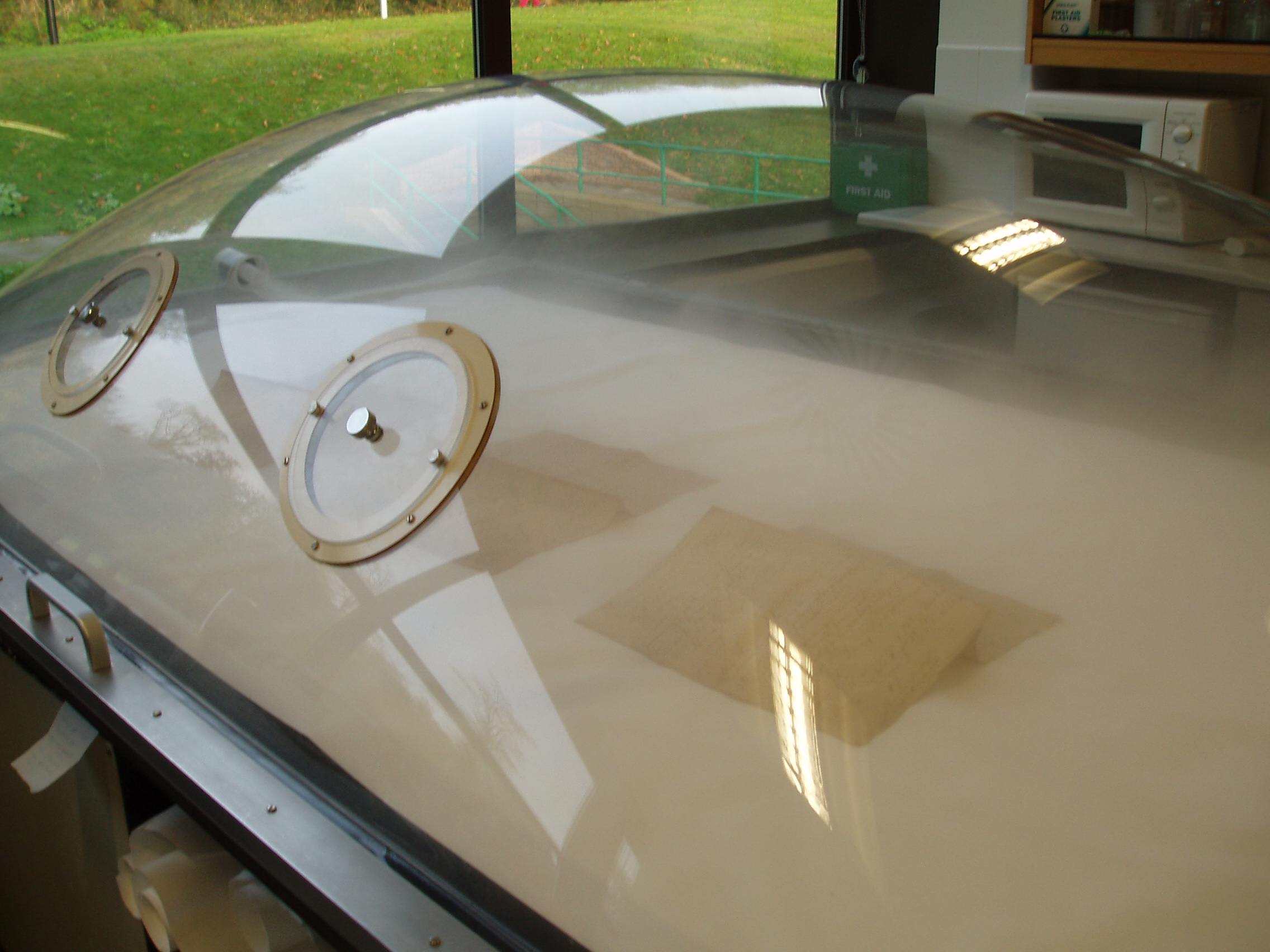
The modern, purpose-designed conservation studio at The Archive Centre has several new pieces of high-tech equipment for the conservation of archives. A humidification dome and low pressure suction table have allowed the conservation section to develop new ways of treating water damaged parchment. Previous methods were more time consuming and could put documents at risk of further damage.
There were two main aims of the conservation work:
- To conserve the parchment pages
- To produce a good quality copy for public access.
It was decided to do the more limited treatment option of only flattening the pages and encapsulating them. To repair the missing areas of the pages and rebind the register would have involved several hundreds of hours of work, which would have been prohibitively expensive.
The treatment began with carefully teasing apart the stuck pages. This allowed the dirt to be removed before the pages were placed into the humidification dome for flattening. The edges of the pages that had suffered the most damage had become very thin and needed to be protected from getting too moist during the humidification stage.
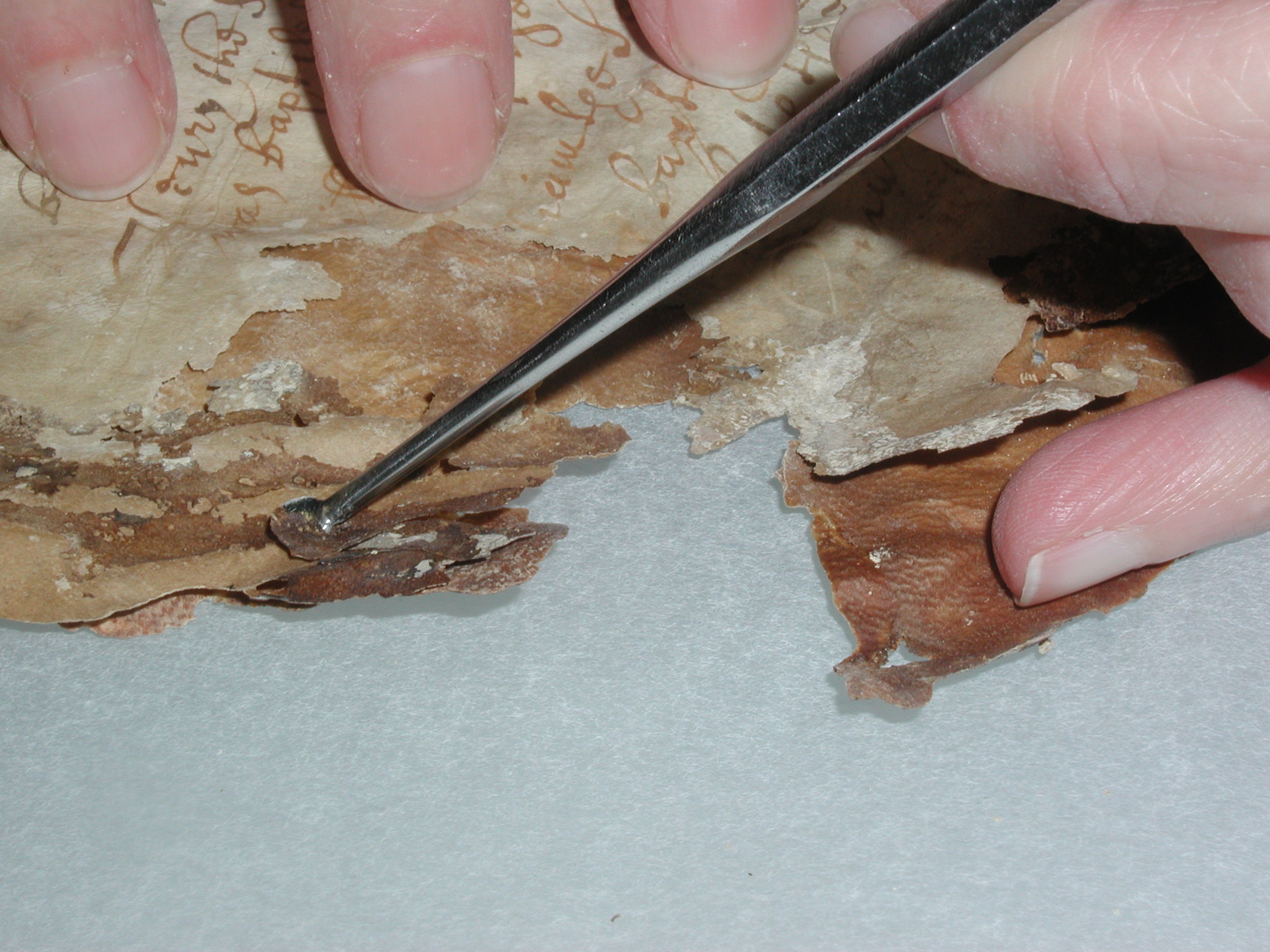
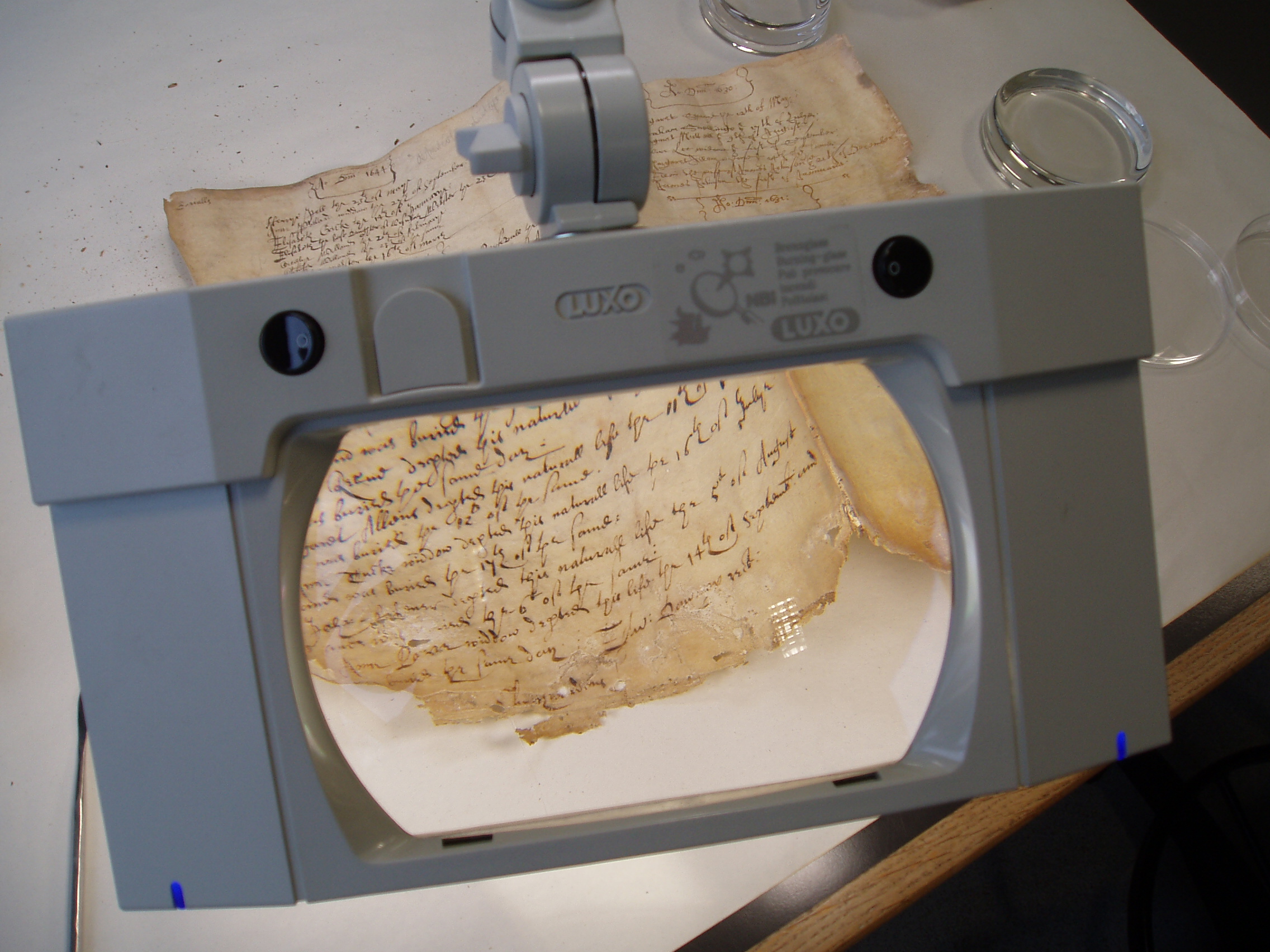
A cool mist introduced into the dome causes the parchment pages to relax and become limp. Small repairs were made using a remoistenable tissue developed by an NRO conservator whilst the page were being held flat on the suction table. Once nearly dry, the pages were pressed between blotting papers for at least a month before being placed into a polyester enclosure.
Access
Providing access to the information in the register has been key to the entire project. Even after conservation treatment, the register pages were too fragile to undergo repeated handling. Good quality copies of the register allow everyone to access the information without damaging the original. The Record Office, in partnership with the group at Salthouse, decided to make both a microfilm and a digital copy of the register. Staff employed a professional photographer to take digital photographs of the register. Volunteers then transcribed and indexed the register entries from these images. The indexed transcript, with colour images of the register pages, is available electronically on one of the computers in the searchroom and as a printed version with the transcripts on the searchroom shelves.
Finally the entries in the register could be read for the very first time in 60 years. Look out for part 2 to discover the stories of some of the people included.



 Norfolk Record Office