
We tend to think of Christmases as a time for having fun with friends and family. Often we forget about those who are unable to do so, particularly those who are working or stationed abroad. This was the case for many Americans based in England during the Second World War. East Anglia was a home for so many American service personnel fighting under the 2nd Air Division of the United States Army Air Force. Between 1942-5 Norfolk had 12 bases, housing over 50,000 personnel at any one time. Using the impressive archives of the Second Air Division we can find out some of the men and women’s thoughts and feelings on Christmas away from home.
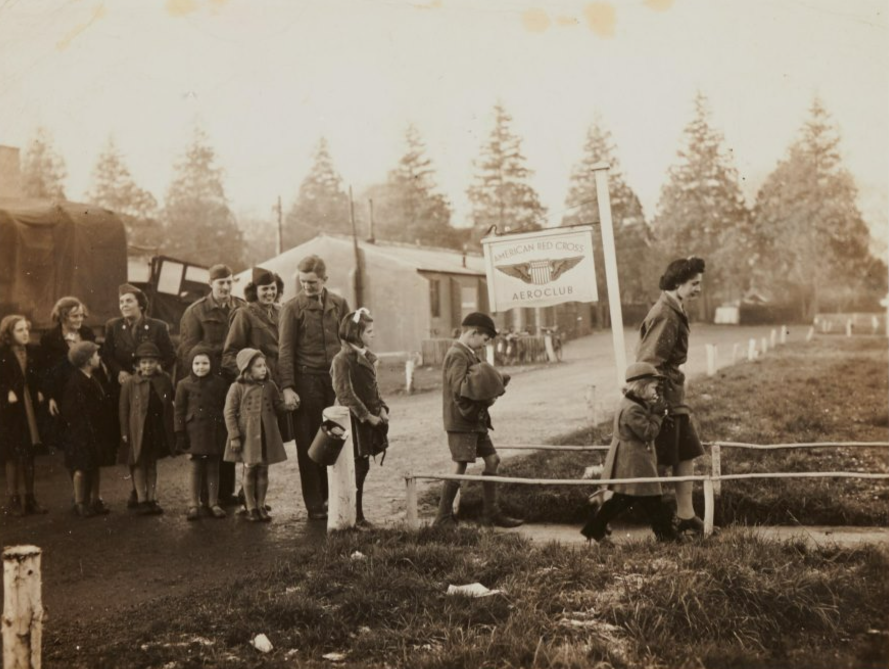
On looking through the archives we can see that during the Christmas period many of these men and women were thinking about the local community, especially the local children. By the time the US entered the war in 1942 British children had spent 3 years under the fear of invasion and air raids. Many would not have seen their fathers, who were away fighting, and, with the introduction of rationing, had limited access to a range of food. This was a contrast to the Americans. Accounts often talk of Americans handing out sweets to the local children. During the Christmas period, service personnel threw Christmas parties for children. The parties involved food followed by a visit to Father Christmas complete with a gift. On 24 December 1944 servicemen held a party at Ketteringham Hall, the headquarters of the Second Air Division. The children ate in the Mess Hall before lining up outside the Red Cross Aeroclub and waiting their turn to meet Father Christmas (or as the Americans called him Santa Claus). A local resident who was a child during the Second World War recalled that until she was much older she thought that Father Christmas ‘spoke with an American accent and called all little girls honey’.
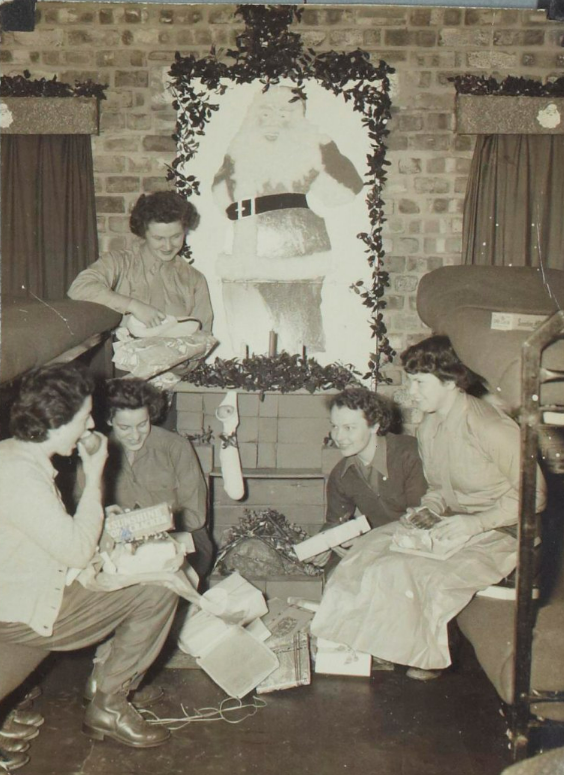
We also know that the Americans celebrated together with the friends and colleagues. Although they service in much smaller numbers around 200 women from the Womens Auxiliary Corps served in Norfolk at any point during the three year period. In this photograph of some of these women celebrating Christmas we can see the way in which they have decorated their lodgings and exchanged gifts
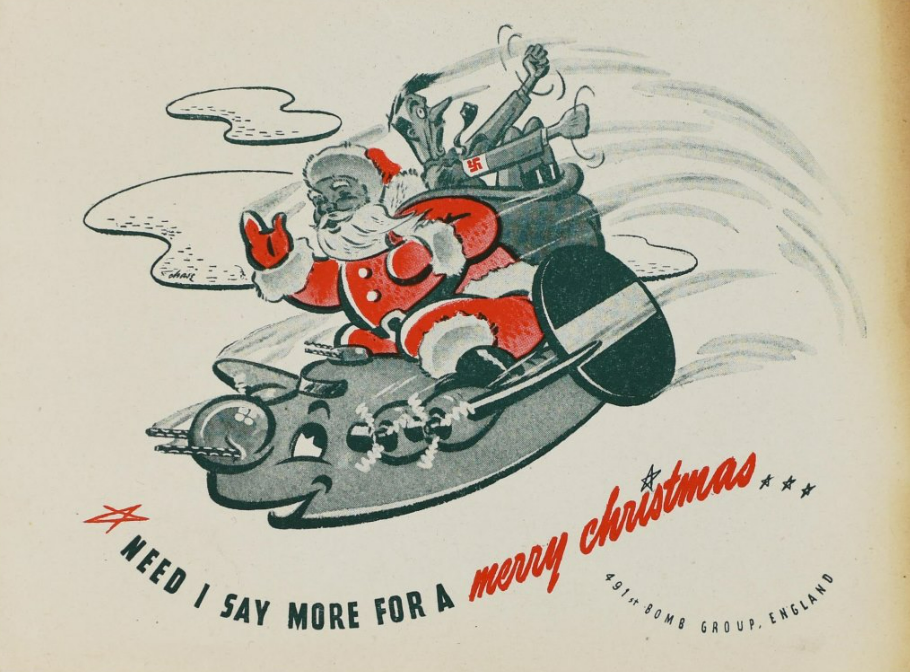
Of course, the service personnel also wanted to share their thoughts for their loved ones back home in America many tailor-made Christmas cards were created for this occasion. They often included references to their lives in England or to the war in general. One example, which appears in several times in the archive, both in black and white and with limited colour is the image of a Father Christmas flying a German plane instead of a sleigh, with the caption ‘Need I say more for a merry Christmas’. We know that it is a German plane as we can see the German soldier sitting in the back clearly marked by the swastika on his arm. Another example gives the emblems of the Bomb Squadrons (NRO, MC 371/8, USF 1/2)
As with letters and cards sent home during the rest of the year, personnel could not tell their families of their exact location, just that they were ‘somewhere in England’. This phrase appears on several Christmas cards, most strikingly on a card portraying the spire of Norwich Cathedral. In England the spire is a recognisable emblem of Norwich. However, to many Americans this would not have been much of a clue and without the ability to search the internet presumably would not have given the location away.
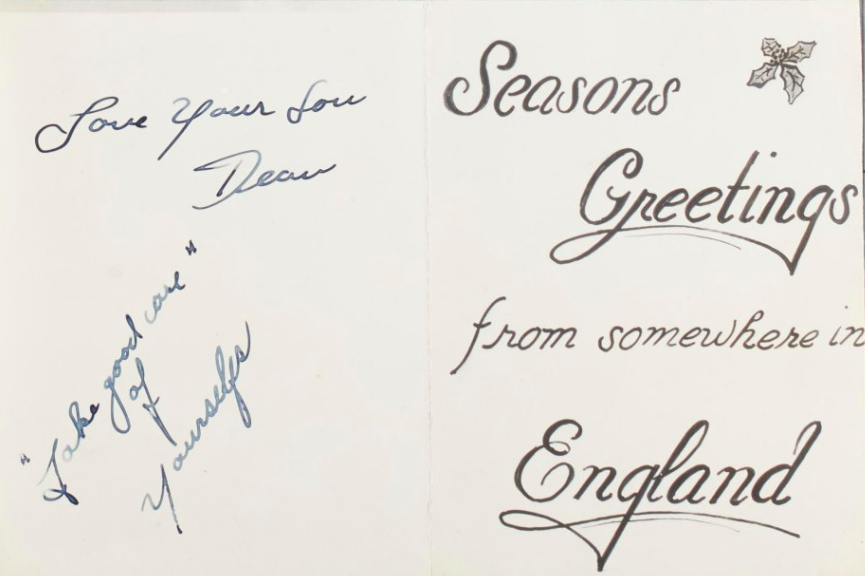
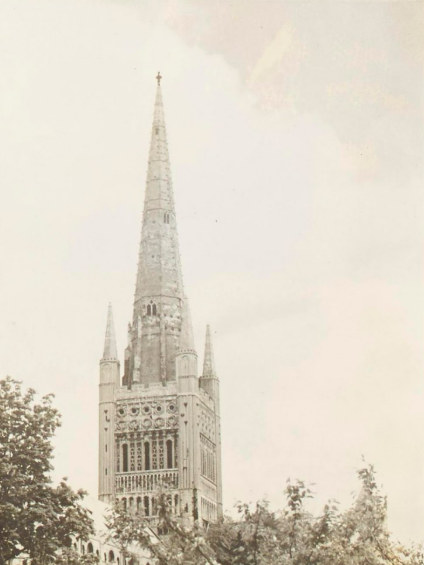
Front and inside of a Christmas card from a serviceman in the 67th Bomb Squadron. NRO, MC 371/8, USF 1/2
Finally, in the archives we can find a rendition of the famous Clemence C Moore poem ‘Twas the night before Christmas’, based on the writers experiences of flying in a bomber. On reading the poem we can see why the writer wanted to remain anonymous. It reads:
Twas the night before Christmas and all through the group
the ‘big wheels’ and ‘wigs’ were grinding out poop
the bombers were parked on their hard stands with care
waiting for ammunition soon to be there
the Flyers were nestled all snug in their beds
while visions of milk runs danced in their heads
when out of the darkness there came quite a knock
we cursed the O.D. and looked at the clock
‘briefing we’ll be in two hours’ he said
and if you’re late you’ll wish you were dead
Time marches on in the minutes fly by
so it’s out of our beds and ready to fly
We rushed to the Mess Hall quick as a flash
and ate cold powdered eggs with hideous hash
Then a long bumpy ride to the group briefing room
where the bigwigs presided and dished out our doom
The target is told on the 1st 6 rows faint
for lo and behold Berlin it ain’t
The brains had slipped up Oh my poor aching back
We’re bombing a place that throws up no flak
Sso it’s back in the truck and off to the line
the road is now smooth and the weather is fine.
The crew is at stations the checklist is run
the engine’s run smooth as we give him the gun
then suddenly the pilot wails in despair
‘look out at the tower they just shot a flare’
We dash to the window with a heart full of dread
The pilot was right and the damn thing is red
so it’s back to the sack and we sweat out our fate
for there’s a practise formation at a quarter past eight
Poem from documents relating to Joseph Michalczyk and his crew. NRO, MC 371/336, USF 7/3
Overall, it seems that many Americans made the most of their situation and were able to enjoy Christmas to an extent and were able to send their wishes to friends and family back in their homeland. It’s worth remembering as we enjoy Christmas this year that 80 years on some people in the world are once again are having to spend it away from friends and family either because of their work or because, like the Americans during the Second World War, they are fighting for their country.
Merry Christmas



 Norfolk Record Office