
The story of Government Beeching-style plans to close schools, told through one village primary school
1985 saw Paul Hardcastle’s ‘19’ spend four weeks at number 1; Roger Moore’s last outing as James Bond; the first photographs of the wreck of the Titanic, 73 years after it sank; your writer starting his illustrious career at Norwich Union; we lost both Wilfred Bramble & Sir Michael Redgrave and came perilously close to losing Hapton Primary School.
The Government of the day came up with a Beeching-style plan for schools, which threatened the very existence of over 100 schools across Norfolk alone, affecting the lives of countless pupils, with the hardest-hit being in rural areas. Any rural infant school with less than 40 pupils was on the target list, but what they hadn’t counted on was the resourcefulness of local communities and Hapton Primary School is still going strong more than 30 years later.
Peace amongst communities was shattered, with, in Fenland, “Insults, abusive language and even threats being flung across the parish boundaries”, whilst “it was easy for those on the side-lines to make comment on and criticise educational provision, but this should not diminish the argument in favour of keeping village schools open”.
Local councillors in South Norfolk were equally vociferous, though much less abusive, when taking to the press to note that Chief Secretary to the Treasury, John MacGregor, MP, having been responsible “for the savage cuts in the Government’s financial support to shire counties like Norfolk” had suddenly done a complete about-face and joined in the campaign to save as many as possible of the small village schools. Surely, no one would suggest that a recent by-election and poll result, indicating South Norfolk to suddenly be a “highly marginal Parliamentary seat” had anything to do with his change of heart. Everyone seemed to think so.
Parents and teachers, with the help of organised groups like Keep Our Rural Schools (KORS) set about drawing up battle plans to combat these draconian plans and each ensure the survival of their own school. Hapton was no exception, and counted every possible tool in its arsenal. Deeds were uncovered which showed the County council were wrong in their assessment of the school, that they had understated the building space per pupil (another criteria for closure) by 89 square metres.
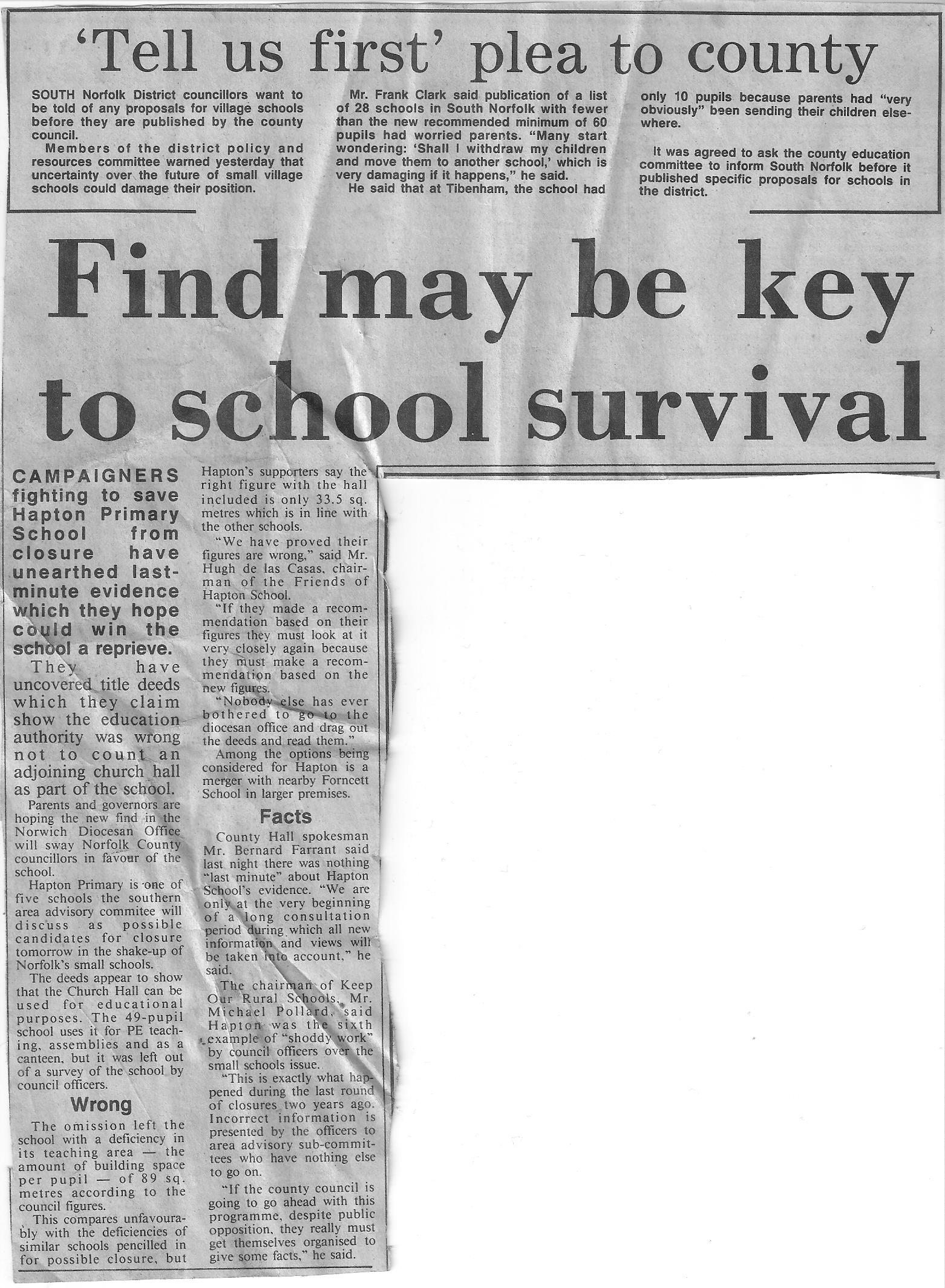
Hugh de las Casas, chairman of the Friends of Hapton School, stated that “nobody else has ever bothered to go to the Diocesan office and drag out the deeds and read them” meaning the council “must look at it very closely again”. He went on to say “the school had a brilliant track record” and “the buildings were not as hopeless as the county council had pictured, as use of the adjoining church hall and school extension would improve the situation”.
The confrontational situation was not helped by a local councillor from Diss calling the premises “diabolical”; causing a parent from Newton Flotman to observe “To me this conjures up a picture of squalor and discomfort. This is certainly not true of Hapton School”. Another, from Tharston, whilst “pleased to read…comments about Hapton School being an “excellent” school with “excellent teachers””, but “we were dismayed to read….the buildings being “diabolical” with no space for improvement”.
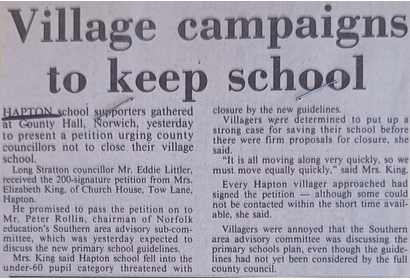
Battle lines were drawn. Hapton joined forces with three other local schools (Forncett, Saxlingham Nethergate & Shelton) to make a united stand, supported by the headmaster at Long Stratton High School stating “two-thirds of his pupils came from the Middle School and one-third from village schools, and educationally there was no difference between the two sets of pupils. Exam results at the school were above average for the County” and Mr de las Casas not mincing words when he declared “he felt councillors were dancing to strings leading back to the Treasury rather than the Department of Education”.
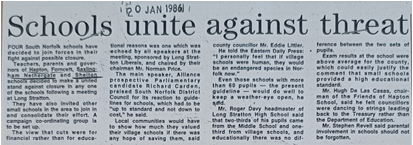
Some wrote to ask if anyone had “really thought about the facts and issues involved, especially little five year-olds. Will you supervise at pick-up & drop-off points and on the bus, or will the bus driver be able to drive and look after 40 children as well”. Loss of the excellent relationships between parents, children & teachers, built up over many years, was a major concern for many, and they went on to point out things could be even worse with associated lost trade leading to the loss of the village shop and post office and that Hapton “will end up a dead village like others have done”. Summing up covered the feeling throughout the village, and wider county – “We are going to fight for the sake of the children”.
The situation started to look brighter, as BBC Radio Norfolk reported on air that “Optimism prevails over the fate of two Norfolk schools. Four had been threatened with closure because they fell below the County Council’s sixty pupil guidelines, but after a meeting of the Southern Area Advisory Sub-committee parents are feeling more optimistic. Hugh de las Cassas, chairman of the Friends of Hapton School, says that no decision has been made about Hapton and Forncett, but Shelton school has been saved because of its isolation and Saxlingham because a change would be too expensive”
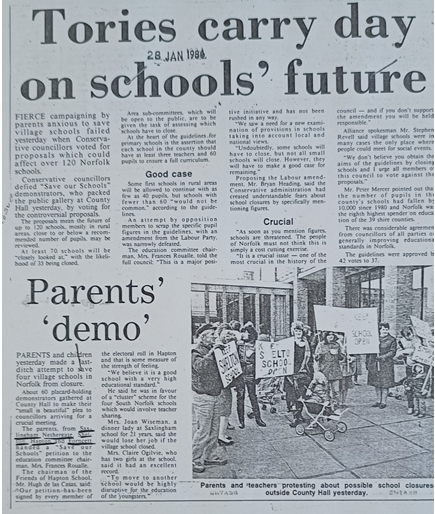
Fortunately, against determination such as this, common sense prevailed and, although it was dressed up in economic terms, everyone knew the right thing to do was for the council to recommend Hapton remain open – and the school has never looked back!
Researched and Written by Tim Ward




 Norfolk Record Office