
If you have arrived here as a fan of history, folklore and Norfolk, I will surmise that you have heard of, and perhaps even been fortunate enough to visit Raynham Hall. Situated in West Norfolk, the Hall began construction in 1619 under the instruction of Sir Robert Townshend. Further expansion was carried out in the 1800s under Palladian architect William Kent and Charles, the 2nd Viscount Townshend. It remains the seat of the Marquesses Townshend to this day.
Our story begins with perhaps one of the most vivacious and beautiful owners in Raynham’s history. Lady Dorothy Walpole (1686 – 1726) sister of Sir Robert Walpole (generally regarded as Britain’s first Prime Minister) was the Mistress of the Manor during the early eighteenth century.
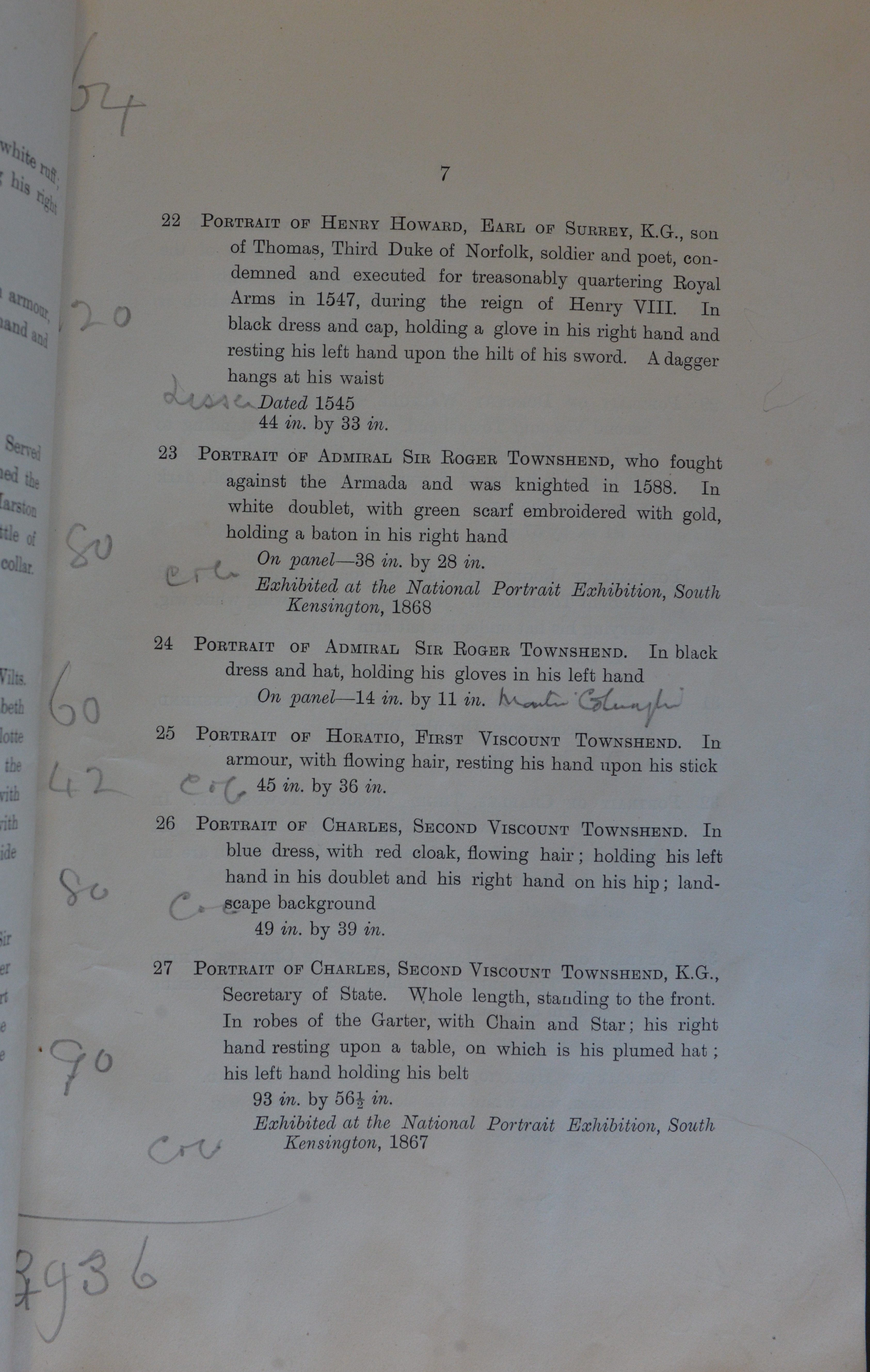
It was common knowledge that Lady Walpole’s marriage to Charles, 2nd Viscount Townshend was not a happy one. It is uncertain as to the cause of this unhappiness; some say the Viscountess was unfaithful, others that her frivolity and extravagance sparked her husband’s infamous fiery temper. Certainly she had a love of high living and fine clothing. The Marchioness Gwladys Townshend, a twentieth century owner of the Hall in 1936 described her as:
“…a charming and frivolous spendthrift, with a pardonable love for pretty clothes, judging from a lengthy bill for chiffons which is kept amongst our family papers.”
Despite her gaiety, Lady Walpole took her role as a mother seriously and doted on her children. Sadly this devotion was to serve as the basis for her disgruntled husband’s vengeance. It is not clear exactly under what circumstances, but following a particular period of marital unrest, it is said that Lady Walpole was not permitted access to her dear children, instead being deprived of any share in their upbringing which was given over completely to the children’s grandmother.
According to folklore, the unfortunate Lady Walpole was locked in her rooms and starved to death. However, Marchioness Gwladys Townshend quite rightly points out that given Lady Walpole’s brother, Sir Robert Walpole was living just a few miles away at Houghton Hall and was a man of great prominence and influence, it is unlikely that such an evil deed would have gone unnoticed:
“In the 17th century, enforced starvation in surroundings like those of Raynham Hall would have been impossible, unless Lady Townshend had staged a hunger strike of such magnitude that she died from it; and, with such an important brother as Sir Robert Walpole living close by, she could not have been “removed” in this manner.”
It is more likely that the folkloric view of her demise developed as a representation of her starvation of love and affection, kept apart as she was from those she held dearest. Her purpose in life was removed, and thus her spirit and soul diminished. Records show that she actually died of smallpox in 1726 – doubtless confined to her rooms as legend suggests, but for practical reasons of preventing contagion rather than any malevolent intent.
And so, perhaps discontent to rest in peace following a tragic and unsettled adulthood, it seems that Lady Dorothy Walpole embarked upon an eventful afterlife. Her appearances after death became so frequent that she gained the moniker of the ‘Family Ghost’, despite Raynham Hall being haunted by various other entities.
Her usual haunts are said to be the corridors and stairways of the Hall – and it is here, on the grand main staircase, that Lady Walpole made her most famous appearance.
The first documented sighting of the Brown Lady – so called because of the notorious brown silk brocade dress that she appears in – was by a visitor to the Hall in 1835. Major Loftus was a family friend, attending a party. In the early hours of the next day, Loftus and a friend decided to retire for some much-needed sleep. To their surprise, they were met by a lady in a brown silk dress on the landing. Thinking the apparition was a creature of flesh and blood, Loftus called out to her – at which point she promptly disappeared.
Loftus was a brave soul, and undeterred by the eerie apparition, decided that he needed to solve the mystery of the elusive Brown Lady. He cleverly stationed himself at a point in the corridor where the phantom would be unable to retreat without being seen. His plan worked, and:
‘He encountered a handsome woman, dressed in brown – but to his horror, two empty eye sockets represented the place where her eyes should have been.’
Consequently, Loftus made a sketch of the spectre to show the family and fellow guests at breakfast the next morning. Upon hearing of the incident, it is said that the entire staff handed in their notice – at which point Lord Charles Townshend admitted to his family and guests that he had seen the Brown Lady several times in his bedroom. Indeed, it is said that children of the family had asked who the Brown Lady was that came into their bedroom frequently.
Their luxurious lifestyle now curtailed by a mass exodus of serving staff, Townshend was none too pleased, and developed a theory that some anonymous prankster had a vendetta against him, and that the whole thing was one enormous practical joke. Being a man of action, Lord Townshend decided to replace his staff with a team of detectives. Gwladys Townshend recounts the family’s tale ending thus:
‘(The detectives) remained at Raynham for months on end without obtaining the smallest clue, either to the ghost or to the instigator of the suspected trickery, the case of the Brown Lady proving as elusive as any modern unsolved police mystery.’
Part 2 to follow….
Researched and written by L Spirit.



 Norfolk Record Office
Pingback: Ghost in the machine? - Breaktime News