
The tenth of September 2024 will mark the 150th anniversary of The Great Thorpe Railway Disaster. This Victorian railway collision was described by Captain Tyler, Inspecting Officer for Railways, when presiding over the Board of Trade Inquiry, as:
“….. the most serious collision between trains meeting one another on a single line of rails […] that has yet been experienced in this country.”[i]
On that Thursday, as timetabled, the 9.10 pm mail train left Great Yarmouth, laden with passengers, heading for Reedham, where it picked up carriages from Lowestoft. On to the riverside village of Brundall to wait in a siding, until the signal arrives to continue to Norwich Thorpe Station. The telegram finally received, Brundall station master ordered the driver, John Prior and his Fireman James Light, both of Norwich, to enter the single line towards the city. Visibility was appalling, due to driving rain and stormy winds. Meanwhile at Thorpe Norwich Station, a momentary misunderstanding between Alfred Cooper, Night Inspector and John Robson, young telegram clerk, meant that the late running London express also left the station, entering the same single line. Although they did not know it, Thorpe-born driver Thomas Clarke, and his Fireman Frederick Sewell of Lowestoft were heading for certain disaster. At just after 9.30 pm, the inevitable catastrophic collision occurred just behind the Three Tuns pub (Rushcutters Arms today) in the village of Thorpe-Next-Norwich. Locals reported hearing what sounded like an enormous clap of thunder. The drivers and their firemen were killed instantly.
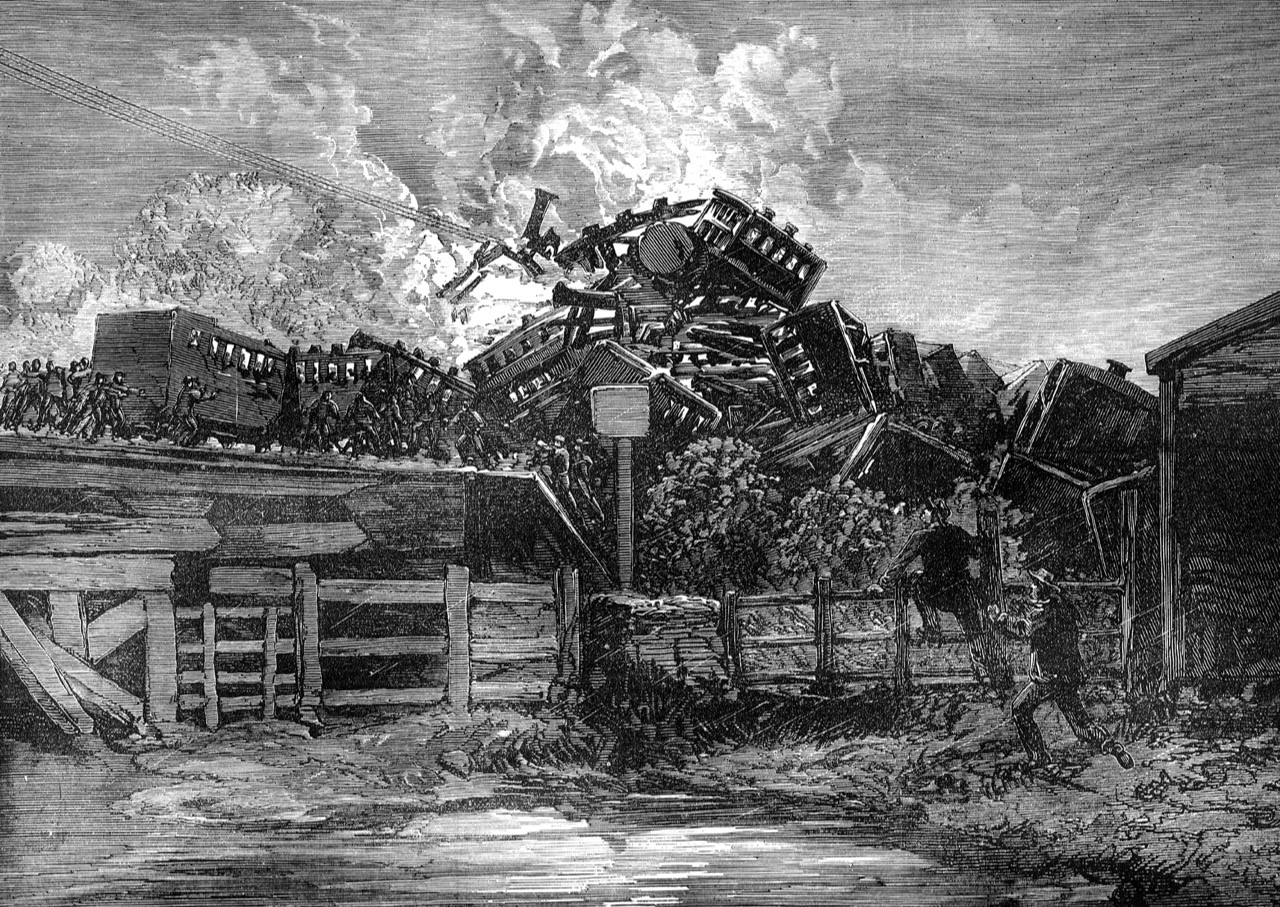
A Thorpe resident will later describe the scene, as witnessed from his window, looking down along the old river to the point of the collision.
‘It was one of the most unearthly and dreadful, yet wonderfully magnificent and varied in effect of colouring. At first the glare of the Norwich train’s red lamps alone broke through the thick darkness, making the night still more hideous. Suddenly small lights, held in the hands of the searchers, glimmered and flittered like “Will o’ the Wisp” around a spot. Soon there appeared the larger stationary light of two fires, whose flames rapidly gathered force, and rose high and bright above the huge wreaths of smoke, which curled and were carried off into space by the wind. These fires became great bonfires and threw abundant light upon the trees around and in the distance – even the woods of Whitlingham were illuminated. The figures of men were seen gliding about the pile of carriages which was gradually reduced, while the departing flashes of lightening became gradually less brilliant, and except for the light from the fires and lamps, darkness prevailed.’ [ii]
Of the two hundred or so passengers and railway servants aboard the two trains, seventeen died at the scene, each body respectfully laid out in the skittle alley of the Three Tuns pub, to await relatives and the County Coroner.
Publican John Hart willingly opened his doors, where surgeons and physicians, summoned from the city, set to work attempting to save precious lives. One young woman, Ellen Ramsdale, the heiress to a Dereham Auction House fortune, suffered the agony of having her left leg amputated with only brandy to sustain her. John invited her to recuperate at the pub, doctors and nursing staff attending to her daily. It would not be until the following January that Ellen was allowed to return home to her mother in Essex Street in Norwich. Over a period of weeks after the collision, nine more victims died of their wounds, either in their own homes or in the Norfolk and Norwich Hospital in Newmarket Road.
From 2018 until late 2020, including throughout the first national lockdowns, I researched the lives of those twenty-six victims and several of the injured. During a research visit to the NRO, I came across a bundle of letters from the Freeman Collection (MC17/22). Within it I found correspondence from 58-year-old Henry Freeman, sent from his lodgings in Kensington. Henry was born in Norwich, and although his work had later taken him to London, members of his immediate family continued to live in East Anglia. On reading his newspaper on the morning of Saturday, 12th September 1874, he had noticed a report from Norwich which concerned him greatly.
‘Fearful Railway Collision. Twenty Persons Killed and Many Injured. From our special correspondent in Norwich.’[iii]
Henry immediately put pen to paper, writing to Mary, his sister-in-law, married to his brother William and living in Upper King Street, Norwich. Estranged as he was from his sister, Anne-Maria White (nee Freeman), he had no choice but to ask the extended family. He wrote:
‘My dear Mary, What a terrible business this is on your railway on Thursday night, and by my paper this morning I see amongst the list of ‘less serious cases’, ‘Mr R White, Junior, dentist St Giles. Severe injuries to shoulder and contusions.’ I do hope the poor fellow is not much hurt, and what a miraculous escape from sudden and violent death.’[iv]
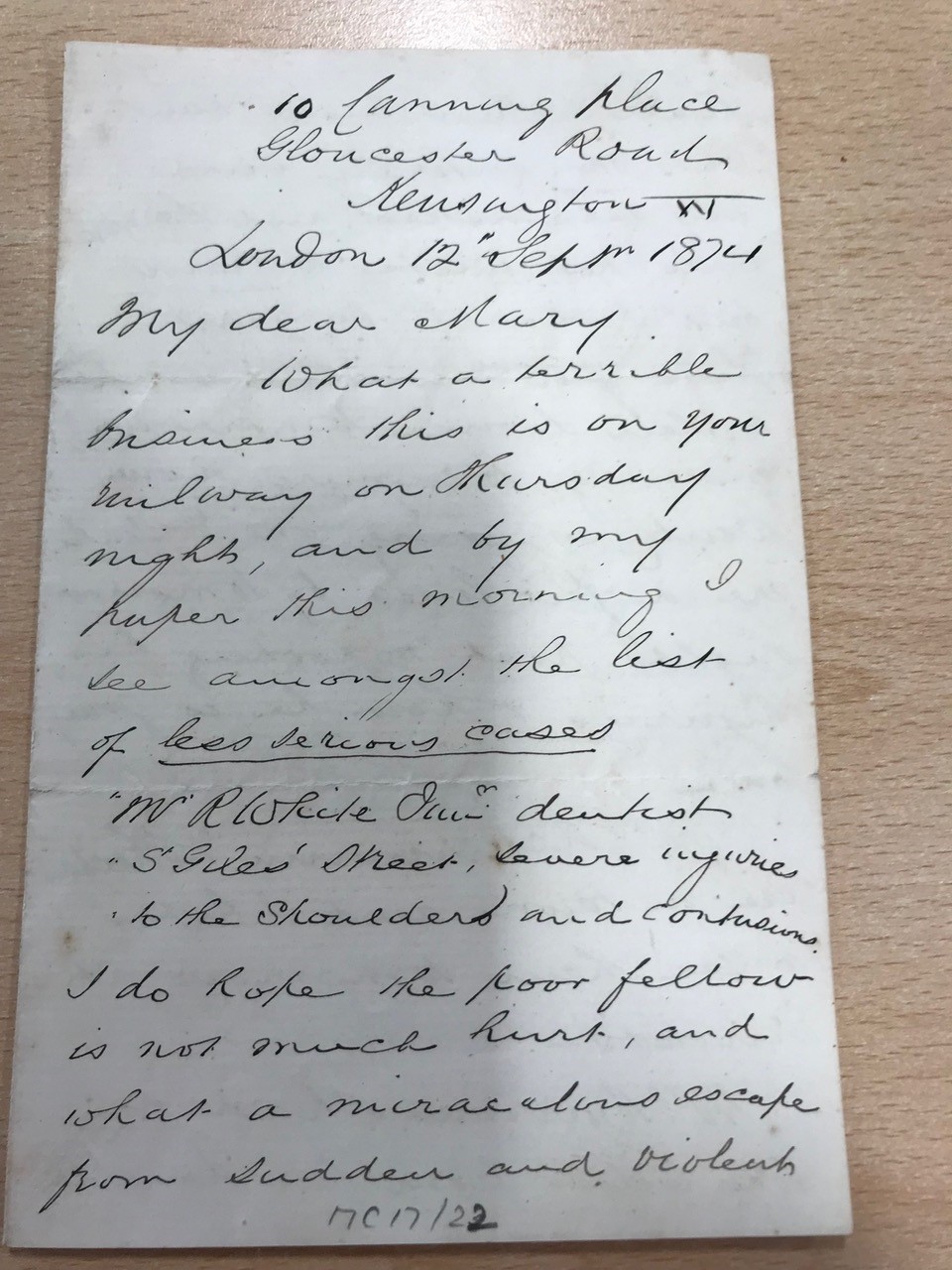
Henry’s nephew, Richard Wentworth White was a young ambitious Norwich dentist, following in the footsteps of his well-known father, also Richard White. ‘Wenty’, as the young man was affectionately known, was, on Thursday 10th September, travelling on the Yarmouth to Norwich mail train. His Uncle Henry had every reason to be concerned. The newspapers of the following Monday, 14th September reported that:
‘Mr R.W. White was jammed in beneath a railway carriage and lay like a man in a coffin bottom upwards. He was in this condition for three hours and a half. In order to sustain him in this agonising position and to prevent him from fainting, Dr Pitt and others contrived to supply him with brandy in which they soaked a handkerchief and placing it on the end of a stick slided it up into his mouth.’[v]
Richard survived his ordeal and his dental career flourished. Considered to be one of the foremost wealthy bachelors in the city, he lived for a while on Thorpe Road, only a short distance from the site of the railway collision. When aged 49, he eventually married, living in Hampshire before returning to Norfolk and retirement in Framlingham Earl.
The story did not end with the inquests and the funerals. Over the next ten months, newspapers throughout the country and overseas, reported verbatim every word of the official Board of Trade Inquiry, the resulting manslaughter trial and the numerous compensation hearings, when Great Eastern Railway paid out the equivalent of £4 million, a record sum at that time.
Every victim’s story was different, coming as they did, from diverse sections of Victorian society. Included amongst them were John Beart, Draper from Aldeburgh in Suffolk; John Betts, off-duty railway stoker with his wife and young sons, only the eldest boy surviving the crash; Sergeant-Major Frederick Cassell and his fishing-buddy, Sergeant Robert Ward, both from Norwich, Sarah Gilding and her young daughter Laura, travelling to Lowestoft from the Mile End Road in London. Also losing their lives were Mary Ann Taylor, forty-six year old supervisor at Caley’s, an emporium in the city; George Womack, a wealthy city draper, whose personal life was giving him some anxiety at the time of the accident; Standley Richard Slade, auctioneer from London, the subject of speculation when no-one turned up to identify his body; William Bransby-Francis, respected Norwich physician, looking forward to his imminent retirement; George Page, failing businessman and Reverend Henry Stacey with his wife Mary Ann, recently retired to Norwich from his parish in Beccles.
In this 150th year since the disaster, the villagers of Thorpe St Andrew will commemorate their lives with a weekend of special events, culminating in the dedication of a commissioned bronze memorial plaque, to be placed inside the Parish Church of St Andrew, displaying the twenty-six names.
Friday 13th September: Thorpe History Group to host an illustrated talk about the Disaster, by Phyllida Scrivens, author of The Great Thorpe Railway Disaster 1874 (Pen and Sword Books 2021) This to be held at 7.30 pm at St. Andrew’s Centre, off Thunder Lane in Thorpe St Andrew. £4 entrance fee. Details at https://www.thorpe-history-group.org/talks-walks/
10th – 15th September: An exhibition created by the Thorpe History Group with information and images about the disaster, will be on display at the Parish Church.
Saturday 14th September: Two guided walks (pre-booking essential by emailing Nick Williams at info@thorpe-history-group.org ), at 11am and 2pm, with max 20 per walk, to be led by members of Thorpe History Group. These will begin and end at the Thorpe St Andrew Cemetery on Yarmouth Road.
Sunday 15th September at 10.30am. Special commemorative service at St Andrew’s Parish Church on Yarmouth Road, with The Bishop of Norwich dedicating a commissioned bronze plaque. Local dignitaries, sponsors and descendants will be among the congregation, and everyone is welcome. Organisations and individuals donating towards the cost of the plaque include Broadland District Council, Thorpe St Andrew Town Council, ASLEF District Council No.5, ASLEF Norwich Branch, Norwich and District Trade Union Council, descendants of victims and residents of Thorpe St Andrew.
And in addition, on 10th, 11th and 12th October, Thorpe Players will present a new play “Crossed Lines: The Drama of a Rail Tragedy”, in Roxley Hall, exploring the events of the disaster. Further details on Thorpe Players website at https://www.thorpe-players.co.uk
For information about these events please contact Phyllida Scrivens on phyllida.scrivens@icloud.com
[i] Eastern Daily Press, 30 September 1874
[ii] Norwich Mercury, Wednesday 16 September 1874
[iii] The Standard Newspaper, 12 September 1874
[iv] NRO, Freeman Collection, MC17/22
[v] Eastern Daily Press, 14 September 1874



 Norfolk Record Office
Pingback: The Thorpe disaster at 150 - The power & problem of centenaries and anniversaries - Railway Work, Life & Death
Pingback: A train crash 150 years ago is helping to bring the forgotten deaths of rail workers into the spotlight – Johansen.se
Pingback: A train crash 150 years ago is helping to bring the forgotten deaths of rail workers into the spotlight - VibeWire Magazine