
Every year the staff who work with volunteers at the Norfolk Record Office arrange an outing as a thank you for their hard work and dedication during the previous 12 months. This year 20 volunteers visited the archives at Holkham Hall. They were split into two smaller groups, one group has an introduction to the Holkham Archives by Lucy Purvis, Estate Archivist, and saw a display of documents, the other group had a tour of the Hall by Joan, a tour guide at Holkham. We asked two of our volunteers to share some of their thoughts and what they learnt from their visit.
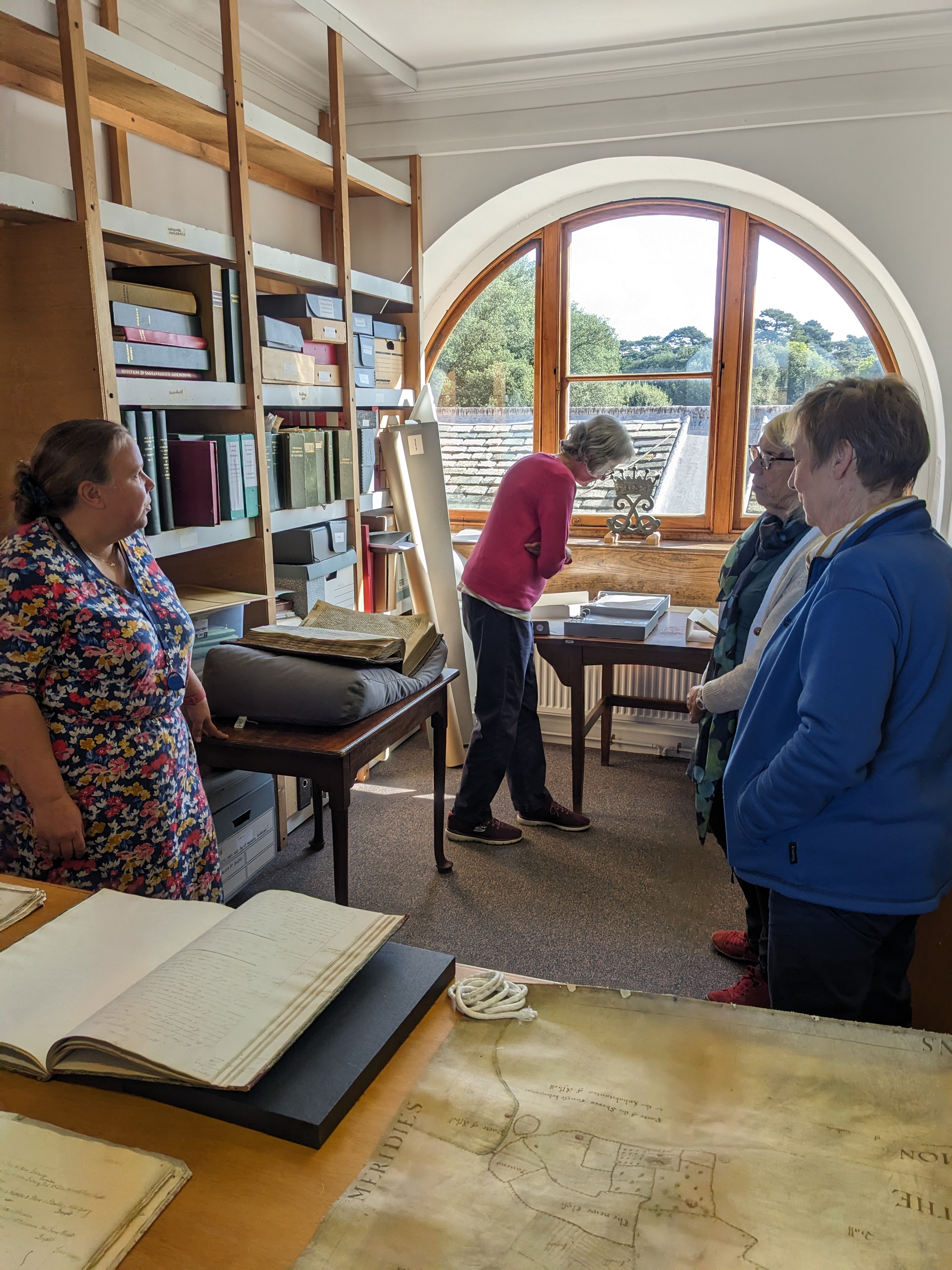
Our first volunteer, Jackie, explains how the day was organised and what struck her about the hall:
My first visit to Holkham Hall was in September 2023 with a group of other volunteers working with the Norfolk Record Office. The day offered a free guided tour of the Hall and time to meet volunteers working on many different projects to myself. The woman leading the tour was very knowledgeable and spoke energetically about the history of the building and how the land was acquired by the Coke family from the mid-1600s to become the Holkham Estate of today. It is still owned and lived in by members of the Coke family who hold the inherited title of the Earl of Leicester. The first Earl being Thomas Coke; born in 1697 and who died in 1759, having had the title bestowed upon him in 1744.
As a young man from a wealthy family, Thomas Coke embarked on the Grand Tour of Europe at aged 15 years. During his 6 years abroad, Thomas conceived of the idea of building a mansion on the family estate. Thomas set about buying many artworks, lavish fabrics and sculptures, many from Italy, with which to furnish his future home. However, on his return to England he was reckless with his wealth. He made very heavy losses through a bad investment in the South Sea Company which went bankrupt in 1720; historically referred to as when the South Sea Bubble Burst. This delayed the building of Holkham Hall by 10 years and it was finally completed 5 years after his death in 1764. His wife, Margaret Tufton, Countess of Leicester, oversaw the completion and furnishing of the hall, living there until her death in 1775.
During our tour of the Hall we were shown beautiful old paintings, many painted by ‘old masters’ such as Ruben’s painting of Return from Egypt. We walked through the Statue Gallery and heard that, whilst they were bought in Europe, most were copies of the originals. Other sculptures and many artworks collected by Thomas Coke decorated the many state and private rooms in the Hall, from the impressive marble entrance hall, modelled on a Roman basilica through to the guest bedrooms which have been used by visiting members of royalty over the years. All bedrooms were complete with four-poster beds, some had an adjoining private bathroom with huge free-standing baths and commodes – more modern facilities were available in rooms that were available for private hire. One elaborate suite of bedrooms had been used by King George V and Queen Mary. At the other end of the guest list, we were shown a bedroom suite used by Jools Holland when his band had performed in the grounds of Holkham Hall.
Our tour guide kept us entertained with similar anecdotes as we walked through the many rooms: the original architect wanted complete symmetry between the two wings to the extent that some of the state rooms had false doors installed to maintain this balance. The ‘apse’ in the north dining room concealed staff corridors and stairs leading to the kitchens a quarter of a mile away. Clearly, food could not be trundled along the main corridors. Many rooms had walls lined with a mixture of wool, linen and silk fabrics; the original materials, some frayed or having peeled away in places. These walls displaying their, ‘faded glory’, of bygone days. Our tour guide explained that, as most of the materials were irreplaceable today, they were kept in as good order as possible to remain faithful to Margaret Tufton’s designs for each room. I felt this to be in keeping with the heritage of the old building.
One of the most interesting aspects to me as we went room by room was the many fireplaces and surrounds. Each one seemed to be made of a different coloured marble and with individual carvings. I was informed that indeed, each was different. They had been made by a craftsman from London who had travelled many times to Holkham when the interior was being built. He measured-up and designed a fireplace and surround for every room, which he duly crafted and fitted himself. One particularly splendid example is in what is called the Long Library which runs the full length of one wing. This room was one of the first to be completed in 1741. It contains 12,000 books mostly collected by Thomas Coke on his Grand Tour, mainly from Italy, and many are in Latin. Academics and other scholars are able to come and read some volumes for reference or other historical purposes by prior arrangement.
The Long Library is in the private wing and is used by resident members of the Coke family. This was evident as several recent, casually posed, family photos were on the side tables here. It contained the artwork that most fascinated me, not an ‘old master’, but an intricate mosaic of a lion fighting a leopard. We were told it was made up of ‘tiles’ the size of a “small fingernail”. It was originally from Italy and acquired by Thomas Coke on his Grand Tour in c.1772. The mosaic once hung in the Pallazzo Gabrrielli in Rome. It forms the centrepiece of the room, standing proud above a beautiful marble fireplace and mantel, enclosed within a striking chimneypiece carved in yellow Siena marble1.
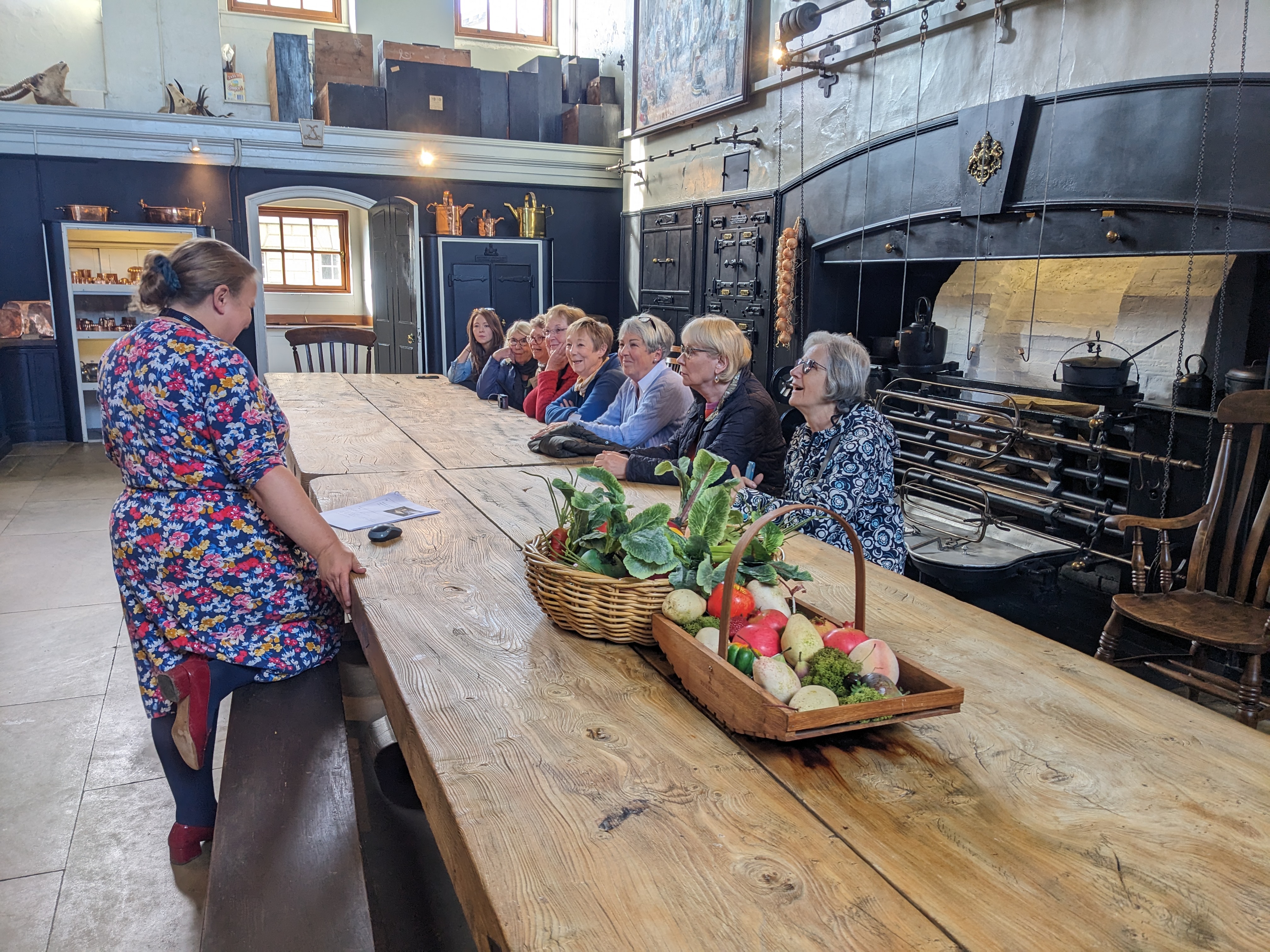
The tour ended with the long walk to the old kitchens, full of cooking utensils of the past and is still used for some school groups and on other occasions to showcase the history of the Hall as it remains open to the public throughout the year.
Full of many thoughts about the history and grandeur of the place, I left Holkham Hall and walked out into the grounds to the sight of the large herd of Fallow deer. These deer are part of the estate and roam freely around the park. They seemed totally at ease in their surroundings as they grazed peacefully beside the large pond and indeed, wandered close-by my car as I left. A tranquil ending for this volunteers’ day out.
Jackie Mitchell
Our second volunteer, Daryl, elaborates more on what struck her on learning more about Thomas Coke’s grand tour:
Thomas Coke of Holkham undertook one of the longest Grand Tours in history; leaving for Europe at the young age of 15 and not returning until he was 21 in 1718. As you walk around the magnificence of Holkham Hall the results of his Grand Tour are evident in almost every room. Of particular note is Holkham’s collection of marble sculptures which overwhelm the visitor in their size and beauty. My lasting impression of this estate was not of the opulence of the Hall itself but of a magnificent tree near the walled garden. The many treasures purchased by Coke had to be carefully shipped back to England. To ensure their safe arrival items were wrapped in the branches of the Holm oak, a tree not native to England. It was seen as the bubble wrap of its day. As items were carefully unwrapped to furnish and decorate the hall, the branches would have been discarded and its acorns left to establish themselves in the grounds of the estate. Thus the results of the Grand Tour is evidenced not only by the skill of the artist but by the natural forces of nature.
Daryl Long
Overall, we had some great feedback from the volunteers about the trip and they are already looking forward to where we go next year.
- Holkham Hall website ↩︎



 Norfolk Record Office