
A seventeenth century document held by the Norfolk Record Office (NRO, FX210/1) details the high drama of a spectacular clash of egos that took place more than three hundred years ago. The broiling emotions of the challenger to the duel, the last to be fought on Norfolk soil, can be read between the lines of his opponent’s acerbic reply.
The gentlemen in question were Norfolk dignitaries Sir Henry Hobart and Oliver Le Neve. Hobart and Le Neve could not be more mismatched, both in personality and combat skills.
Hobart was the proud owner of Blickling Hall, the fourth baronet and former Whig MP of King’s Lynn. He had been knighted by King Charles II at the tender age of thirteen, and was described as ‘sophisticated, headstrong and argumentative.’[1]
Conversely, his opponent was a staunch Tory supporter. Le Neve was a renowned lawyer, and the owner of Great Witchingham Hall. Unlike the upstanding Hobart, Le Neve was a hedonistic country gentleman through and through, preferring to spend his time hunting and fishing; he was a ‘well-known drinker.’[2]
The combatants were to come to blows over rumours that Le Neve was supposed to have circulated, purporting to Hobart’s cowardly conduct at the Battle of the Boyne in 1690. Hobart consequently held Le Neve and his gossiping responsible for the loss of his seat in Parliament in 1698.
Hobart’s already tempestuous nature was particularly agitated given that he had previously supported Le Neve by introducing a private bill to the Commons on his behalf. Initially Le Neve replied to Hobart’s accusation with a blatant denial of his rumour mongering, but his opponent was not to be appeased.
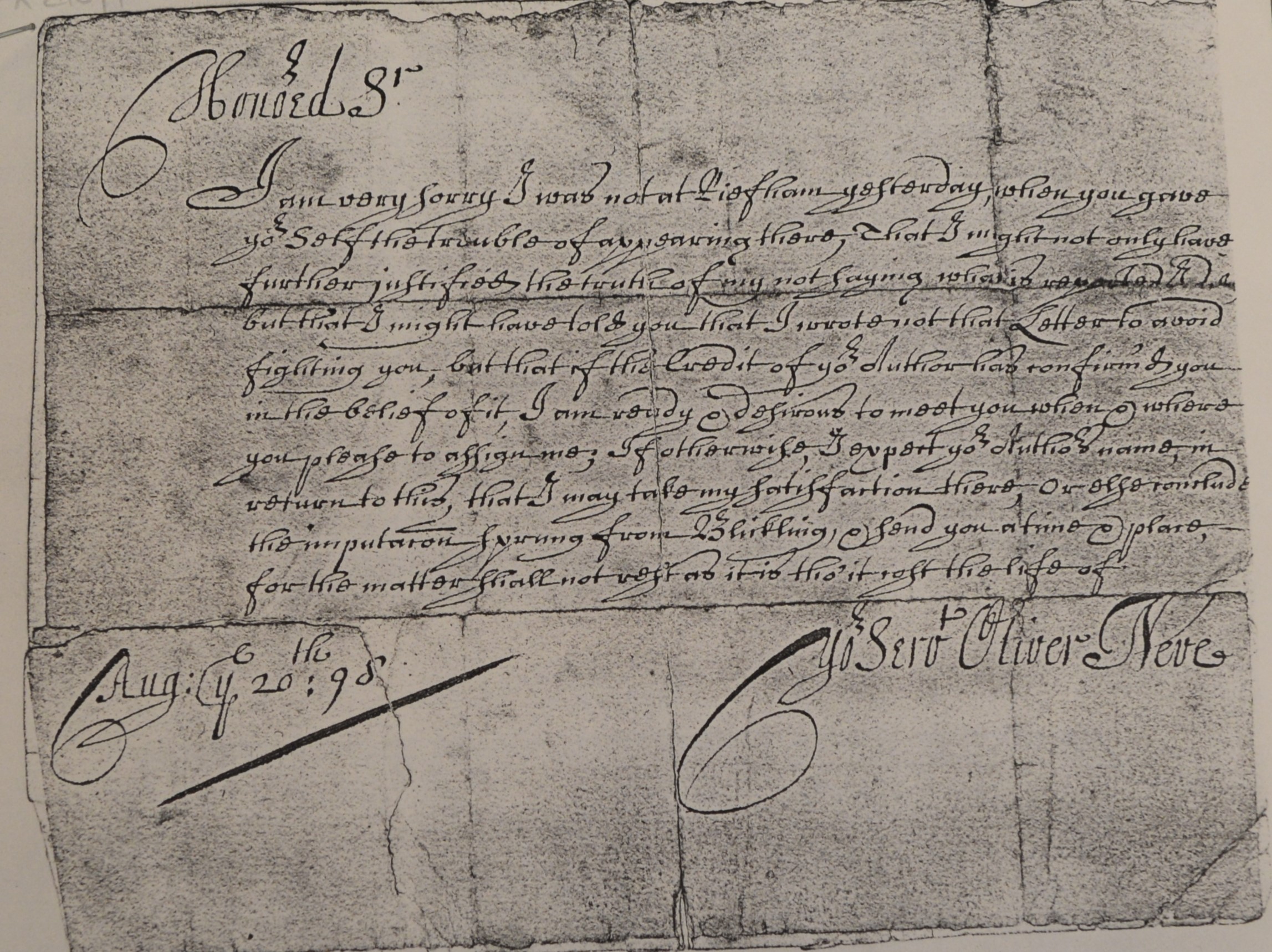
Hobart’s wrath culminated in challenging Le Neve to a duel. As a consummate swordsman, he knew that fate would be on his side. Society had long accepted duelling as an honourable way to maintain one’s reputation – and indeed to decline a duel was a matter of shame. Le Neve had no choice but to accept. His letter of acceptance reads as follows (NRO, FX210/1):
August 20th 1698
Honoured Sir,
I am very sorry I was not at Riefham (Reepham) yesterday, when you gave yourself the trouble of appearing there, that I might not only have further justified the truths of my not saying what is reputed and why, but that I might have told you that I wrote not that letter to avoid fighting you, but that of the credit of your author has confirmed you in the belief of it.
I am ready and desirous to meet you when and where you please to assign me, and if otherwise I support your author’s name in return to this, that I may take my satisfaction
there or else… the imputation sprung from Blickling and send you a time and place, for this matter shall not rest as it is tho’ it rest the life of,
Your servant,
Oliver Neve
The location was determined accordingly as Cawston Heath, a point equidistant between Gt. Witchingham and Blickling. For reasons lost in the mists of time, the duel was to be fought illegally, without the presence of ‘seconds’. These were neutral men who were given the task of ensuring that the duel was fought in honourable conditions, with equally deadly weapons and to mutually decide the duration of the duel.
It is said that the only witness of this illegal wrangle was a servant girl, who hid behind the bushes on Cawston Heath looking on in terror.
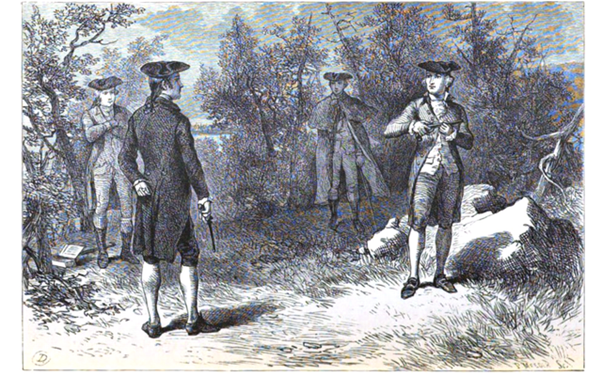
Ultimately the duel was brutal and rapid. Hobart’s lightning-fast reflexes thrust his sword into Le Neve’s arm, but became entangled in his enemy’s coat. Hobart was in essence disarmed; Le Neve took advantage of his disorientation and ran his sword swiftly through Hobart’s stomach. The duel was over almost before it had begun.
Hobart was rushed to his home at Blickling, but succumbed to his injury and died of his wounds the following day. Le Neve, realising the magnitude of his conduct fled to Holland. Had he not have done so, Hobart’s powerful friends and family may well have petitioned for him to be convicted of murder.
Two years later, the dust had settled and Le Neve made a cautious return to Norfolk where he was arrested and stood trial at Thetford assizes. To his joy, he was acquitted – some say his easy-going and affable nature had not been forgotten by his circle of influential local townspeople.
It would appear that Hobart has not found the peace of mind that Le Neve enjoyed following his acquittal. Many say that his ghost haunts the bedroom where he passed away in the southwest turret of Blickling Hall, moaning in agony as his fatal wounds torment him endlessly.
A stone urn hidden just off the Holt Road near Cawston was erected in 1770 to commemorate the duel and can still be seen today. It is said that on a clear night, the clashing of ghostly swords can be heard as the sworn enemies continue to reenact their fatal encounter for eternity. Dare you visit the duel stone?

L Spirit, NRO Blogger
[1] Stacia Briggs & Siofra Connor, Eastern Daily Press: Weird Norfolk
[2] Briggs & Connor (ibid.)
Other sources:
Norfolk Tales, Myths & More, The Last Norfolk Duel
The Paranormal Database, Clash of Swords



 Norfolk Record Office
Wow. What a fascinating tale. Thank you.
LikeLiked by 1 person
Thanks, Kevin! Glad you enjoyed it.
LikeLiked by 1 person
Great story. Do you by any chance have the OS grid reference for the duel stone? I’d love to visit it. Thank you.
LikeLike
Hello Alan, glad you enjoyed the post. Here is a link to Norfolk Heritage Explorer with the location details – https://www.heritage.norfolk.gov.uk/record-details?MNF12384-Duel-Stone&Index=11645&RecordCount=56734&SessionID=b10d655e-1fa1-4ea4-be1e-3adea9e99950
LikeLike